
Voyager 1’s Georgian Folk Song Marks First Light-Day Milestone in November
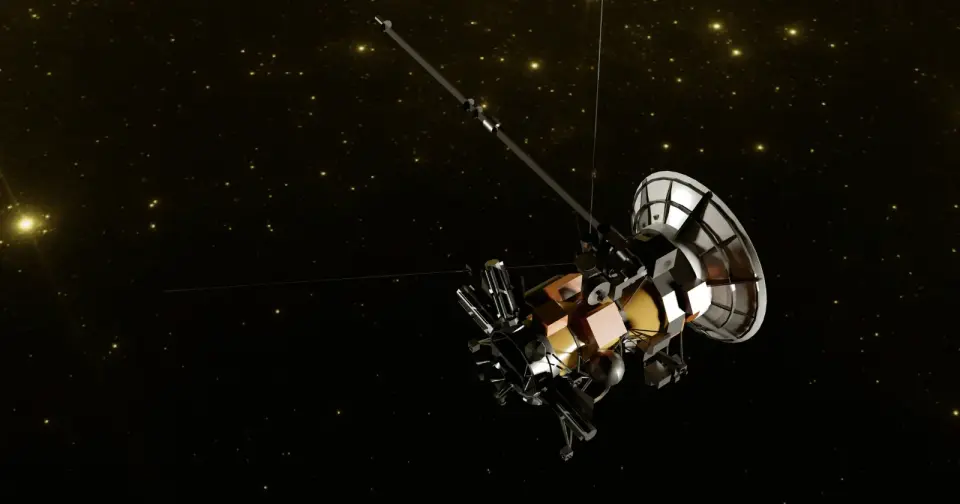
Voyager 1 will reach a distance of one light-day from Earth on November 18, 2026, becoming the first human-made object to do so. The spacecraft carries the Golden Record, which includes 'Chakrulo,' a Georgian polyphonic song selected in 1977. This milestone highlights the extreme remoteness of the probe, which is traveling at approximately 128,700 kilometers per hour. Although its instruments are being powered down to conserve energy, the craft will continue drifting into interstellar space for decades.
Key points
- Voyager 1 is scheduled to reach a distance of one light-day from Earth on November 18, 2026, a milestone that will take roughly 25.9 billion kilometers to achieve.
- The spacecraft carries the Golden Record, a gold-plated phonograph disc containing 27 pieces of music and sound, including the Georgian folk song 'Chakrulo.'
- 'Chakrulo' is a three-part polyphonic song from the Kakheti region, featuring two soloists over a choir, with harmonies tuned to intervals that do not exist in standard Western equal-temperament systems.
- The original soloists, including Rostom Saginashvili, were unaware their recording had been selected for the mission until two weeks after the September 1977 launch.
- NASA is currently powering down instruments to extend the spacecraft's life, with communications expected to continue until the early 2030s as its plutonium power source declines.
Background
Previous coverage in July 2026 confirmed that Voyager 1 is on track to reach the one-light-day mark on November 18, 2026, at approximately 2:16:07 a.m. PST. Earlier reports noted that the probe has been traveling at roughly 38,000 mph and has already entered interstellar space. The Golden Record, assembled by a committee led by Carl Sagan, was designed to represent Earth's culture to any future finders, with 'Chakrulo' being one of the few non-Western musical selections included alongside pieces by Bach, Beethoven, and Chuck Berry.
Why it matters
This milestone underscores the extreme remoteness of interstellar space, where a radio signal would take 24 hours to reach the spacecraft and another 24 hours to return. It also highlights the cultural significance of the Golden Record, which preserves unique musical traditions like Georgian polyphony that cannot be replicated on standard Western instruments. The event serves as a tangible marker of humanity's reach, demonstrating that a small country's artistic heritage is now traveling farther from Earth than any other human creation.
What to watch
Voyager 1 will continue to drift into interstellar space, with its instruments gradually being powered down as its power source depletes. Communications are expected to cease in the early 2030s, but the spacecraft will continue to travel indefinitely, carrying the Golden Record with it. Future missions may provide further data on the interstellar medium as the probe moves deeper into space.
Want the full story? Read the original reporting
Read on Space Daily