
Crew-13 Cleared for Launch: Four Astronauts to Reach ISS in Record-Breaking Transit
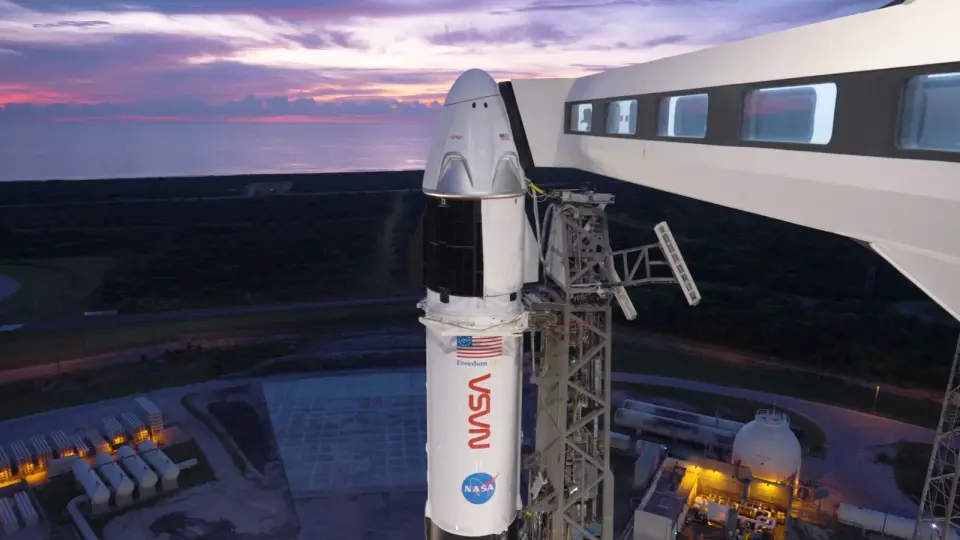
NASA and SpaceX have cleared the Crew-13 mission for launch on October 1, 2026, at 11:10 a.m. EDT from Cape Canaveral. The four-person crew, led by Jessica Watkins, will travel to the International Space Station in a record-breaking transit of under nine hours. The mission follows a previous delay caused by a spacecraft leak and marks the first U.S. crewed launch in six months.
Key points
- Launch is scheduled for 11:10 a.m. EDT on October 1 from Space Launch Complex 40 at Cape Canaveral Space Force Station.
- The crew consists of NASA astronauts Jessica Watkins (commander) and Luke Delaney (pilot), Canadian Space Agency astronaut Joshua Kutryk, and Roscosmos cosmonaut Sergey Teteryatnikov.
- Jessica Watkins will become the first NASA astronaut to launch aboard a SpaceX Crew Dragon for a second time, having previously flown on Crew-4 in 2022.
- The Dragon spacecraft, named 'Grace,' is expected to dock with the Harmony module of the ISS in less than nine hours, a record for the vehicle.
- The mission was previously delayed from September due to an oxidizer leak in the Dragon's propulsion system, which has since been resolved.
- The crew will join Expedition 75 on the ISS, where they will conduct scientific research and maintenance for approximately six months.
Background
The Crew-13 mission is part of NASA's Commercial Crew Program, which relies on SpaceX as the primary provider for crew transport to the ISS. The mission was originally targeted for September 12 but was rescheduled to October 1 after engineers discovered an oxidizer leak in the Dragon spacecraft's propulsion system during prelaunch preparations. This is the first U.S. crewed launch in six months, following the return of Crew-11 in January 2026. The launch also marks the second flight for Jessica Watkins, who previously served as a mission specialist on Crew-4 in 2022.
How outlets are covering it
All sources agree on the launch date, time, and crew composition. Space.com and NASA emphasize the 'go' status of the hardware and the 55% chance of favorable weather, noting that the mission is contingent on meteorological conditions. ScienceDaily highlights the record-breaking transit time, noting that the Dragon could reach the ISS in as little as 7 hours and 50 minutes. Spaceflight Now provides additional detail on the Falcon 9 booster, noting that the B1101 first stage will attempt a landing at Landing Zone 40, which would be its third flight and the 664th Falcon booster landing to date. All sources confirm that the crew will join Expedition 75 and that the previous Crew-12 team will return to Earth after a handover period.
Why it matters
The successful launch of Crew-13 demonstrates the reliability of SpaceX's Falcon 9 and Dragon systems, which are critical for NASA's human spaceflight operations. The record-breaking transit time highlights the efficiency of the Commercial Crew Program, which has significantly reduced the time required to reach the ISS compared to previous methods. The mission also marks a milestone for Jessica Watkins, who becomes the first NASA astronaut to fly twice on a Crew Dragon, and for Joshua Kutryk, who becomes the second Canadian to fly to space in 2026. The launch also underscores the importance of international cooperation, as the crew includes astronauts from the United States, Canada, and Russia.
What to watch
The launch is scheduled for 11:10 a.m. EDT on October 1, with docking planned for approximately 8 p.m. EDT. The crew will join Expedition 75 on the ISS, where they will conduct scientific research and maintenance for approximately six months. After a handover period, the Crew-12 team will return to Earth aboard the Dragon Freedom spacecraft. The Falcon 9 booster is expected to land at Landing Zone 40 at Cape Canaveral, approximately eight minutes after liftoff.
- SpaceX is ��go’ to launch NASA’s Crew-13 astronaut mission to the ISS on Oct. 1 Space
- What time will SpaceX launch Crew-13 astronauts for NASA on Oct. 1? How to watch live (full timeline) Space
- NASA, SpaceX Conclude Review, Crew-13 ‘Go’ for Launch NASA (.gov)
- NASA’s Crew-13 could go from Florida to the ISS in under 9 hours ScienceDaily
- Live coverage: NASA, SpaceX to launch next crewed mission to the International Space Station Spaceflight Now
Want the full story? Read the original reporting
Read on Space