
Galileo’s Final Moon Flyby Reveals Amalthea’s Low Density
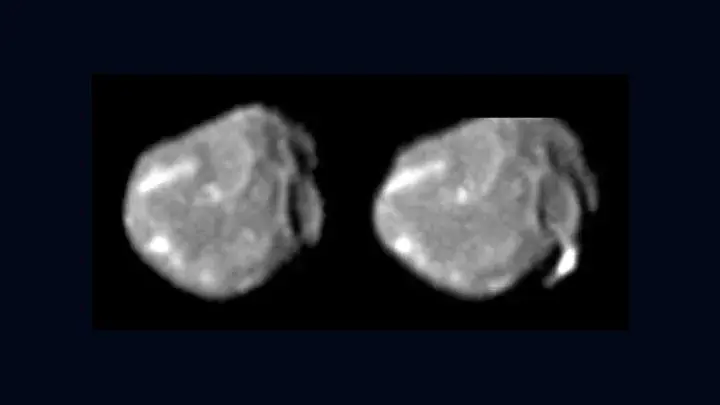
On November 5, 2002, NASA’s Galileo spacecraft performed its final flyby of Jupiter’s moon Amalthea. The mission, nearing the end of its fuel supply, captured data that later revealed Amalthea is a porous, icy rubble pile with a density lower than water. This encounter marked the last time Galileo visited a Jovian moon before its deliberate atmospheric entry in September 2005.
Key points
- Galileo flew within 99 miles of Amalthea, its closest approach to Jupiter before its final plunge.
- The flyby triggered a temporary safe mode due to intense radiation, but the spacecraft was quickly restored.
- Analysis of the data showed Amalthea is less dense than water, suggesting a porous structure of ice and rock.
- Amalthea is the reddest object in the solar system due to sulfur contamination on its surface.
- This was the last moon Galileo visited before its mission ended with a crash into Jupiter in 2005.
Background
The Galileo mission, which began in 1989, was the first to orbit Jupiter. It operated for nearly eight years, providing unprecedented data on the gas giant and its moons. The spacecraft’s final phase involved a series of close flybys to maximize data collection before its controlled impact with Jupiter’s atmosphere in September 2005, a decision made to prevent potential contamination of other moons like Europa. This event is part of a broader history of robotic exploration of the Jovian system, which continues today with missions like ESA’s JUICE, which recently used Earth gravity assists to reach Jupiter.
Why it matters
The discovery that Amalthea is a low-density, porous body challenges previous assumptions about the formation and composition of small Jovian moons. It suggests that these bodies may not be solid rock but rather aggregates of ice and dust, offering insights into the early solar system’s accretion processes. Furthermore, the successful recovery of Galileo after a radiation-induced safe mode demonstrated the resilience of deep-space probes, even in their final operational stages.
What to watch
While Galileo’s mission ended in 2005, its data continues to inform current and future missions. ESA’s JUICE spacecraft, which recently performed an Earth gravity assist, is en route to Jupiter to study its icy moons in greater detail. Additionally, NASA’s ongoing Artemis program, which successfully completed a crewed lunar flyby in 2026, underscores the continued importance of robotic and human exploration in understanding our solar system’s history and potential for future habitation.
Want the full story? Read the original reporting
Read on Space