
Ingenuity's Post-Mortem: How a Broken Mars Helicopter Became a Silent Weather Station
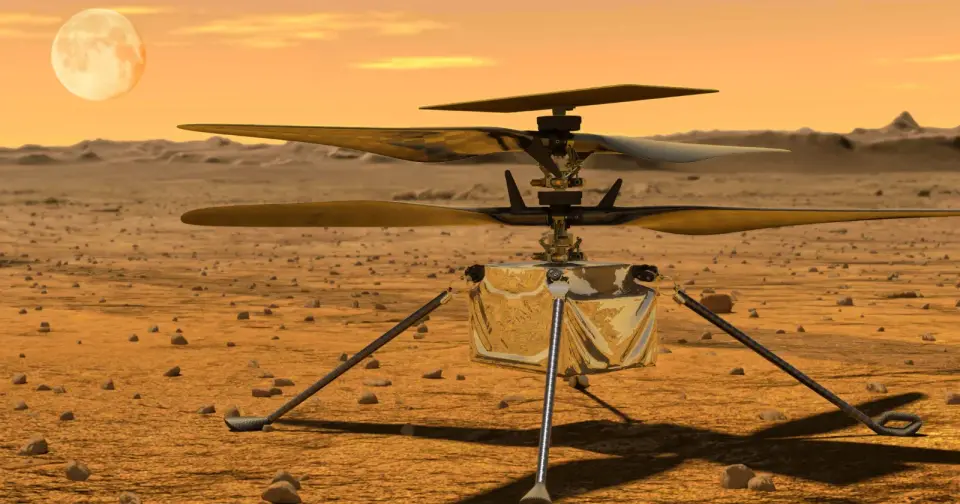
NASA's Ingenuity helicopter, originally designed for five flights over 30 days, completed 72 sorties over nearly three years before a hard landing shattered its rotor blades in January 2024. Although its flying career ended, the aircraft remains upright on Mars and continues to record local temperature and surface data. However, because the Perseverance rover has moved out of communication range, this data is stored locally and cannot be transmitted to Earth until a future mission retrieves it.
Key points
- Ingenuity was built to prove powered flight was possible in Mars' thin atmosphere, which is less than one percent as dense as Earth's.
- The helicopter weighed 1.8 kilograms and used counter-rotating rotors spinning at 2,400 rpm to generate lift in the thin air.
- Its final flight on January 18, 2024, ended in a hard landing on sand ripples, snapping all four rotor blades roughly a third of the way from their tips.
- After the crash, engineers uploaded a final software patch, converting the aircraft into a stationary environmental recorder that wakes daily to take photos and measure temperatures.
- The helicopter cannot transmit this new data to Earth because it relies on the Perseverance rover as a radio relay, which is now out of range.
- NASA estimates the onboard memory can store up to 20 years of daily data, but the hardware may fail from dust or cold before retrieval.
Background
Ingenuity launched in July 2020 and landed in Jezero Crater in February 2021 alongside the Perseverance rover. It was part of a broader suite of technology demonstrations, including the MOXIE oxygen generator, designed to test capabilities for future human exploration. The success of Ingenuity directly influenced the design of the SkyFall mission, a future project involving three larger helicopters to scout for water ice and landing sites, with an aeroshell contract awarded to Firefly Aerospace in 2026.
How outlets are covering it
Space Daily emphasizes the 'quiet afterlife' of the helicopter, highlighting the philosophical aspect of a machine continuing to record data without the ability to transmit it, effectively becoming a sealed field notebook. Economictimes focuses on the engineering triumph, framing the 72 flights as a massive success story that exceeded the original 30-day plan by a factor of 33, and notes the symbolic connection to the Wright Brothers. Both sources agree on the technical cause of the crash but differ in emphasis: Space Daily focuses on the data storage limitation, while Economictimes highlights the legacy for future missions like SkyFall.
Why it matters
Ingenuity's transition from a flying demonstrator to a stationary sensor illustrates the evolving nature of planetary missions. It proves that even after primary mission failure, hardware can be repurposed for secondary scientific value. The challenge of retrieving this data underscores the logistical hurdles of future Mars exploration, where communication infrastructure is sparse and dependent on specific rover locations.
What to watch
The data recorded by Ingenuity will remain on the Martian surface until a future mission, potentially involving a new rover or aircraft, reaches the Valinor Hills site to establish a radio link or physically retrieve the memory. Meanwhile, NASA continues to develop the SkyFall mission, which will deploy larger, more capable helicopters to leverage the operational experience gained from Ingenuity's 72 flights.
- NASA's Mars helicopter was built to prove that flight was possible in an atmosphere one percent as thick as Earth's, and it was expected to manage five flights over thirty days, but it flew 72 times across almost three years before a hard landing shattered its rotor spacedaily.com
- Ingenuity was funded as a technology demonstration with five flights and a thirty-day window, assembled partly from mobile phone components because nothing space-rated was light enough, and it flew seventy-two times across nearly three years before a rot spacedaily.com
- It was built for 30 days. It survived 1,004: How a 4-pound helicopter became one of NASA's greatest succes economictimes.com
Want the full story? Read the original reporting
Read on spacedaily.com