
Physicist Proposes Laser-Powered Probe to Test Gravity at Nearby Black Hole
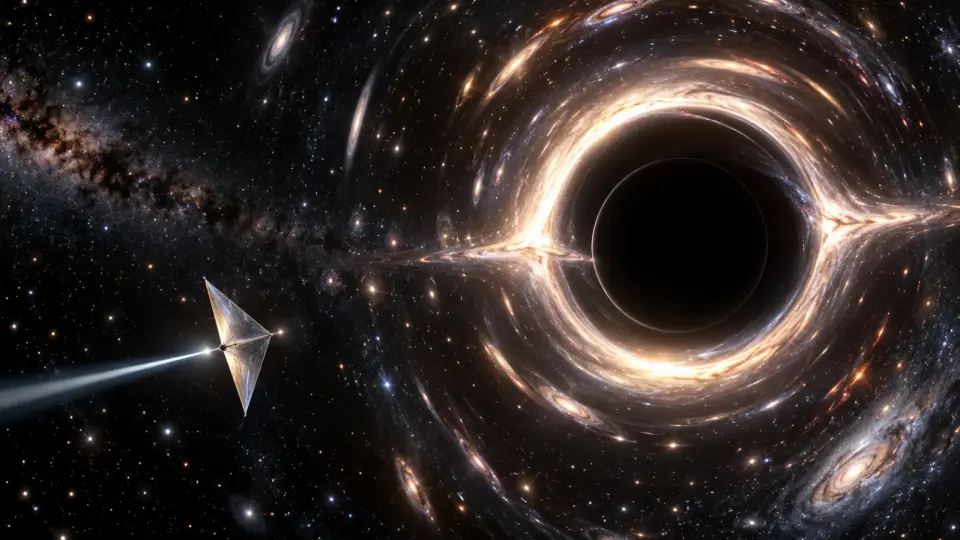
Cosimo Bambi of Fudan University has published a theoretical framework in iScience for sending gram-scale spacecraft to a black hole within 20 to 25 light-years of Earth. The mission would rely on ground-based laser arrays to accelerate probes to one-third the speed of light, reaching the target in 60 to 75 years. While no such nearby black hole has been confirmed, statistical models suggest isolated black holes may exist in this range. The primary goal is to conduct direct tests of general relativity, specifically the Kerr metric and the existence of event horizons, which are difficult to verify from Earth due to intervening gas and dust.
Key points
- Cosimo Bambi of Fudan University published a study in iScience outlining a mission to a black hole located 20 to 25 light-years away.
- The concept uses gram-scale nanocraft propelled by Earth-based laser arrays to reach one-third the speed of light.
- Travel time would be 60 to 75 years, with data return taking an additional 20 to 25 years.
- No confirmed black hole exists within this range; the nearest known, Gaia BH1, is 1,560 light-years away.
- The mission aims to test the Kerr metric and event horizon properties using multiple probes in orbit.
- Major engineering hurdles include the cost of laser systems, estimated at one trillion euros, and orbital capture mechanics.
Background
This proposal builds on earlier concepts like Breakthrough Starshot, which explored laser-driven probes for Alpha Centauri. It follows recent advancements in detecting isolated black holes via gravitational microlensing and astrometry, such as the confirmation of OGLE-2011-BLG-0462. The study addresses limitations of Earth-based observations, which are often obscured by turbulent gas around astrophysical black holes, by proposing a direct probe in a cleaner gravitational environment.
Why it matters
This research shifts the paradigm from remote observation to direct experimentation in extreme gravity. If feasible, it would allow precise tests of general relativity and potential deviations from standard black hole models, such as fuzzball concepts. It also highlights the potential for future interstellar missions to address fundamental physics questions that are currently unanswerable from Earth.
What to watch
The next steps involve improving detection methods for isolated black holes, such as gravitational microlensing and gravitational wave searches, to identify a suitable target. Additionally, research must focus on reducing the cost of coherent laser power and developing technologies for orbital capture and autonomous navigation of gram-scale electronics over decades-long journeys.
Want the full story? Read the original reporting
Read on The Brighter Side of News