
NASA's Roman Space Telescope Reaches Launch Pad After Budget Crisis
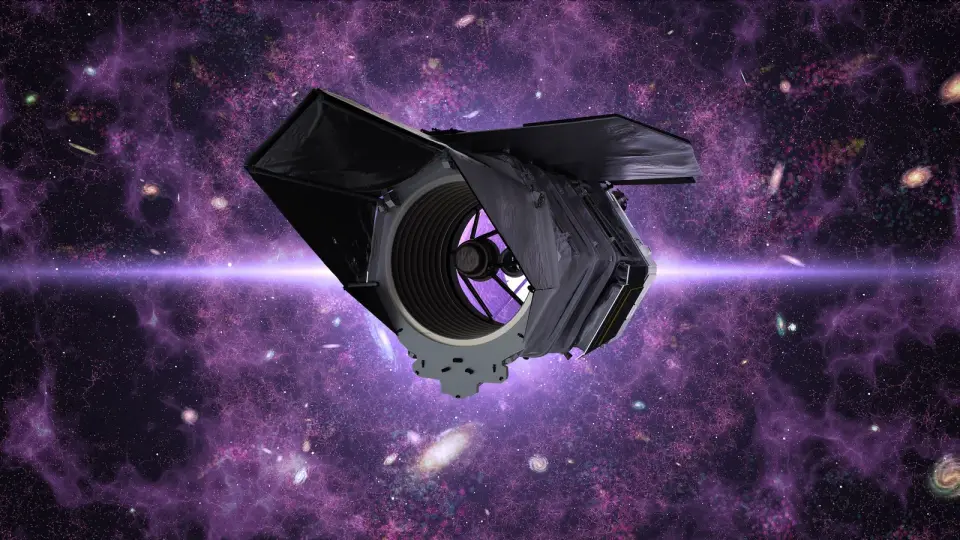
The Nancy Grace Roman Space Telescope is set to launch on August 30, 2026, from Kennedy Space Center aboard a SpaceX Falcon Heavy. After surviving a proposed 50% cut to NASA science funding in 2025, the observatory will travel to the Sun-Earth L2 point to study dark energy and exoplanets using a wide-field camera 100 times larger than Hubble's.
Key points
- The Nancy Grace Roman Space Telescope is scheduled to launch on August 30, 2026, at 7:27 a.m. EDT from Launch Complex 39A at NASA's Kennedy Space Center.
- The spacecraft will ride a SpaceX Falcon Heavy rocket and travel to the Sun-Earth Lagrange Point 2, located approximately 1.5 million kilometers from Earth.
- The telescope features a wide-field camera with a field of view 100 times larger than the Hubble Space Telescope, utilizing 18 near-infrared detectors totaling 300 megapixels.
- Roman will conduct surveys to map dark matter, measure the expansion rate of the universe via supernovae, and test coronagraph technology for detecting exoplanets.
- The mission survived a 2025 budget proposal that threatened to cancel it, which included a 24% overall reduction in NASA funding and a 50% cut to science programs.
Background
The Nancy Grace Roman Space Telescope represents the culmination of nearly two decades of development and a $4 billion investment. Originally developed by the National Reconnaissance Office, the hardware was transferred to NASA in 2012. The observatory is designed to complement existing missions like the James Webb Space Telescope (JWST) and Hubble by providing a much broader field of view, enabling the study of the universe's large-scale structure and the distribution of dark matter.
How outlets are covering it
Space.com highlights the political tension surrounding the launch, noting that President Trump's 2026 budget proposal threatened to cancel the mission entirely, causing significant anxiety among NASA scientists. In contrast, The Conversation emphasizes the technical heritage of the telescope, explaining how its spy-program origins and advanced infrared detectors will enable new discoveries in dark energy and exoplanet detection. NASA's official communications focus on the logistical progress, confirming the telescope's encapsulation and transport to the SpaceX hangar on August 25, 2026. While all sources agree on the August 30 launch date, Space.com frames the event as a victory against budget cuts, whereas The Conversation positions it as a technological milestone in the history of astronomical discovery.
Why it matters
The launch of the Roman Space Telescope marks a critical step in understanding the fundamental forces of the universe, specifically dark energy and dark matter. Its wide-field capabilities will allow astronomers to survey a billion galaxies, providing data that could resolve long-standing questions about the universe's expansion rate. Additionally, the mission's coronagraph instrument will test technologies essential for future missions aimed at directly imaging Earth-like exoplanets, potentially paving the way for the discovery of life beyond our solar system.
What to watch
NASA is targeting a launch window of August 30, 2026, with a backup window set for August 31. Following launch, the telescope will spend approximately 30 days traveling to the Sun-Earth L2 point, followed by a multi-month checkout period. Once operational, Roman will begin its primary survey mission, collecting hundreds of terabytes of data annually to map the universe's structure and search for exoplanets.
- Trump tried to scrap NASA's Roman Space Telescope last year. Now it's ready to launch Space
- NASA is gearing up to launch its next flagship space telescope – combining spy technology with sophisticated infrared detectors The Conversation
- Roman telescope aims to directly image exoplanets 1,000 times fainter than current limits Phys.org
- Roman Space Telescope Mission SpaceX
- Roman Space Telescope Travels to SpaceX Hangar NASA (.gov)
Want the full story? Read the original reporting
Read on Space