
NASA's Roman Telescope Activates 300MP Camera, Fuel Savings Extend Mission to 22 Years
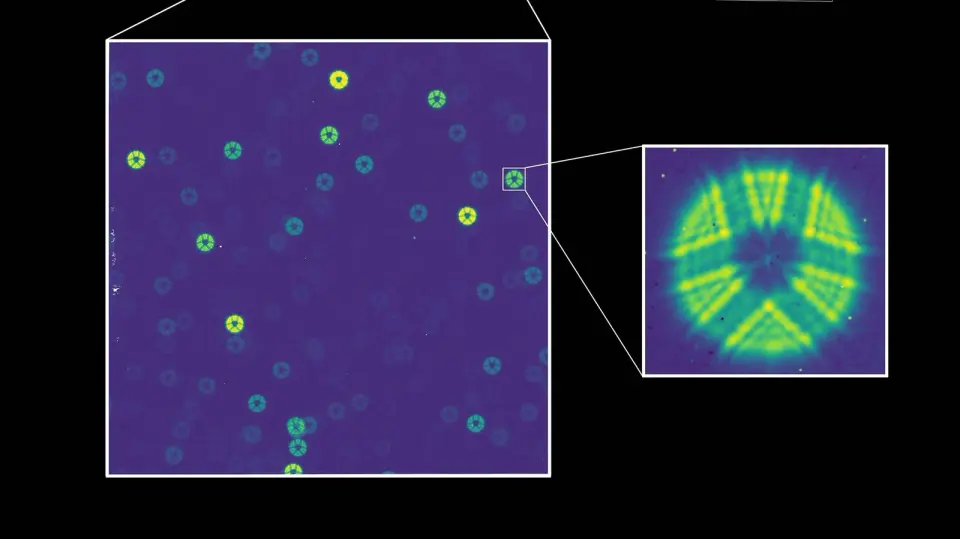
NASA’s Nancy Grace Roman Space Telescope has successfully activated its 300-megapixel Wide Field Instrument (WFI) and Coronagraph Instrument during its journey to the L2 point. The WFI’s first test image shows out-of-focus, neon-green stars, confirming the instrument is operational. Meanwhile, a highly efficient first mid-course correction used only 18 kg of fuel against a 200 kg budget, potentially extending the mission’s operational lifespan from 10 to at least 22 years. Full science images are expected by early 2027.
Key points
- The Wide Field Instrument (WFI) was activated on September 11, 2026, after a 10-day decontamination period at -85°F, followed by cooling to -225°F.
- The first test image, released September 15, shows stars as green rings due to the instrument being out of focus; final images will be 100 times larger than Hubble’s with similar sharpness.
- The Coronagraph Instrument, designed to block starlight for exoplanet imaging, passed initial tests at near-room temperature (72°F) and is now undergoing a 30-day decontamination phase.
- The first mid-course correction on August 31 used only 18 kg of fuel, achieving over 99% accuracy, compared to a 200 kg budget.
- NASA estimates that fuel savings from the efficient correction, lighter launch mass, and future trajectory adjustments could extend the mission’s potential operations to at least 22 years.
- The telescope is on track to release its first full science images by early 2027, with data transmission expected to reach 1.4 terabytes per day.
Background
The Nancy Grace Roman Space Telescope, named after NASA’s first chief astronomer, launched on August 30, 2026, aboard a SpaceX Falcon Heavy. It is designed to survey 50 times more sky than Hubble did in 30 years, using a 2.4-meter mirror and 300-megapixel infrared camera to map dark matter, measure cosmic expansion, and image exoplanets. The mission was completed in 2025 after surviving funding cuts, and it will operate alongside the James Webb Space Telescope at the L2 point.
How outlets are covering it
Live Science and NASA Science emphasize the successful activation of the WFI and the significance of the first test image, highlighting the 'groundbreaking science' ahead. PetaPixel focuses on the technical milestones, including the coronagraph tests and the $4.3 billion cost of the telescope. Space Daily provides a detailed analysis of the fuel efficiency, noting that the 18 kg used for the first correction, combined with a lighter launch mass, could extend the mission to 22 years, though it cautions that this is a conditional forecast dependent on hardware health and funding. All sources agree on the timeline for full science images in early 2027.
Why it matters
The successful activation of the WFI and Coronagraph confirms that Roman is on track to deliver unprecedented wide-field infrared surveys, which will advance our understanding of dark matter, dark energy, and exoplanets. The potential extension of the mission to 22 years due to fuel savings could allow for longer-term observations, improving measurements of stellar motions and cosmic expansion, and providing a more comprehensive dataset for future astronomical research.
What to watch
NASA will continue commissioning the WFI and Coronagraph, including activating the fine-guidance system and focusing the optics. The second mid-course correction is expected in September, followed by L2 orbital insertion in early December. Full science images are expected by early 2027, with data transmission beginning at 1.4 terabytes per day.
- 'We are on our way to groundbreaking science': NASA shares first test image from Roman telescope's 300-megapixel camera Live Science
- NASA Activates Roman’s Primary Instrument, Checks Out Coronagraph NASA Science (.gov)
- NASA's New $4.3 Billion, 300MP Space Telescope Passed its First Tests One Million Miles Away petapixel.com
- NASA budgeted 200 kilograms of fuel for Roman’s first course correction, but the telescope used only 18. Combined with extra fuel loaded before launch and further expected savings, that could stretch its 10-year fuel plan to at least 22 years. Space Daily
- NASA says new Roman telescope's lifespan could more than double, to 22 years ksl.com
Want the full story? Read the original reporting
Read on Live Science