
NASA LRO Images Confirm 60-Foot Crater from SpaceX Falcon 9 Lunar Impact
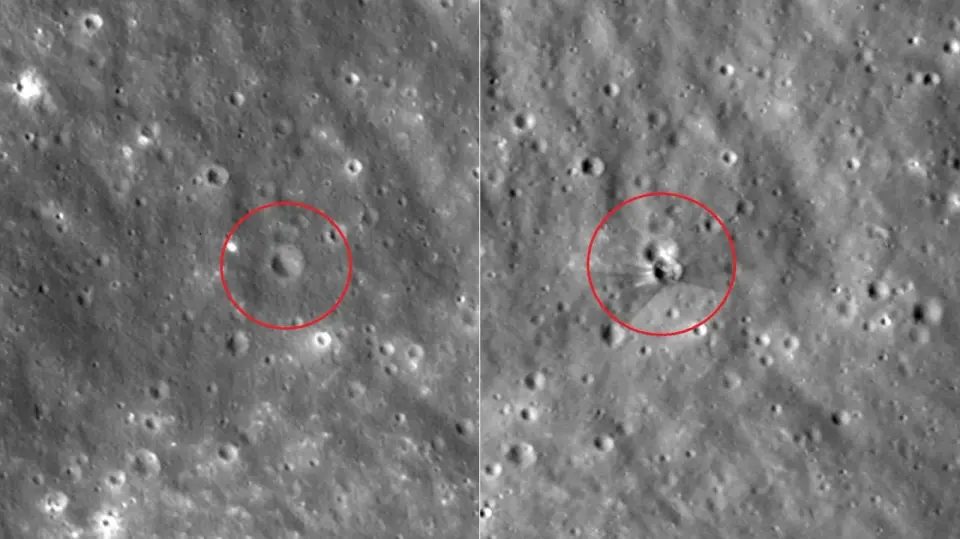
NASA’s Lunar Reconnaissance Orbiter (LRO) has released high-resolution images of a new crater on the Moon, formed on August 5, 2026, by the impact of a SpaceX Falcon 9 upper stage. The booster, discarded after the January 2025 Firefly Blue Ghost 1 mission, struck the lunar surface at 5,400 mph. The resulting crater is approximately 60 feet wide and less than 10 feet deep. This event highlights growing concerns about space debris accumulation on the Moon as commercial lunar activities increase.
Key points
- The Falcon 9 upper stage impacted the Moon on August 5, 2026, creating a crater 60 feet wide and under 10 feet deep.
- NASA’s LRO captured detailed images between August 11 and 12, 2026, from an altitude of 60 miles, revealing bright and dark ejecta rays.
- South Korea’s Danuri orbiter initially located the impact site, with NASA’s Center for Near Earth Object Studies refining the trajectory calculations.
- The impact site is located at 19.4759°N, 266.7138°E, overlapping a pre-existing crater.
- This incident is part of a trend of unintended lunar impacts, including a Chinese rocket stage in 2022 and a Russian Luna-25 probe in 2023.
Background
Previous coverage from our archive in August 2026 noted that South Korea’s Danuri orbiter was the first to image the crash site, with NASA’s LRO expected to follow up for higher-resolution data. Earlier reports also emphasized that while such impacts are considered a safe method for disposing of spent hardware, they contribute to lunar pollution.
How outlets are covering it
Jalopnik emphasizes the environmental impact, describing the event as 'humanity's detritus' and noting the lack of strict regulations for spent rocket stages. NASA Science focuses on the technical details of the imaging process, highlighting the precision required for LRO to capture the crater and the collaboration with international partners. Space.com frames the incident as a 'tangible operational risk' for future lunar settlements, underscoring the need for better debris management. CNN’s coverage, while largely obscured by technical code in the source, aligns with the general reporting on the impact site’s visibility and the coordination involved in locating it.
Why it matters
The incident underscores the growing challenge of space debris as commercial and governmental lunar activities expand. It highlights the need for clearer regulations and enforcement mechanisms to prevent the contamination of celestial bodies, as outlined in the Outer Space Treaty. The detailed imaging by LRO also demonstrates the capability of current technology to monitor and document such events, which is crucial for future mission planning and planetary defense.
What to watch
NASA and international space agencies will likely continue to monitor the lunar surface for additional impacts. There may be increased calls for stricter regulations on the disposal of spent rocket stages to prevent further contamination of the Moon. Future missions may also incorporate debris avoidance protocols to protect both the lunar environment and operational assets.
- New NASA Pictures Reveal SpaceX Crash's Devastation On The Moon's Magnificent Desolation Jalopnik
- NASA’s LRO Images Falcon 9 Crater on Moon, Learns New Details NASA Science (.gov)
- New images reveal what happened when a SpaceX rocket slammed into the moon CNN
- SpaceX rocket's moon crash highlights 'a tangible operational risk' of lunar settlement Space
- NASA's Lunar Reconnaissance Orbiter Images Falcon 9 Crater on Moon, With Some Help From a Korean Spacecraft Universe Today
Want the full story? Read the original reporting
Read on Jalopnik