
Rosetta Locates Philae on Comet 67P After Two-Year Search
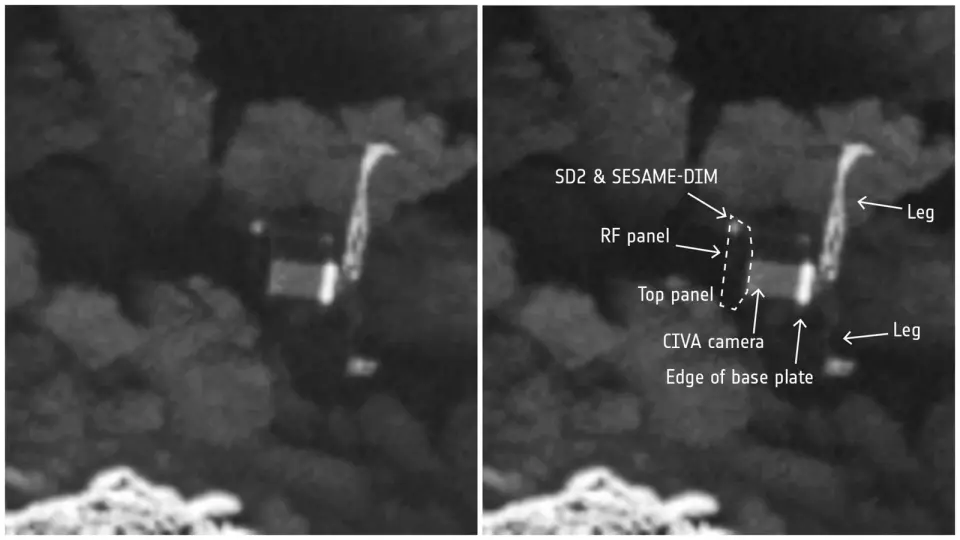
On September 2, 2016, the European Space Agency confirmed the location of its Philae lander on Comet 67P after a two-year search. The lander had bounced during its 2014 descent and ended up in a shadowed crevice, limiting solar power. Rosetta’s cameras finally spotted the craft lying on its side, providing closure before Rosetta’s mission ended with a controlled crash on the comet.
Key points
- Philae, the size of a washing machine, was deployed by Rosetta in November 2014.
- Landing harpoons failed, causing Philae to bounce and land in a dark, rocky crevice.
- Solar panels received insufficient light, limiting power and communication.
- Rosetta located Philae on September 2, 2016, after nearly two years of searching.
- The discovery occurred shortly before Rosetta’s mission concluded with a crash on the comet.
Background
This event concludes the Rosetta mission, which was the first to successfully land a probe on a comet. The mission aimed to study the composition and history of Comet 67P, providing insights into the early solar system. The loss and subsequent recovery of Philae highlighted the challenges of landing on low-gravity, irregularly shaped bodies.
Why it matters
Locating Philae provided closure for the ESA and confirmed the final resting place of a historic spacecraft. It underscored the technical difficulties of comet landings and the importance of robust landing systems for future missions to small bodies.
What to watch
The Rosetta mission ended shortly after this discovery with a controlled crash on Comet 67P. Future missions will use lessons from Philae’s landing to improve landing systems for asteroids and comets.
Want the full story? Read the original reporting
Read on Space