
Roman Telescope Activates Instruments and Gains 22-Year Fuel Reserve
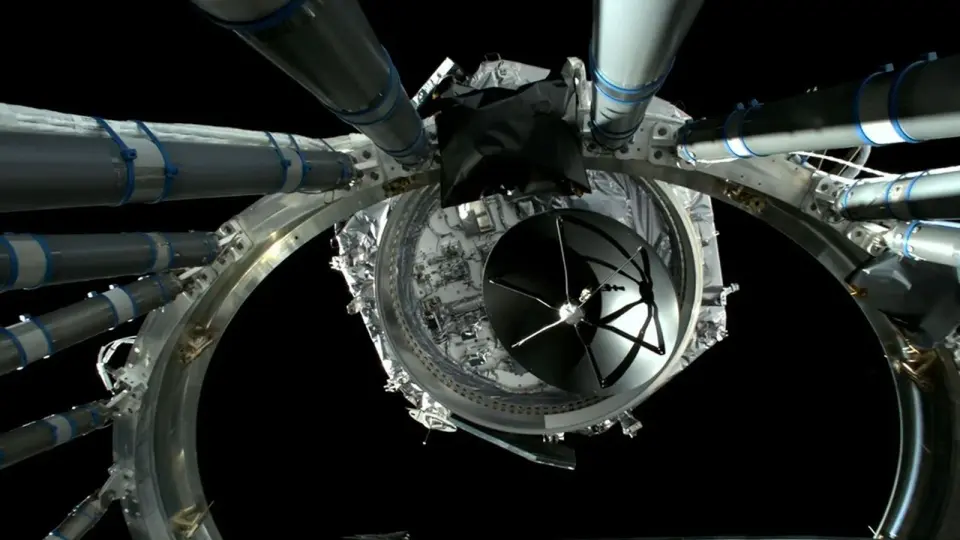
NASA has successfully activated the Wide Field Instrument on the Nancy Grace Roman Space Telescope, marking a key milestone in its commissioning phase. The observatory, which launched on August 30, is currently traveling to the Sun-Earth L2 point. Initial tests confirm the 300-megapixel infrared camera is operational, with detectors cooling to their required temperatures. Additionally, NASA confirmed that Roman has enough fuel for at least 22 years of operations, double the original estimate, due to precise launch execution and lower-than-expected mass. The Coronagraph Instrument has also passed initial checks, though full science operations are not expected until early 2027.
Key points
- NASA activated the Wide Field Instrument (WFI) on September 11 after a 10-day decontamination period.
- The WFI’s 18 infrared detectors cooled to -225 Fahrenheit (-143 Celsius) to begin initial tests.
- The Coronagraph Instrument passed preliminary checks, confirming communication with all components.
- Roman has enough fuel for 22 years, double the original 10-year estimate, due to precise launch and lower mass.
- First science images are expected by early 2027, after further calibration and focus adjustments.
Background
The Nancy Grace Roman Space Telescope launched on August 30 aboard a SpaceX Falcon Heavy rocket. It is on a three-month journey to the Sun-Earth L2 point, approximately one million miles from Earth. The telescope is designed to survey large swaths of the sky and directly image exoplanets, complementing the James Webb Space Telescope. Previous coverage noted its potential to expand the known exoplanet catalog and study dark energy.
How outlets are covering it
Space.com and NASA Science emphasize the successful activation of the Wide Field Instrument and the progress in commissioning. Ars Technica and Universe Today focus on the unexpected fuel efficiency, highlighting that Roman has enough propellant for 22 years, double the original estimate. Ars Technica notes that the precise launch and lower mass contributed to this outcome, while Universe Today details the specific fuel savings from the first mid-course correction. All sources agree that the telescope is on track for science operations in early 2027, but they differ in emphasis: Space.com and NASA Science focus on instrument activation, while Ars Technica and Universe Today focus on mission longevity.
Why it matters
The successful activation of the Wide Field Instrument and the extended fuel reserve are critical milestones for the Roman Space Telescope. These developments ensure that the observatory can operate for a longer period, allowing for more extensive surveys of the cosmos and direct imaging of exoplanets. The extended mission duration also reduces the need for a potential refueling mission, which is currently not feasible. This progress supports NASA’s goals to study dark energy, map the distribution of matter, and expand the known exoplanet catalog.
What to watch
Roman will continue its journey to L2, with a second mid-course correction planned for later this month. The telescope will enter its final orbit at L2 in early December. Further calibration and focus adjustments will be conducted before the first science images are released in early 2027. The Coronagraph Instrument will also undergo additional tests to ensure it is ready for direct imaging of exoplanets.
- Roman Space Telescope starts waking up as NASA powers on instruments for the 1st time Space
- NASA Activates Roman’s Primary Instrument, Checks Out Coronagraph NASA Science (.gov)
- The Roman telescope has enough gas for 22 years, double NASA’s expectations Ars Technica
- From 10 to 22 years: The Nancy Grace Roman Space Telescope's Mission Has Just Been Extended. Universe Today
- NASA’s Roman Space Telescope will use gravity as a magnifying glass to find distant planets The Conversation
Want the full story? Read the original reporting
Read on Space