
NASA's Roman Telescope Launches Ahead of Schedule to Map Dark Energy
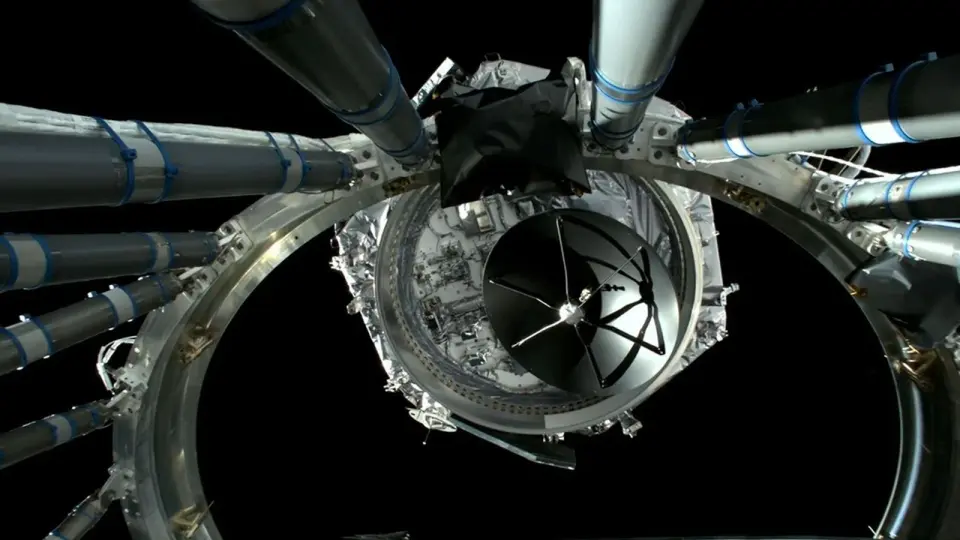
NASA's Nancy Grace Roman Space Telescope successfully launched on August 30, 2026, aboard a SpaceX Falcon Heavy rocket from Kennedy Space Center. The mission, which arrived nine months ahead of schedule and under budget, will travel to the Sun-Earth Lagrange Point 2 to conduct wide-field surveys of the universe. Roman features a 300-megapixel camera and a coronagraph designed to detect exoplanets and study dark energy, generating data at a rate 1,000 times faster than the Hubble Space Telescope. The observatory is expected to begin science operations after a 90-day commissioning period.
Key points
- Launched August 30, 2026, at 7:26 a.m. EDT from Kennedy Space Center on a SpaceX Falcon Heavy.
- Mission cost $4.3 billion and was completed ahead of schedule and under budget.
- Roman will travel to Lagrange Point 2, approximately 1.5 million kilometers from Earth.
- The telescope uses a 7.9-foot primary mirror donated by the National Reconnaissance Office.
- It will downlink 1.4 terabytes of data daily, totaling 20 petabytes over its five-year mission.
- A 90-day commissioning period will precede full science operations.
Background
Prior to launch, NASA confirmed the August 30 liftoff date with a backup window on August 31. Earlier reports highlighted the telescope's role as a successor to Hubble and a complement to the James Webb Space Telescope, emphasizing its ability to survey 12% of the sky compared to Hubble's 0.1%. The mission was named after Nancy Grace Roman, NASA's first chief astronomer, who championed space-based telescopes.
How outlets are covering it
Space.com highlighted the visual separation of the telescope from the rocket 31 minutes after launch, noting the folded solar arrays and high-gain antenna. CBS News emphasized the scientific potential, quoting NASA Administrator Jared Isaacman on Roman providing a 'new atlas of the universe' and project scientist Julie McEnery on resolving the 'Hubble Tension' regarding dark energy. Ars Technica focused on the engineering feat, noting the use of a refurbished spy satellite mirror and the massive data volume, comparing it to music streaming platforms. NASA's official release confirmed the launch and the mission's goal to survey billions of stars and galaxies. All sources agree on the launch success and the mission's significance, but differ in emphasis: Space.com on imagery, CBS on cosmological implications, and Ars on technical and data challenges.
Why it matters
Roman's launch marks a major milestone for NASA, delivering a flagship observatory ahead of schedule and under budget. Its ability to survey the sky 1,000 times faster than Hubble will accelerate discoveries in dark energy, dark matter, and exoplanet atmospheres. The mission's success demonstrates the viability of using donated spy satellite technology for civilian science and sets the stage for a new era of large-scale astronomical surveys that could challenge the current Standard Model of cosmology.
What to watch
Roman will spend approximately three months traveling to Lagrange Point 2, followed by a 90-day commissioning period to calibrate instruments. First science images are expected by the end of 2026. The telescope will then begin its five-year primary mission, including the High-Latitude Wide-Area Survey and the Galactic Bulge Time-Domain Survey, which aims to discover over 100,000 exoplanets.
- Roman telescope leaves its rocket behind photo of the day for Aug. 31, 2026 Space
- Roman Space Telescope, NASA's next "great observatory," launches into space CBS News
- NASA’s Nancy Grace Roman Space Telescope Launches NASA (.gov)
- NASA’s next “great observatory” begins mission to widen our view of the Universe Ars Technica
- NASA’s newest space telescope launches to spot ‘the weird, the rare and the unusual’ CNN
Want the full story? Read the original reporting
Read on Space