
SpaceX Transporter-18 Delivers Google's Orbital AI Prototype and 129 Other Payloads
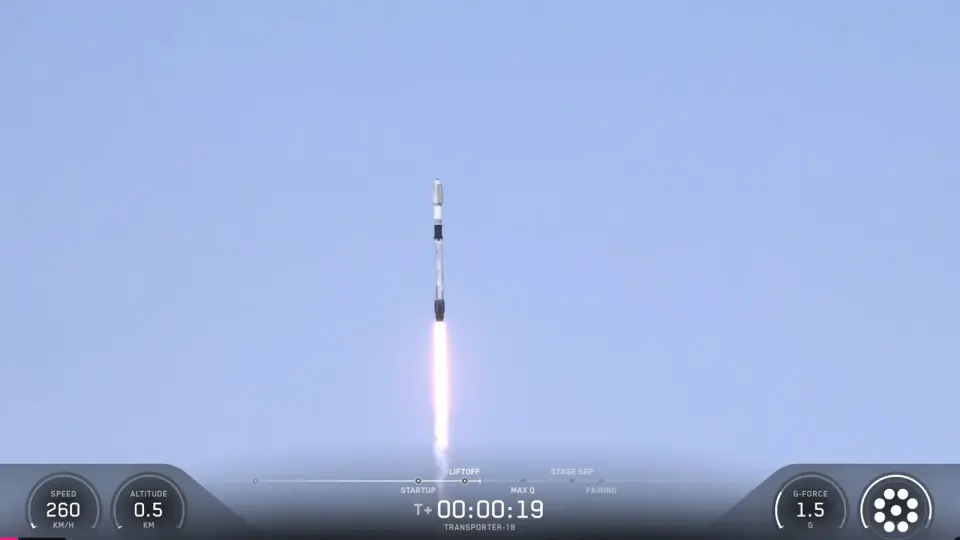
SpaceX successfully launched the Transporter-18 rideshare mission on October 1, 2026, from Vandenberg Space Force Base. The Falcon 9 rocket carried 130 payloads to low Earth orbit, including a prototype satellite for Google's Project Suncatcher. The first stage booster completed its 25th flight, landing safely at the launch site approximately 7.5 minutes after liftoff. The upper stage deployed the payloads over an 11-minute period, marking the second leg of a planned spaceflight tripleheader.
Key points
- The Transporter-18 mission lifted off at 2:32 p.m. EDT from Vandenberg Space Force Base in California.
- The mission carried 130 total payloads to low Earth orbit, including a prototype for Google's Project Suncatcher AI constellation.
- The Falcon 9 first stage booster completed its 25th flight, landing at Vandenberg's Landing Zone 4 about 7.5 minutes after launch.
- The upper stage deployed the payloads over an 11-minute window starting 54.5 minutes after liftoff.
- Cowboy Space also flew on the mission with its Reason-1 satellite, which tests power beaming via high-power lasers for future space data centers.
Background
This launch follows earlier reports in late September 2026 regarding Google's plans to test orbital AI computing. Previous coverage indicated that the refrigerator-sized satellite, built by Planet Labs, was designed to validate Tensor Processing Units (TPUs) in space. The mission is part of Project Suncatcher, an initiative aimed at testing solar-powered AI infrastructure in orbit before a planned dual-satellite launch in 2027. Additionally, recent months have seen increased activity at Vandenberg, which has become a primary site for SpaceX as the company shifts East Coast focus toward Starship operations.
How outlets are covering it
Space.com and KSBY News both confirmed the successful launch and payload count of 130, with Space.com highlighting the significance of the Google AI satellite and Cowboy Space's Reason-1 mission. Spaceflight Now provided context on the broader launch cadence at Vandenberg, noting that Transporter-18 followed a classified U.S. Space Force mission (USSF-385) earlier in September, which was part of a series deploying Starshield satellites. While all sources agree on the success of the Transporter-18 launch, Space.com emphasized the technological implications for AI in space, whereas Spaceflight Now focused on the strategic shift of launch operations to the West Coast. KSBY News noted local impacts, such as sonic booms heard by residents near Vandenberg due to the booster's re-entry.
Why it matters
The successful deployment of Google's Project Suncatcher prototype marks a critical step in validating AI hardware for orbital operations, potentially reducing latency and energy costs for future space-based data centers. The high success rate of Falcon 9 booster landings, including this 25th flight, underscores SpaceX's continued dominance in reusable launch technology. Furthermore, the concentration of launches at Vandenberg reflects a strategic realignment of SpaceX's operations, prioritizing West Coast sites for commercial and national security missions as East Coast facilities focus on Starship development.
What to watch
Google will analyze the performance data from the Project Suncatcher prototype, particularly regarding TPU radiation resistance and heat dissipation, to inform the design of a dual-satellite launch planned for 2027. Cowboy Space will evaluate the results of its Reason-1 power beaming test to advance its optical systems for space-based energy transfer. SpaceX is expected to continue its high-frequency launch cadence from Vandenberg, potentially including additional rideshare or national security missions in the coming weeks.
- Watch SpaceX launch Google AI satellite, 129 other payloads to orbit today Space
- Transporter-18 Mission spacex.com
- SpaceX’s Transporter-18 Mission could bring sonic booms to Central Coast KSBY News
- SpaceX Falcon 9 launches classified mission for U.S. Space Force from West Coast Spaceflight Now
- SpaceX plans Falcon 9 rocket launch in California. Track today's liftoff Ventura County Star
Want the full story? Read the original reporting
Read on Space