
Swift Telescope Ends 22-Year Mission With Uncontrolled Reentry
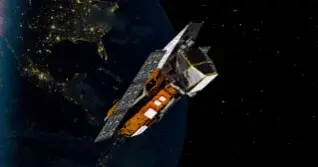
NASA's Neil Gehrels Swift Observatory, a 1.5-ton telescope launched in 2004, is expected to reenter Earth's atmosphere on November 4, 2026. After a failed commercial rescue mission by Katalyst Space, the telescope decayed to 171 miles altitude and ceased operations in October. Most of the craft will burn up, but dense tungsten and mirror components may survive, posing a low risk of harm to people on Earth.
Key points
- The U.S. Space Force predicts reentry at approximately 3:30 a.m. EST on November 4, with an 11-hour uncertainty window.
- NASA estimates the risk of human casualty from surviving debris at roughly 1 in 2,100, well below the agency's 1 in 10,000 safety threshold.
- The telescope's orbit passes over a band within 21 degrees of the equator, covering ocean and parts of Africa, Asia, and Latin America.
- Swift recorded over 2,000 gamma-ray bursts and 1,400 supernovae during its 22-year mission, contributing to approximately 7,000 scientific papers.
- The failed rescue involved Katalyst Space's Link spacecraft, which launched in July but could not reach the telescope due to technical issues.
Background
Swift was launched in November 2004 with an initial two-year mission duration but operated for nearly 22 years. Increased solar activity since late 2024 accelerated its orbital decay. In July 2026, NASA contracted Katalyst Space to launch the Link spacecraft to boost Swift's orbit, but the mission failed after Link could not reach the telescope. Following the failure, Swift resumed science operations until October 2026 when it entered safe mode at 171 miles altitude. This event follows broader trends in low-Earth orbit debris management, including NASA's recent request for commercial bids to reboost the Hubble Space Telescope before its predicted 2033 reentry.
How outlets are covering it
CBS News and Popular Science emphasize the scientific legacy of Swift, highlighting its 22-year contribution to gamma-ray burst research and the emotional farewell from the mission team. Space.com and USA Today focus on the technical details of the reentry, noting that while most of the telescope will burn up, dense components like reaction wheels and mirrors may survive. Dean Sladen, an aerospace engineer cited by Space.com and USA Today, argues that NASA should publish detailed risk assessments for transparency, even though the risk is low. Darren McKnight of LeoLabs, cited by Space.com, contextualizes Swift's reentry within a broader trend of increasing uncontrolled reentries, noting that 10 times more objects are reentering annually than five years ago. All sources agree that the risk to people on Earth is minimal, with most debris likely falling into the ocean.
Why it matters
The reentry of Swift underscores the challenges of managing aging satellites in low-Earth orbit, particularly as solar activity accelerates orbital decay. The failed rescue mission highlights the risks and limitations of commercial satellite servicing, while the successful scientific output of Swift demonstrates the value of long-duration missions. As more satellites are launched, the need for 'design for demise' and controlled reentry becomes increasingly critical to prevent debris accumulation and ensure safety on Earth.
What to watch
The U.S. Space Force and NASA will continue to monitor Swift's reentry and update predictions as it approaches Earth. Surviving debris is expected to fall into the ocean or sparsely populated areas, with minimal risk to people. NASA is also exploring commercial solutions for other aging satellites, such as Hubble, to prevent uncontrolled reentries in the future.
- An aging 1.5-ton space telescope is plunging back to Earth. NASA has calculated the risk of harm to people. CBS News
- NASA's Swift space telescope is about to crash to Earth. Where will it fall? Space
- Aging NASA telescope crashing to Earth after rescue mission fails USA Today
- NASA’s Swift telescope expected to crash to Earth after failed rescue mission KTLA
- A NASA telescope will likely plummet to Earth on Wednesday Popular Science
Want the full story? Read the original reporting
Read on CBS News