Tag

Anticoagulation

All articles tagged with #anticoagulation

Interacting Medications Drive Breakthrough Strokes in Anticoagulated Atrial Fibrillation
health2 days ago

Interacting Medications Drive Breakthrough Strokes in Anticoagulated Atrial Fibrillation

In 1,649 AF patients on anticoagulants who had a breakthrough ischemic stroke, about 44% had identifiable causes—primarily drug interactions (28.4%) or competing non-cardioembolic etiologies. Patients with a potential cause had roughly double the 90-day risk of a new ischemic stroke (HR ~2.04), and interacting drugs were linked to a ~3.3-fold higher 90-day risk of myocardial infarction; death rates did not differ significantly. The findings suggest a need for personalized secondary prevention beyond mere anticoagulation to address alternative stroke mechanisms.

GAE for Knee OA: Mixed Evidence and Caution, Plus Head-Trauma CT Advice for Seniors on Anticoagulants
health9 days ago

GAE for Knee OA: Mixed Evidence and Caution, Plus Head-Trauma CT Advice for Seniors on Anticoagulants

In Dr. Roach’s Q&A, genicular artery embolization (GAE) for knee osteoarthritis shows potential pain relief in some studies but lacks consistent benefit in rigorous sham-controlled trials, making knee replacement a possibly longer-lasting option; the expectation of a year-long rehab after knee surgery is inaccurate, as typical postoperative rehab is about 2–3 months with ongoing home exercise. Separately, for people over 65 on anticoagulants who fall, prompt ER evaluation and brain imaging with a CT scan is recommended to rule out intracranial bleeding, especially with red flags like vomiting, prolonged amnesia, seizures, or skull fracture signs.

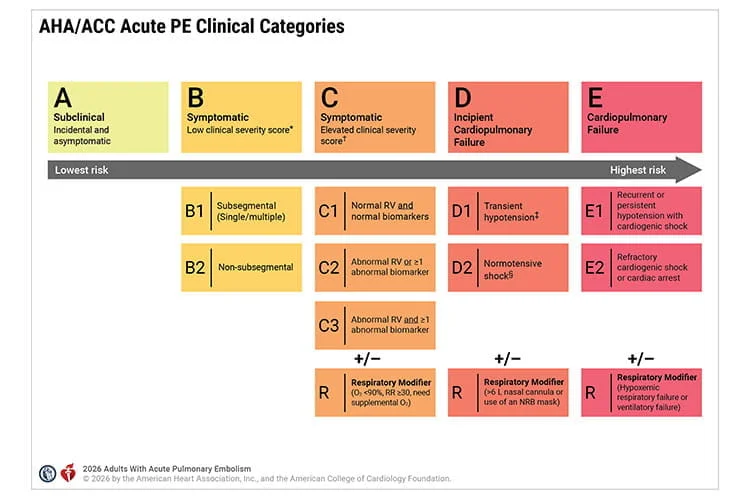
New Multisociety Guideline Uses Five Acute PE Categories to Guide Care
cardiology6 months ago

New Multisociety Guideline Uses Five Acute PE Categories to Guide Care

A new joint ACC/AHA/peer-society guideline for evaluating and managing acute pulmonary embolism in adults introduces five Acute PE Clinical Categories (A–E) to stratify severity and guide therapy across emergency, inpatient, and post-acute settings. It recommends low-molecular-weight heparin over unfractionated heparin for initial anticoagulation, favors direct oral anticoagulants over vitamin K antagonists when appropriate, and supports continuing anticoagulation beyond 3–6 months for selected patients; it also emphasizes PE response teams (PERTs) and notes future evidence gaps.

2026 Acute PE Guideline Introduces Five-Category Risk System to Guide Management
health6 months ago

2026 Acute PE Guideline Introduces Five-Category Risk System to Guide Management

The 2026 AHA/ACC guideline for acute PE introduces a five-category Acute PE Clinical Categories system (A–E) to sharpen risk stratification and guide therapy; patients with higher risk (categories C–E) or cardiopulmonary failure should be hospitalized, and for those eligible for oral anticoagulation, direct oral anticoagulants are preferred over vitamin K antagonists to prevent recurrent VTE and reduce major bleeding.

Anticoagulation Fails to Prevent Cognitive Decline in AF Patients
health1 year ago

Anticoagulation Fails to Prevent Cognitive Decline in AF Patients

A trial investigating the use of the anticoagulant rivaroxaban to prevent cognitive decline in atrial fibrillation (AF) patients was halted due to lack of efficacy. The BRAIN-AF study found no significant difference in cognitive decline between patients taking rivaroxaban and those on placebo, despite a high overall rate of cognitive decline. The study, which involved low-risk AF patients, suggests that other mechanisms beyond microemboli may contribute to AF-related cognitive decline, warranting further research.

Optimizing Treatment for Pulmonary Embolism and Afib with Catheter-Based Interventions.
healthcare3 years ago

Optimizing Treatment for Pulmonary Embolism and Afib with Catheter-Based Interventions.

Catheter-directed thrombolysis (CDT) is a safer and more effective treatment option than systemic thrombolysis or anticoagulation therapy for patients with intermediate- or high-risk pulmonary embolism, according to a systematic review and network meta-analysis of over 20,000 patients. CDT was associated with a 57% lower risk for death than systemic thrombolysis and a 64% lower risk than anticoagulation. The researchers suggest that CDT should be considered a first-line therapy for this patient population, and hope their study will influence treatment guidelines.