Tag

Gait

All articles tagged with #gait

Real-Time Brain Pacemaker Adapts to Each Step to Improve Parkinson’s Gait
technology26 days ago

Real-Time Brain Pacemaker Adapts to Each Step to Improve Parkinson’s Gait

UCSF researchers developed a closed-loop adaptive deep brain stimulation system that detects step-specific brain signals and automatically modulates stimulation within milliseconds, synchronizing with walking to improve gait symmetry and reduce falls in five Parkinson’s patients—evidence supporting a shift from fixed stimulation to behavior-responsive neuromodulation with potential broader applications.

Aging Rewrites the Way We Walk: Balance Trumps Speed
health1 month ago

Aging Rewrites the Way We Walk: Balance Trumps Speed

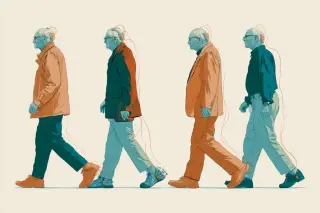
A 2026 study of 107 adults aged 26–86 found that aging shifts walking strategy from efficiency to safety: the ankle and surrounding muscles show more co-contraction, increasing joint stiffness to improve balance, but reducing forward push-off, shortening strides and slowing walking, which makes tasks feel more tiring and raises fall risk. The researchers suggest training that targets balance and coordination—not just strength—to help older adults stay mobile, with activities like tai chi and lower-leg strengthening recommended.

Aging Slows Our Stride: The Ankles and Brain Lean Toward Safety
health1 month ago

Aging Slows Our Stride: The Ankles and Brain Lean Toward Safety

New study of 107 adults aged 26–86 shows older walkers exhibit ankle muscle co-contraction, stiffening joints to improve balance but reducing push-off, shortening strides, and slowing pace. The nervous system appears to favor stability over performance as muscles weaken, increasing fatigue and fall risk; targeted balance/coordination training could help maintain a steadier gait.

Gait cues reveal mood: study links limb swing to anger and sadness
science3 months ago

Gait cues reveal mood: study links limb swing to anger and sadness

New research shows that how a person walks—especially arm and leg swing amplitude—can signal their emotional state. In experiments, observers correctly guessed emotions from point-light gait videos, with bigger swings associated with anger and smaller swings with sadness or fear; altering swing amplitude made these emotions easier to infer, suggesting gait is a key nonverbal cue with potential applications in CCTV screening and mood-monitoring wearables, though ethical considerations remain.

Legs as a Warning Sign: Dementia Risk and Dietary Solutions
health2 years ago

Legs as a Warning Sign: Dementia Risk and Dietary Solutions

A study conducted by the University of Minnesota and Monash University suggests that walking slower in old age could be a red flag for dementia. The study examined 17,000 participants aged over 75 and found that those who lost 0.05 meters per second from their walking pace every year showed signs of mental decline. The researchers believe that the link between brain decline and walking speed could be due to the areas of the brain involved in controlling walking and pace. Those who experienced a decline in both cognition and walking speed were found to be at a higher risk of dementia. The study highlights the importance of assessing both speed and memory to detect cognitive decline and assess future decline.