Despite massive investment, AI has not yet triggered the predicted productivity surge. While individual task speed has increased, aggregate economic gains remain modest, and many workers face increased pressure rather than reduced workloads.
Grand Theft Auto VI releases on November 19, 2026, triggering estimates of massive global productivity losses. While some models predict a $1 billion hit to the US economy and NIS 170 million to Israel, experts argue these figures are exaggerated. Companies like Logitech are granting paid days off, while others brace for absenteeism. The launch also highlights labor disputes at developer Rockstar Games.
Initial US unemployment claims dropped to 189,000 for the week ending October 31, matching the lowest level since 1969. Simultaneously, third-quarter worker productivity rose at a 3.6% annualized rate, driving unit labor costs down for the first time in over a year. These figures suggest the labor market is not fueling inflation, potentially giving the Federal Room more flexibility to address price pressures from the Middle East conflict, though economists debate whether low claims reflect genuine resilience or a shrinking labor force due to immigration restrictions.
Grand Theft Auto 6 launches November 19, 2026, projected to cost the US economy $1 billion in lost productivity as 1.5 million workers take the day off. While Take-Two Interactive expects to gain $1 billion in cash flow, industry analysts warn that the game's massive scale highlights unsustainable AAA development trends, with layoffs and homogenized gameplay becoming common. Competing titles like Call of Duty face significant player attrition, and the release may accelerate a shift toward smaller, more efficient game development models.
Grand Theft Auto 6 is scheduled for release on November 19, 2026. Analysts project that approximately 1.5 million US workers will take the day off, resulting in a single-day productivity loss of $1 billion. This economic dip is nearly equivalent to the $1 billion in operating cash flow expected by publisher Take-Two Interactive. The impact is concentrated among men aged 18 to 30 and the technology sector, with some companies treating the date as a perk while others face a 'work blackout.'
Grand Theft Auto VI is set to release on November 19, 2026, with analysts projecting a $1 billion hit to US productivity. Approximately 1.5 million workers, primarily men aged 18 to 30 in the tech sector, are expected to take the day off. The publisher, Take-Two Interactive, is projected to gain nearly $1 billion in revenue, offsetting the economic loss. Surveys indicate 10% of employees plan to skip work, while 42% expect reduced productivity. The release may also reduce attendance at sporting events and movie theaters, with 39% of gamers less likely to see the Hunger Games film. Preorder revenue has already reached $600 million, and Rockstar Games is promoting the game through Miami-based marketing, including special Miami Heat jerseys.
Anthropic teams with Blackstone, Hellman & Friedman, Goldman Sachs Asset Management and a broad investor consortium to form a $1.5 billion venture described as the 'McKinsey of AI' that will develop a repeatable AI-enabled transformation playbook for portfolio companies, embedding AI into workflows, offering early access to model upgrades, and aiming to boost productivity and returns while navigating cybersecurity and data-center scaling.
Labor productivity in the U.S. has dropped significantly, with 37 states and the District of Columbia experiencing a decrease from 2021 to 2022. Energy-producing and tourism-dependent states were hit the hardest. Only Idaho saw a sizable increase in productivity due to an influx of tech workers. Experts suggest that a labor shortage, low-wage jobs, remote work, and pandemic stress could be contributing factors to the drop in productivity.
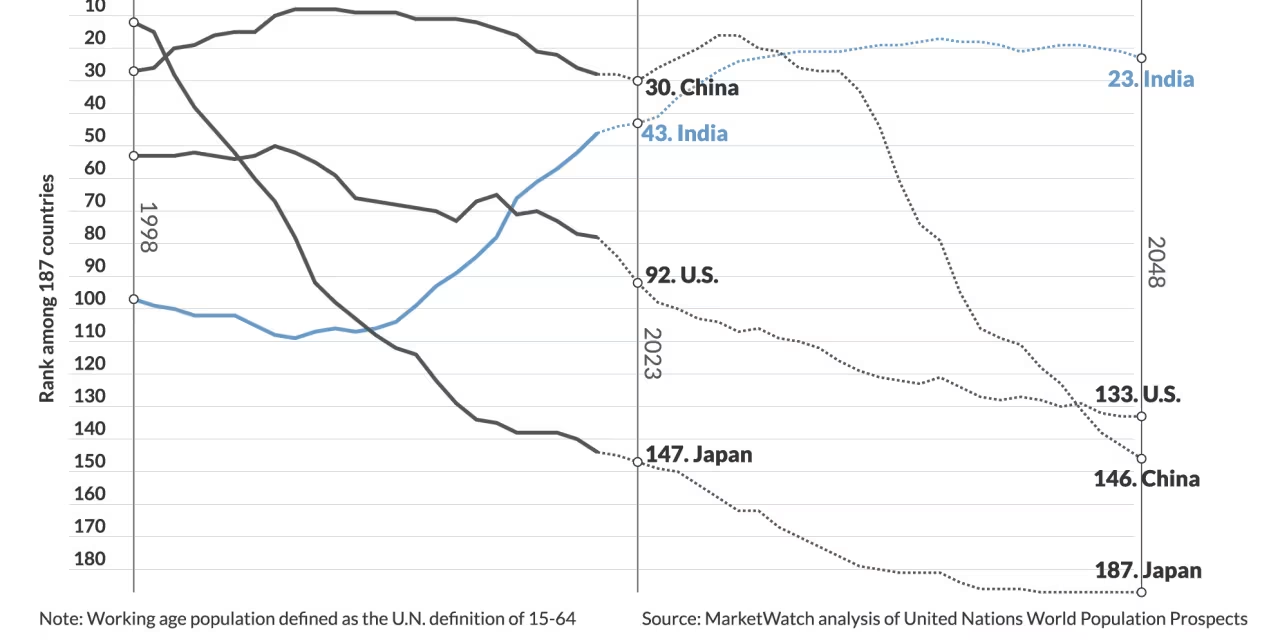
India's population has surpassed China's, making it the world's most populous country. India's demographic makeup, particularly its low dependency ratio, gives it a competitive advantage for economic growth. However, India needs to improve labor productivity and female participation rates to fully realize its economic potential. The World Bank recommends policies to improve healthcare, education, and shift the economy from agriculture to manufacturing. India trails behind other emerging economies in terms of labor productivity and capital accumulation growth potential, but exceeds them in total factor productivity.