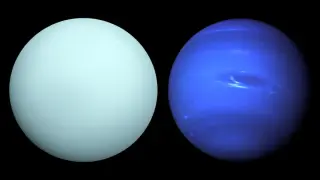
Researchers used diamond anvil cells and synchrotron X-rays to heat water to roughly 2,357 C and pressures up to 200 GPa, observing the predicted superionic ice (ice X) where oxygen forms a lattice and hydrogen ions move freely, matching theoretical models of ice giants’ interiors—though decades of work remain to confirm Neptune/Uranus mappings.
Physicists propose GRB 221009A’s extreme 300 TeV photons survived a two‑billion‑light‑year trip by briefly converting into axion‑like particles, with a tiny Lorentz‑invariance violation enabling a “fast lane.” A predicted one‑hour gap between lower‑energy photons and the 300 TeV burst matched an independent Chinese observation, offering empirical support and a potential probe of quantum gravity.
An oceanographer noticed humpback calls near Massachusetts appeared to exceed the speed of sound, but the effect isn’t physics breaking — it comes from interference between the direct sound and its surface-reflected echo reaching the hydrophone, making the strongest signal peak appear to arrive faster. This observer-relative illusion aligns with special relativity concepts, and the researchers propose experiments to verify this underwater SR-like phenomenon, with potential applications to light-based tests.
Monash University researchers propose a new quantum state—stable Bose-Fermi droplets formed by a mixture of bosons and fermions balanced by attractive forces and fermionic pressure. The work provides a theoretical ansatz and an experimental roadmap to realize these droplets in ultracold systems, with potential implications for ultra-precise sensors and future quantum technologies.
Japanese researchers suspended thousands of colloidal particles in water between microfabricated electrodes and applied an alternating electric field, which caused mixed-size particles to form self-propelled pairs and chase one another, effectively breaking action–reaction symmetry for about an hour. When all particles were the same size, interactions remained reciprocal and the system crystallized; with mixed sizes, particles clustered and then split repeatedly. The finding could inform programmable materials and microrobotics.
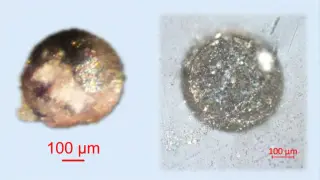
A Science Advances study reports the discovery of a previously unknown, silicon-rich multicomponent alloy formed inside microscopic grains called ‘hiroshimaites’ created by the Hiroshima atomic blast. The highly ordered tiny crystal demonstrates that extreme, rapid quenching from nuclear detonations can forge new crystalline materials, potentially encoding diagnostic information about the device, environment, and detonation conditions, with implications for nuclear forensics and materials science.
A University of Oslo team theorizes that by using a fast optical shutter to create a left/right superposition, a photon can be effectively “cut” into a highly nonclassical state that, in principle, contains photons with numbers extending to infinity. The result isn’t two photons or a photon plus vacuum; instead, removing the shutter pulls photons from the vacuum, forming a sharp edge with a transition region. Local measurements on either side would resemble a single-photon state and vacuum respectively, even though the underlying state is much more complex. The study is purely theoretical but highlights surprising aspects of quantum field theory and wave–particle duality, and could in principle be tested experimentally.
Physicists Parisi and Zamponi credit Claude, an AI model, with sparking a simple idea that, despite initial errors, guided a clean proof that two parameters in the jamming (granular) model sum to one. The researchers refined Claude’s premise and published their result in the Journal of Statistical Mechanics: Theory and Experiment, illustrating AI’s potential to surface patterns and literature while underscoring that human verification remains essential.
Physicists show lugworms defy gravity with upward-defecating poop whose shape follows elastic rope-coiling physics, explaining why the poop emoji’s cone form emerges from gravity and suggesting biology leverages basic physical laws rather than requiring special biological design.
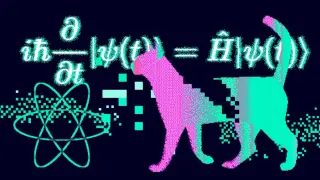
Physicists developed a method to create and control quantum superpositions in the motion of a trapped strontium ion, turning the ion's internal spin into a tool to sculpt cat-like quantum states with distinctive interference patterns, expanding the Schrödinger cat family and offering new capabilities for quantum computing, simulations, and sensing.
Researchers used computer simulations to show gold’s surface atoms rearrange into hexagonal patterns that dramatically suppress oxidation (by about a billion to a trillion), explaining its long-lasting shine and suggesting new ways to optimize gold-catalyzed reactions.
APS’s large survey of about 1,660 participants—ranging from researchers to science enthusiasts—reveals widespread disagreement on core physics questions, from the Big Bang to quantum gravity. The Big Bang is widely seen as a hot, dense state (68%), not necessarily the absolute beginning (25%). Quantum interpretations are not universally accepted: Copenhagen leads at around 36%, with many opting for other theories or 'no opinion.' About half agree on cosmic inflation, while dark energy and ΛCDM show no clear majority, with evolving dark energy edging ahead slightly. Only a minority subscribe to specific quantum gravity views, with string theory leading among them. The results underscore that physics frontiers remain active and data and theory must advance to resolve these debates.
Physicists analyzing red trinitite from the Trinity test have identified a previously unknown silicon-calcium-iron clathrate, a nanoscale crystal structure formed by vaporized tower metals; confirmed with single-crystal X-ray diffraction and nanoscale imaging, this new phase could advance understanding of clathrates used in batteries, solar cells, and quantum devices, and provides a rare extreme-condition crystal for modeling.
A cryogenic device generates tunable, predictable phonons (quantized sound) by driving electrons through a 2D crystal, offering a new route for quantum communications—particularly where light struggles, like the deep ocean—though it requires ultracold temperatures to work.
Texas A&M has launched the Detonation Research Test Facility (DRTF), the world’s largest lab devoted to controlled explosions, featuring a 150-meter methane–air detonation tube with advanced sensors and lasers to study high-speed reactive flows, ignition, and transitions from deflagration to detonation and quenching; the research aims to advance safety, propulsion, and fundamental science across engineering and astrophysics, with Mach-5 detonations achievable in under five seconds and the project rooted in concerns from the mining community about natural gas explosions after a 2021 approval and commissioning.