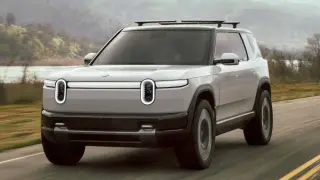
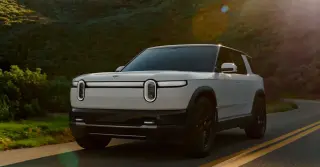
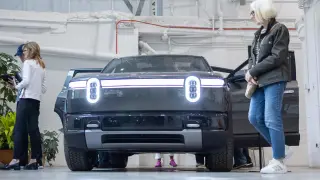
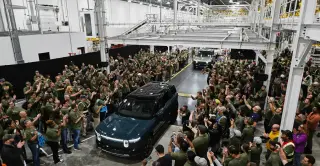
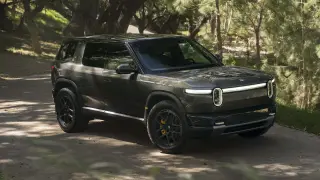
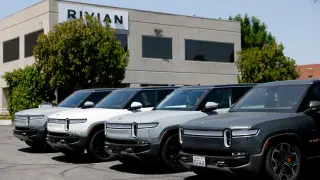
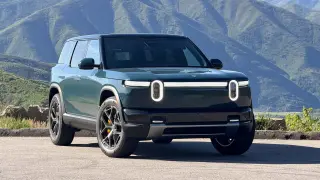
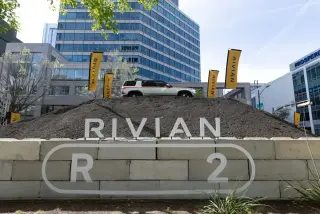
Rivian’s R2 advances a mainstream EV by using a chassis-integrated inverted-tub battery and a redesigned suspension. The front subframe is stamped steel—about 50% cheaper and ~10% lighter than the R1’s—and the suspension swaps in coil springs and rigid anti-roll bars for the previous air and hydraulic setup, cutting build costs roughly in half while preserving ride and handling.
Rivian announced an underwritten public offering of 75 million shares to raise about $1.5 billion (potentially ~$1.7B if underwriters exercise their option for up to 11.25 million additional shares), following a strong Q2 delivery beat and raised full-year guidance. The deal would dilute existing shareholders by roughly 6%. Proceeds are intended to fund the R2 ramp and related DOE loan equity obligations, giving Rivian more runway to scale production.
Rivian raised its 2026 delivery outlook to 65,000–70,000 vehicles after stronger-than-expected Q2 demand, with Q2 production of 12,613 and deliveries of 12,194. Growth was driven by the electric delivery van and the flagship R1 lineup, plus the start of R2 midsize SUV deliveries and ramp-up at its Normal, Illinois plant with 160,000 annual capacity. The company will report Q2 results on July 30 as rivals Tesla and Lucid prepare to disclose their numbers.
Rivian’s push to scale the affordable R2 is tested by a tornado that damaged its Normal, Illinois factory just as the EV market cools and policy shifts bite; the company bets on vertical integration, in-house software, and a VW partnership to carry it to mass production, but success now hinges on the R2 delivering volume and profitability amid supply-chain volatility and competition.
Rivian announced layoffs of roughly 300 employees (about 2% of its workforce) as it begins delivering the R2 and pursues profitable growth, with cuts focused on service, customer, and go-to-market teams; the EV maker has yet to post an annual profit and is planning a Georgia plant to reach up to 300,000 vehicles per year by 2028.
Rivian laid off hundreds—less than 2% of its workforce, primarily from service and customer-facing roles—just a week after starting R2 deliveries, the fourth round of cuts since 2024 as it seeks profitability amid heavy losses and a high-stakes mass-market launch. The move comes as Uber plans a substantial investment in Rivian and its autonomy program, highlighting investor pressure even as the company ramps the R2.
Rivian is laying off hundreds of workers—under 2% of its staff—as it scales the R2 SUV rollout and pursues profitability, following a $3.6 billion loss last year and ongoing restructuring that affected service and customer teams.
Rivian confirms the R2 is arriving in US driveways and teases a broader plan, with the R3X planned for around 2028 ahead of a standard R3; a Georgia factory ramp is tied to the timeline, and while Rivian has floated variants like an R2T, the company says the immediate focus remains on the R2 and exploring multiple possibilities for future models.
Rivian has begun delivering the R2 and launched its official Gear Shop, offering a $755 compact spare tire that fits under the trunk floor (with no built-in compressor) alongside other accessories. The first shipments are the top-spec Performance with Launch Package, delivering up to 656 hp, 0-60 mph in 3.6 seconds, and about 330 miles of EPA range from an 87.9 kWh pack, with more affordable Standard versions arriving later in 2027.
Needham reiterates a Buy on Rivian with a $23 target, arguing the R2 launch is TAM-expanding and could bring new buyers into Rivian’s ecosystem; catalysts include point-to-point navigation, a LiDAR-enabled hands-free variant, and cheaper R2 trims. Rivian says missing features on the initial R2 rollout were delayed for quality and will arrive via monthly OTA updates this summer. With R2 deliveries underway, the stock rose about 1% in overnight trading as investors are encouraged to test-drive the vehicle rather than rely on broad EV adoption alone, supporting a bullish longer-term view despite near-term volatility.
Rivian unveiled the R2 SUV at a base price around $44,990 to broaden demand, but its stock fell about 7% after the announcement and is roughly 17% lower for the year. With only 10,365 Q1 deliveries and $1.81 billion in revenue (net loss $416 million), Rivian’s $21 billion market cap looks stretched next to GM’s $75 billion. Investors and analysts question whether a late-to-market, higher-priced EV can reverse Rivian’s trajectory amid stiff competition from Tesla and BYD, suggesting the R2 may be too little, too late.
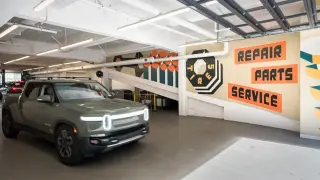
Rivian has overhauled its service operations to dramatically cut wait times—from days for non-critical issues to hours for critical ones—after earlier 40–50 day delays. CEO RJ Scaringe says the improvements come from building out infrastructure and scaling for the mass-market R2, with the goal of handling higher volumes and delivering better service as the R2 rollout begins, a trend reflected in improving online feedback.
Rivian CEO RJ Scaringe outlines a mass‑market push centered on the R2, with the company targeting profitability on a per‑vehicle basis by Q4 this year as volume climbs. The plan includes a Georgia factory to scale R2 (and future R3) in two phases, a broader RAD program to create high‑performance variants, and continued expansion of the Rivian Adventure Network (RAN). The interview also covers service improvements (including mobile service to cut wait times), ongoing charging network upgrades, and software/controls evolution (Rivian OS 2.0 and CarPlay support), all aimed at balancing cost, safety, repairability, and customer experience while moving toward a larger, multi‑product lineup beyond R2 and R3.
Rivian’s R2 is designed to move the brand into mass‑market EVs, with a four‑trim lineup planned through 2027. The launch Performance model starts at about $57,990 (roughly $59,485 with destination) delivering 656 hp, 609 lb‑ft, 0–60 in 3.6 seconds, and about 330 miles of range; the lineup later adds a Standard Long Range and a base Standard model, with a target $45k price in late 2027. Early R2s will use Gen 2 RAP1 hardware (no lidar, no Level 3 autonomy yet) but Rivian plans Gen 3 hardware later, plus a 29‑minute 10–80% charge on NACS chargers. The goal is higher sales and better cash flow, though early tech and cost‑cutting choices mean some features will arrive after launch.
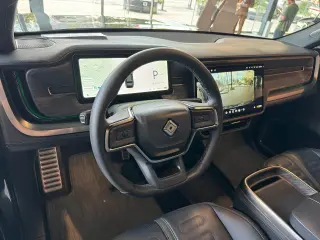
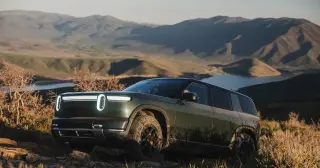
Rivian’s 2027 R2 targets mass-market appeal with a two-row midsize EV SUV priced under $60k for the Launch Edition, offering a lighter, more refined ride, improved steering and suspension, and a cost-conscious 400V architecture with a NACS port. It pairs up to 345 miles of range in the long-range single-motor variant (330 miles in the dual-motor Launch Edition, 656 hp, 609 lb-ft), a 4,998-pound curb weight, and 11 kW bidirectional charging. The vehicle uses a software-defined, AI-driven interior (Halo dials, 200 TOPS compute) and OTA updates, plus a high-powered infotainment system and 65 MP cameras. Off-road capability is solid but not R1-level; Rivian emphasizes daily practicality and a competitive price against the Model Y, with sustainability features (about 25% recycled/biological materials) and future generations expected to inherit tech from the R2.