The US Department of Defense has committed a $400 million conditional loan to Sunrise Energy Metals to develop the world’s first primary scandium mine in New South Wales, Australia. This move aims to reduce Western reliance on Chinese rare earth supplies, with production targeted for late 2028.
The US Department of Defense has committed $400 million to an Australian scandium mine, part of a broader $3 billion federal initiative to secure critical mineral supply chains. Simultaneously, the Department of Energy launched a $100 million program to double mining graduates within two years, addressing a severe workforce deficit.
Scientists have identified scandium as a promising element for the development of nuclear clocks, which could offer accuracy up to 1 second in 300 billion years. Unlike atomic clocks that rely on electron shell oscillation, nuclear clocks use the oscillation of the atomic nucleus for enhanced timekeeping. Scandium's atomic resonances are more acute than those of electrons, making it a potential candidate. However, generating the necessary oscillation in scandium requires X-rays with high energy levels. The researchers demonstrated a resonant width of only 1.4 femtoelectronvolts, suggesting an accuracy of 1:10,000,000,000,000. This advancement could have applications in extreme metrology, nuclear clock technology, and ultra-high-precision spectroscopy.
An international research team has made a significant breakthrough in the development of atomic clocks by creating a pulse generator based on scandium that is a thousand times more precise than the current standard atomic clock based on cesium. Using the X-ray laser at the European XFEL, the team achieved an accuracy of one second in 300 billion years, compared to the current standard of one second in 300 million years. Atomic clocks have numerous applications, including precise positioning using satellite navigation, and the breakthrough opens up possibilities for ultrahigh-precision spectroscopy and the measurement of fundamental physical effects.
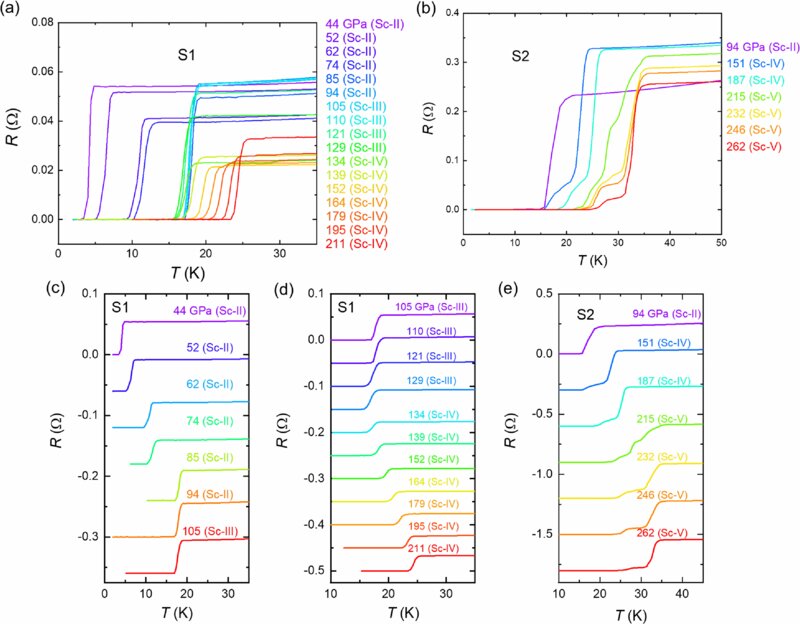
Researchers have achieved a new record for the highest elemental superconducting transition temperature by reaching 36 K in elemental scandium (Sc) under high pressure. The study provides insights into the relationship between the structure of elemental materials and their superconducting properties, opening up possibilities for discovering high-temperature superconducting materials in simple systems.