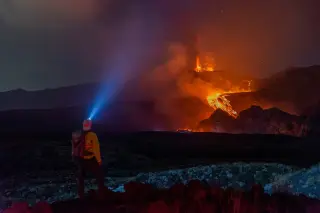
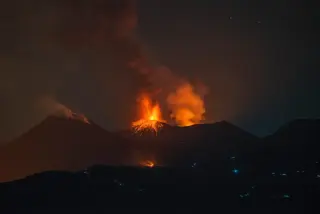
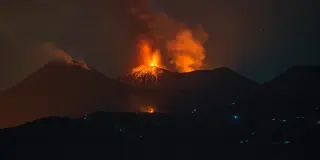
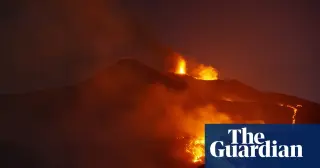
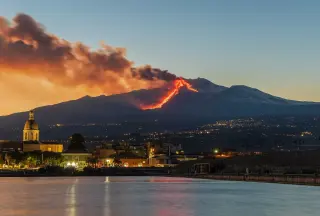
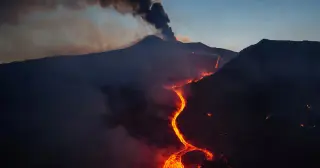
Mount Etna’s August 2026 eruption caused significant travel disruptions in Sicily, leading to mass flight cancellations at Catania Airport and stranding tourists like Julie Sagoskin, who had to reroute via Rome to return home.
A 29-year-old American tourist, identified as Dylan Standfast from Wichita, Kansas, died after being struck by lightning while hiking Mount Etna in Sicily. He was found in serious condition on Sunday evening at an altitude of approximately 1,400 meters in the Rocca Capra area. Firefighters airlifted him to Cannizzaro Hospital in Catania, where he was pronounced dead. The incident occurred during a period of intense volcanic activity that had previously forced the closure of Catania's airport and restricted access to parts of the volcano's slopes.
A 29-year-old man from Wichita, Kansas, identified as Dylan Standfast, died after being struck by lightning while hiking Mount Etna in Sicily. He was airlifted to a hospital in Catania on Sunday evening but pronounced dead. The incident occurred during a period of intense volcanic activity that had forced the closure of parts of the volcano and the nearby Catania airport. Italian officials noted that lightning strikes have caused more fatalities on Etna in recent decades than volcanic eruptions, with the last eruption-related deaths occurring in 1987.
A 29-year-old American tourist from Kansas died after being struck by lightning while hiking Mount Etna in Sicily. The incident occurred on August 16 during a period of intense volcanic activity that had closed parts of the volcano and disrupted flights. While the volcano's activity was the backdrop, officials note that lightning has historically caused more deaths on Etna than eruptions in recent decades.
A 29-year-old American hiker from Kansas died after being struck by lightning on Mount Etna in Sicily. The incident occurred during a period of intense volcanic activity that had already forced airport closures and restricted access to parts of the volcano. While the victim was found in an exposed area, it remains unclear if he was in a zone officially closed to the public. This event highlights a statistical anomaly: lightning strikes have caused more fatalities on Etna in recent decades than volcanic eruptions, with the last eruption-related death occurring in 1987.
Four Renaissance paintings by Antonello da Messina were stolen from the Accascina Regional Museum in Messina, Sicily, on the night of August 15. The theft occurred during the city's major religious festival, La Vara, which drew 100,000 people and diverted police attention. The stolen works include three panels from the San Gregorio Polyptych and a double-sided devotional panel. These were the only known works by the artist remaining in his birth city. Authorities are investigating the breach, noting that alarms did not trigger, while experts warn that such high-value items are difficult to sell on the black market.
A 29-year-old American man from Kansas, identified as Dylan Standfast, died after being struck by lightning while hiking on Mount Etna in Sicily. The incident occurred Sunday evening in an exposed area above the tree line, where authorities had closed sections of the volcano due to recent volcanic activity. Standfast was airlifted to a hospital in Catania but pronounced dead. Italian officials noted that lightning strikes have caused more fatalities on Etna in recent decades than volcanic eruptions, with the last eruption-related deaths occurring in 1987.
A 29-year-old American tourist from Kansas died after being struck by lightning while hiking in a restricted zone on Mount Etna in Sicily. The incident occurred on Sunday evening during a period of intense volcanic activity that had previously forced the closure of Catania airport. Emergency services reached the victim via helicopter, but he was pronounced dead at a local hospital. Authorities noted that the hiker entered an area closed to the public due to safety concerns.
A 2,100-year-old Roman shipwreck was discovered 3 miles off the coast of Mazara del Vallo, Sicily, at a depth of 46 meters. The vessel, measuring 21 by 6 meters, contains approximately 500 intact amphorae, likely used for wine, along with lead anchors and a pipe. Italian authorities have confirmed the find as a major archaeological discovery from the 1st or 2nd century BC, with further scientific documentation planned to determine the cargo's origin and destination.
Mount Etna’s ongoing eruption has forced the closure of Catania-Fontanarossa Airport, suspending flights until at least 2:00 AM on August 15. Ash plumes have disrupted over 1,350 flights and diverted traffic to Palermo and Comiso. While the eruption is geologically normal, it poses significant travel risks and minimal environmental impact.
Mount Etna’s eruption has persisted for seven days, forcing the indefinite closure of Catania airport and stranding thousands of travelers during peak summer season. While lava flows remain contained, ash clouds have disrupted air traffic across the Mediterranean, with experts noting the event’s duration is unprecedented since the 1970s.
Two free divers accidentally discovered a Roman shipwreck off the coast of Sicily, revealing a massive mound of amphorae dating to the 2nd or 1st century BCE. The wreck, located 4.8 kilometers from Mazara del Vallo at a depth of 46 meters, contains hundreds of wine jars and lead anchors. Italian authorities have begun a 3D survey of the site, calling it a major archaeological find.
A 2,100-year-old Roman shipwreck has been discovered off the coast of Sicily, Italy. The vessel, dating to the 1st or 2nd century B.C., lies at a depth of approximately 46 meters and contains roughly 500 amphorae, likely used for transporting wine. Italian authorities have declared the find a major archaeological discovery and are moving to protect the site.
Italian authorities have confirmed the discovery of a 2,100-year-old Roman shipwreck approximately 3 miles off the coast of Mazara del Vallo, Sicily. The vessel, located at a depth of 46 meters, contains roughly 500 amphorae, primarily of the Dressel 1A type used for transporting wine. Culture Minister Alessandro Giuli described the find as a major archaeological discovery that illuminates ancient Mediterranean trade routes. The wreck was initially spotted by fisher Giacomo De Mola, who reported it to the Carabinieri, leading to a joint investigation by the Sicilian Sea Superintendency. Future research aims to determine the exact date, origin, and destination of the cargo, while implementing protective measures for the site.
Italian authorities confirmed the discovery of a Roman-era shipwreck approximately 2,100 years old, located about three miles off the coast of Mazara del Vallo, Sicily. The vessel, dating to the second or first century B.C., rests at a depth of 46 meters and is covered in hundreds of well-preserved amphorae. Culture Minister Alessandro Giuli called the find one of the most significant underwater archaeological discoveries in recent years. The wreck was initially spotted by a fisherman using sonar technology, who reported it to local marine authorities. Specialists from the Carabinieri and the Sicilian Sea Superintendency have since secured the site for further investigation.