
ALMA Reveals Long-Lived Hotspots on Betelgeuse’s Bubbling Surface
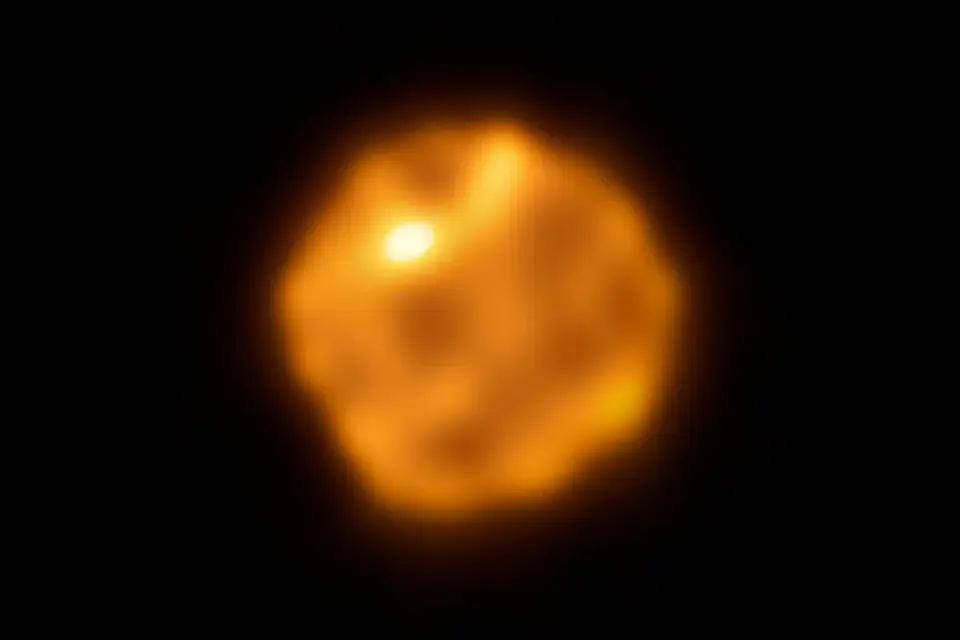
Astronomers using the Atacama Large Millimeter/submillimeter Array (ALMA) have captured the most detailed image of the red supergiant Betelgeuse, revealing an uneven, bumpy surface with persistent hotspots. The 2023 observations show that a bright hotspot in the star’s northeast has remained in the same location for at least seven years, challenging current models of stellar convection. This new data highlights the complex, non-spherical structure of Betelgeuse as it approaches its eventual supernova.
Key points
- ALMA’s 2023 observations, using its longest-baseline configuration, achieved a resolution of about seven milliarcseconds, revealing Betelgeuse’s irregular outline and bright hotspots.
- The star’s atmosphere has an average temperature of around 2,300 K (about 2,020°C), with the brightest hotspot being up to 800 K (about 526°C) hotter than the surrounding gas.
- A prominent hotspot in the northeast of Betelgeuse appeared in nearly the same location and with similar intensity in 2015 and 2023, suggesting it has persisted for at least seven years.
- This long-lived hotspot contradicts theoretical models, which predict that large convective structures in Betelgeuse should have much shorter lifetimes.
- ALMA measured variations of up to 6% in Betelgeuse’s apparent radius, confirming that the star is far from spherical, with fainter emission extending several stellar radii into its atmosphere.
Background
Betelgeuse, a red supergiant in the constellation Orion, is one of the closest such stars to Earth at about 600 light-years. It is 800 times as wide as the Sun and is expected to eventually explode as a supernova. Recent discoveries, including the likely detection of a companion star (Betelgeuse B) using ESO’s Very Large Telescope, have added new factors to consider in understanding Betelgeuse’s evolution and changing brightness. The star’s famous dimming event several years ago was attributed to a dust cloud, not a pre-supernova sign.
How outlets are covering it
The primary source (BBC Sky at Night Magazine) and the ALMA observatory blog emphasize the unprecedented detail of the 2023 ALMA image and the surprise of finding a hotspot that has persisted for at least seven years, challenging convection models. The ALMA blog also notes that the orientation of the hotspots is intriguing in light of the recent evidence for a companion star, though it does not establish a direct connection. Science Daily, while focusing on the companion star discovery, provides context on Betelgeuse’s changing brightness and the possibility that the companion could influence its future supernova. All sources agree on the significance of the new ALMA data for understanding Betelgeuse’s structure and evolution.
Why it matters
Understanding the structure and behavior of Betelgeuse, one of the closest red supergiants, is crucial for predicting the timing and nature of its eventual supernova. The discovery of long-lived hotspots and the non-spherical shape of the star provide new data to refine models of stellar convection and mass loss. This knowledge could help astronomers better understand the final stages of massive star evolution and the potential impact of a supernova on the surrounding environment, including the possibility of a companion star influencing the process.
What to watch
Astronomers plan to continue high-resolution observations of Betelgeuse with ALMA to determine if the hotspots remain fixed and to investigate their relationship to convection, mass loss, and the structure of the star’s extended atmosphere. Further observations are also needed to confirm the existence and orbit of Betelgeuse B, the suspected companion star, and to assess its potential influence on Betelgeuse’s evolution.
- Want to see a star in close-up? Astronomers have produced one of the most detailed images of Betelgeuse we've ever seen BBC Sky at Night Magazine
- The bubbling surface of doomed supergiant star Betelgeuse has been revealed like never before Space
- ALMA Reveals Long-Lived Hotspots on Betelgeuse’s Bubbling Surface Observatorio ALMA
- “I jumped from my chair” – Astronomers spot Betelgeuse’s hidden companion Science Daily
- ALMA Reveals Betelgeuse’s Fiery, Long-Lived Hot Spots Sci.News
Want the full story? Read the original reporting
Read on BBC Sky at Night Magazine