
CORAL model integrates spatial omics to map immune resistance in liver cancer
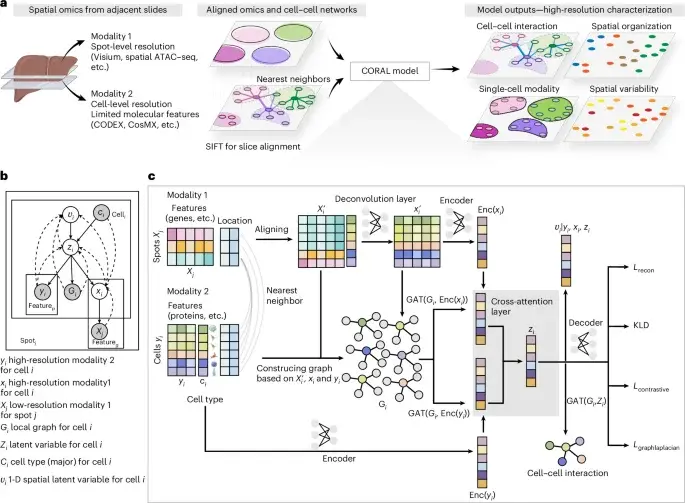
Researchers from Stanford University and MD Anderson Cancer Center have developed CORAL, a probabilistic deep generative model designed to integrate diverse spatial omics data. The tool addresses challenges in aligning datasets with varying resolutions and molecular coverage by using graph attention mechanisms. CORAL was tested on synthetic and experimental data, successfully identifying spatial domains and predicting molecular profiles. In a clinical application, it analyzed hepatocellular carcinoma patients before and after immunotherapy, revealing immune-cell subsets and signaling pathways linked to therapeutic resistance. The study demonstrates the model's ability to resolve tissue organization and multicellular interactions across multiple biological scales.
Key points
- CORAL is a probabilistic deep generative model that utilizes graph attention to integrate spatial transcriptomic, proteomic, metabolomic, and epigenomic data.
- The model addresses the challenge of integrating datasets with different spatial resolutions and molecular coverage by jointly modeling high-resolution and low-resolution data.
- CORAL generates unified representations that combine broad molecular coverage with high spatial resolution, enabling the identification of spatial domains and cell-cell interactions.
- In hepatocellular carcinoma studies, CORAL identified organized immune-cell subsets and signaling pathways associated with resistance to immunotherapy.
- The tool was benchmarked against existing methods like SpatialGlue and MISO, showing superior performance in detecting spatial domains and imputing single-cell molecular profiles.
Background
This development follows recent advancements in spatial omics analysis, such as the VIMA method introduced in October 2026, which uses deep learning to identify disease-specific spatial patterns without manual segmentation. The broader field of spatial omics has seen significant growth, with previous studies highlighting the importance of spatial context in understanding complex biological systems like the brain and tumor microenvironments.
Why it matters
Integrating multi-modal spatial data is critical for understanding complex tissue architectures and disease mechanisms. CORAL provides a unified framework that can handle the heterogeneity of current spatial omics platforms, potentially accelerating the discovery of biomarkers and therapeutic targets. Its application in cancer immunotherapy suggests it could help identify why some patients do not respond to treatment, guiding more personalized medical strategies.
What to watch
The CORAL package and associated code are available on GitHub and Zenodo, allowing researchers to apply the model to their own datasets. Future work may involve expanding the model to other disease types and integrating additional omics modalities to further refine the understanding of tissue organization and cellular interactions.
Want the full story? Read the original reporting
Read on Nature