
Prime assembly enables large-scale, precise gene editing in non-dividing cells
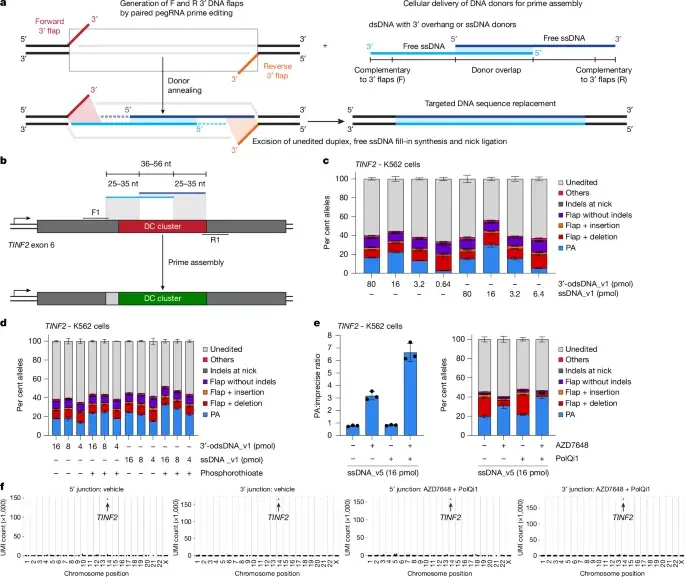
Researchers at Boston Children's Hospital have developed 'prime assembly,' a new genome engineering method that allows for the precise insertion of large DNA sequences into human cells without requiring double-strand breaks or active cell division. Published in Nature, the technique uses CRISPR-targeted flap synthesis to assemble and integrate medium-to-large genomic modifications, offering a potential solution for correcting diverse mutations in genetic disorders. The method demonstrated high specificity and efficiency in primary human cells, including hematopoietic stem and progenitor cells, and outperformed existing platforms in benchmarking tests.
Key points
- Prime assembly utilizes CRISPR-targeted dual flap synthesis to enable site-specific integration of single or double-stranded DNA fragments in human cells.
- Unlike homology-directed repair, the method functions effectively in both dividing and non-dividing cells, expanding its applicability to quiescent primary cells.
- The technique achieved up to 33.1% editing efficiency in exon recoding and successfully integrated transgenes up to 12.1 kb in size.
- Prime assembly demonstrated high genome-wide specificity, with no recurrent guide-dependent off-target integrations observed in initial tests.
- The method supports megabase-scale rearrangements, including deletions, inversions, and translocations, using single-stranded DNA donors to minimize toxicity.
Background
Current therapeutic genome editing faces challenges in installing medium-to-large genomic modifications in therapeutically relevant cells. Existing methods like homology-directed repair are restricted to actively dividing cells, while nuclease-driven double-strand breaks raise safety concerns regarding off-target editing and genomic instability. Prime editing, while precise, is limited to short modifications of less than 250 base pairs. Prime assembly addresses these limitations by leveraging cellular DNA repair pathways to assemble and integrate exogenous DNA without requiring double-strand breaks or cell cycle progression.
How outlets are covering it
The primary source, Nature, provides detailed technical data on the mechanism, efficiency, and specificity of prime assembly, highlighting its advantages over homology-directed repair and other nuclease-based platforms. News-Medical emphasizes the clinical potential of the method, particularly its ability to correct diverse mutations with a single approach and its safety profile compared to untargeted insertion methods. Both sources agree on the significance of the development for gene therapy, but the Nature article focuses on the molecular mechanisms and experimental results, while News-Medical highlights the broader implications for treating genetic disorders and the next steps in clinical translation.
Why it matters
Prime assembly could revolutionize gene therapy by enabling the correction of diverse mutations in genetic disorders with a single, generalizable approach. Its ability to function in non-dividing cells and its high specificity make it a promising tool for developing universal gene-specific solutions for pathogenic mutations. The method's potential to reduce off-target effects and toxicity could lead to safer and more effective gene therapies for a wide range of diseases.
What to watch
The research team plans to further investigate the molecular mechanisms to improve the efficiency and precision of prime assembly. They are also working on improving the delivery of prime assembly components to disease-relevant human cells in vivo, such as hematopoietic stem cells for blood disorder therapies. Additionally, they are exploring applications of prime assembly to deliver genetic payloads as mutation-agnostic therapies for inherited human diseases with unmet clinical needs.
Want the full story? Read the original reporting
Read on Nature