
Voyager 1 Crosses One Light-Day Mark, Extending Signal Delays to 48 Hours
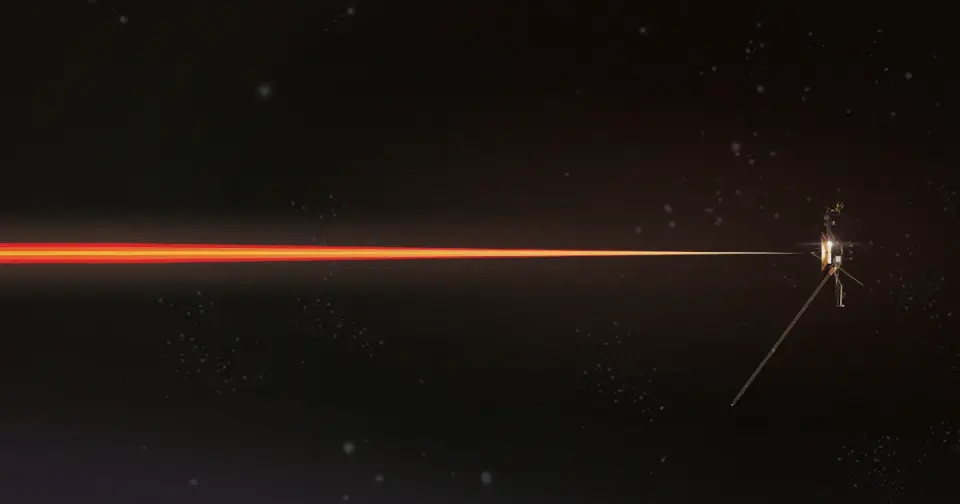
NASA’s Voyager 1 reached a distance of one light-day from Earth on November 18, 2026, marking a historic milestone for the 49-year-old probe. This distance means radio signals now take 24 hours to reach the spacecraft and another 24 hours for a response, creating a 48-hour communication loop. Despite recent technical glitches and dwindling power, the probe continues to transmit data on interstellar magnetic fields and plasma. Engineers at the Jet Propulsion Laboratory confirmed the milestone using trajectory calculations and carrier signals, while the Empire State Building was illuminated in gold to celebrate the achievement.
Key points
- Voyager 1 achieved the one light-day distance on November 18, 2026, at 5:16 a.m. EST, after nearly 50 years of travel.
- The probe is approximately 16.1 billion miles (26 billion kilometers) from Earth, a distance light takes 24 hours to traverse.
- Communication delays have extended to 48 hours total, as signals take 24 hours to reach the probe and 24 hours for the reply to return.
- Voyager 1 recently experienced a 48-hour data glitch, but engineers confirmed the milestone using carrier signals and trajectory calculations.
- The spacecraft continues to study interstellar magnetic fields and plasma, despite losing 4 watts of power annually and having most instruments disabled to conserve energy.
Background
Voyager 1, launched on September 5, 1977, is humanity’s farthest-flying spacecraft. It crossed into interstellar space in 2012, becoming the first human-made object to do so. The probe carries a Golden Record, a gold-plated copper disc containing sounds, images, and greetings in 55 languages, intended as a message to any advanced civilization that might encounter it. Previous archive reports noted concerns about funding risks and the probe’s dwindling power supply, with its radioisotope thermoelectric generators losing power steadily since launch.
How outlets are covering it
My Modern Met and The New York Times emphasized the historic and symbolic significance of the milestone, with NASA officials describing it as a testament to the teams that built and operate the spacecraft. Space.com focused on the technical challenges, noting that Voyager 1’s power is dwindling and that engineers recently executed a power redistribution maneuver to preserve science instruments. Good News Network highlighted the recent data glitch, where the probe stopped sending science data but maintained its carrier signal, and noted the Empire State Building’s gold illumination to celebrate the achievement. All sources agreed on the milestone’s date and distance but differed in emphasis, with some focusing on the scientific implications and others on the engineering challenges and cultural celebrations.
Why it matters
The one light-day milestone underscores the vastness of interstellar space and the resilience of Voyager 1, which continues to operate nearly 50 years after launch. It highlights the growing challenges of deep-space communication, as signal delays extend to 48 hours, and the need for innovative engineering solutions to keep the probe operational. The milestone also serves as a reminder of humanity’s ambition to explore beyond the solar system and the legacy of the Voyager missions, which remain the only human-made objects to reach interstellar space.
What to watch
Voyager 1 is expected to continue transmitting data on interstellar magnetic fields and plasma, though its power is dwindling, and engineers are monitoring the probe’s thermal state and communication stability. Voyager 2, which took a slower trajectory to study Uranus and Neptune, is projected to reach one light-day from Earth in 2035. The mission team is committed to keeping the probe operational as long as possible, with no major changes anticipated until after the 50th anniversary of the launch in August and September 2027. The probe is expected to remain in contact with Earth until 2036, when it may pass beyond the reach of NASA’s Deep Space Network.
- NASA’s Voyager 1 Reaches a Historic Distance of One Light-Day From Earth My Modern Met
- After 49 Years, Voyager 1 Is a Mind-Blowing One Light-Day From Earth The New York Times
- What's next for NASA interstellar Voyager 1 probe after passing 1 light-day from Earth? Space
- Empire State Building Lit Up with Gold Marks Historic Milestone of NASA’s Voyager 1 This Week Good News Network
- Voyager 1 stops sending science data ahead of its light-day milestone — but NASA has a plan to fix it Live Science
Want the full story? Read the original reporting
Read on My Modern Met