
Voyager 2 Marks 49 Years in Space as NASA Prepares Final Power Swap for Voyager 1
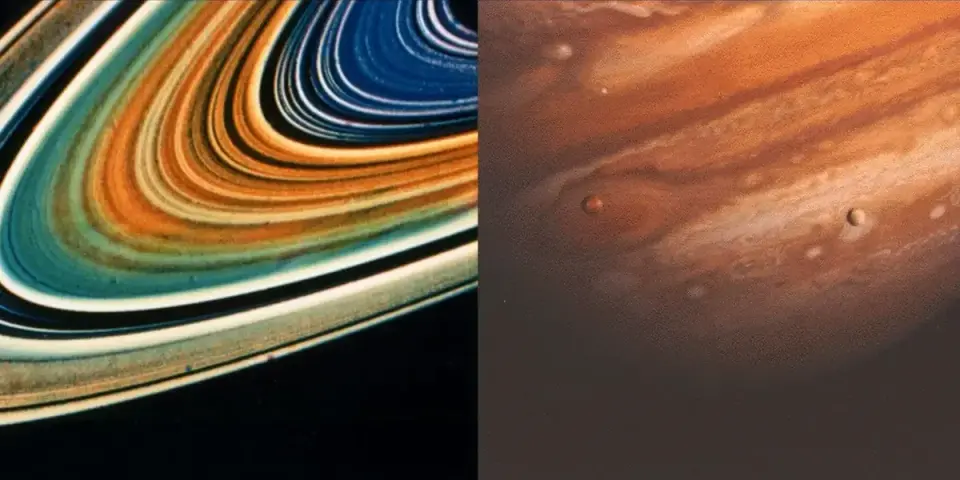
Voyager 2 celebrates its 49th anniversary in interstellar space, having visited all four outer gas giants. After a successful 'Big Bang' power upgrade in August 2026, NASA is preparing a similar update for Voyager 1 to extend its mission into the 2030s.
Key points
- Voyager 2 launched on August 20, 1977, and remains the only spacecraft to visit Jupiter, Saturn, Uranus, and Neptune.
- In August 2026, NASA successfully executed a 'Big Bang' update on Voyager 2, swapping high-power devices for lower-power alternatives to save approximately 10 watts.
- This upgrade preserves necessary heat distribution while extending the probe's operational life by two to three years.
- NASA plans to apply the same power-saving update to Voyager 1 in the coming months to prevent instrument shutdowns.
- Voyager 2 is currently 13.2 billion miles from Earth, while Voyager 1 is 16 billion miles away, with signal delays approaching 20 hours.
Background
The Voyager mission, launched in 1977, was originally designed for a four-year tour but has operated for nearly half a century. Previous archive coverage from August 2026 detailed the initial 'Big Bang' software update on Voyager 2, which reconfigured power loads to conserve energy as the plutonium generators degrade. The probes have faced various technical challenges, including a 2023 communication loss for Voyager 2 and garbled data from Voyager 1 in 2022.
How outlets are covering it
Business Insider emphasizes the historical significance of Voyager 2's 49-year journey and its status as NASA's longest-lived mission, costing over $865 million. ExtremeTech focuses on the technical mechanics of the 'Big Bang' upgrade, highlighting how the swap saves 10 watts of power, equivalent to two to three years of power decay, while maintaining thermal stability. TalkOfTitusville provides a detailed technical breakdown of the launch and subsequent instrument losses, noting that Voyager 2 lost its plasma science instrument in 2024 and its low-energy charged particle experiment in 2025. While Business Insider highlights the visual history of the probes, ExtremeTech and TalkOfTitusville concentrate on the immediate engineering challenges of keeping the aging spacecraft operational.
Why it matters
The success of the 'Big Bang' upgrade demonstrates NASA's ability to extend the life of aging spacecraft through remote reconfiguration. This ensures continued data collection from interstellar space, providing unique insights into the heliopause and the space between stars that cannot be obtained from Earth-based observatories.
What to watch
NASA plans to implement the same power-saving update on Voyager 1 in the coming months. If successful, this could potentially allow the reactivation of the Low-energy Charged Particles instrument on Voyager 1, which was shut down in April 2026.
- See the remarkable photos of NASA's Voyager probes after decades of traveling through the solar system Business Insider
- Inside NASA’s ‘Big Bang’: A Daring Plan to Keep the Distant Voyagers Alive The New York Times
- On this day in space! Aug. 20, 1977: Voyager 2 launches to the outer planets Space
- NASA's Quest to Upgrade the Voyager Probes From 16 Billion Miles Away extremetech.com
- Forty-Nine Years Later, Voyager 2 Continues Trekking To The Stars TalkOfTitusville.com
Want the full story? Read the original reporting
Read on Business Insider