
Dark Matter Clump Distorts Jet of Feeding Black Hole, Offering Neutrino Clues
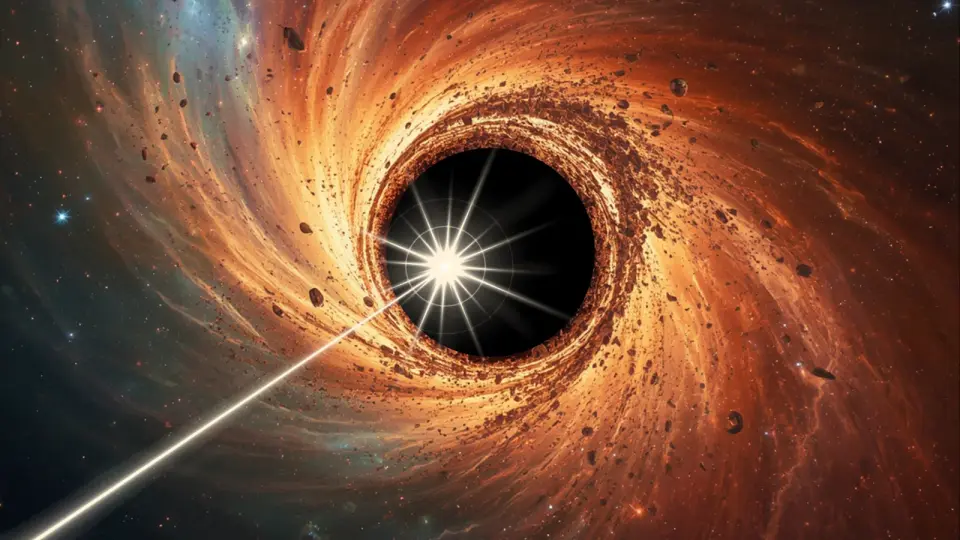
Astronomers have detected that a plasma jet from the supermassive black hole in blazar PKS 2233-148 is being gravitationally lensed by an unseen clump of dark matter. This discovery provides a potential method to trace the origin of cosmic neutrinos, which are difficult to detect due to their lack of charge and minimal mass. By analyzing the distortion of the jet, researchers aim to confirm that blazars act as cosmic accelerators for these ghost particles.
Key points
- The plasma jet from blazar PKS 2233-148 is being bent by the gravity of a dark matter clump.
- This gravitational lensing effect could help identify the source of neutrinos, which are hard to trace.
- Blazars are suspected to be cosmic accelerators that generate neutrinos, but this link has been difficult to prove.
- The discovery of this lensing phenomenon offers a new way to study neutrino emission from supermassive black holes.
Background
Recent studies have highlighted the complex feeding cycles of supermassive black holes, such as the self-sustaining gas flows observed in NGC 4696 and the rapid accretion phases seen in SDSS J110546.07+145202.4. Additionally, research into ancient black holes has suggested they may be linked to dark matter and early universe formation. These findings provide a backdrop for understanding how black hole jets and dark matter interact in the cosmos.
Why it matters
Understanding the relationship between dark matter and black hole jets could solve the mystery of neutrino origins. Neutrinos are nearly impossible to detect and trace, but if blazars are confirmed as their source, it would revolutionize our understanding of cosmic particle acceleration and the role of dark matter in shaping the universe.
What to watch
Researchers will continue to study the lensing effects on blazar jets to confirm the link between blazars and neutrino production. This could lead to new methods for detecting and tracing neutrinos, providing insights into the behavior of supermassive black holes and the distribution of dark matter.
Want the full story? Read the original reporting
Read on Space