
JWST Analysis Reveals 3I/ATLAS as a Dusty, Ancient Interstellar Time Capsule
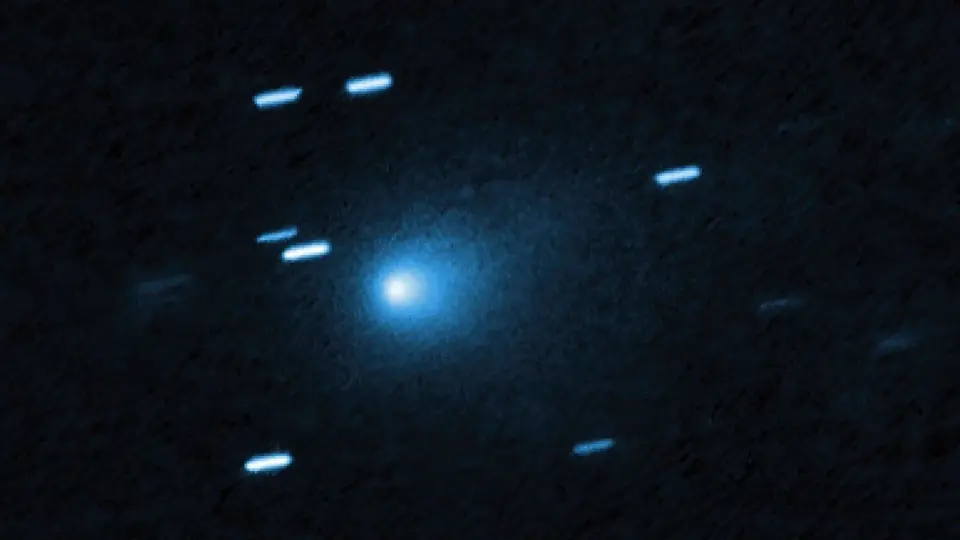
The James Webb Space Telescope (JWST) has provided new insights into the composition and origins of interstellar comet 3I/ATLAS, discovered in July 2025. Analysis indicates the comet is composed of sub-micron grains of dirty water-ice mixed with dust, differing from the cleaner ice found in solar system comets. Its spectrum resembles trans-Neptunian objects (TNOs), suggesting it formed in a cold, ancient environment. Further studies reveal high deuterium-to-hydrogen ratios and amorphous silicates, pointing to an origin in a low-metallicity protostellar disk potentially 10 to 12 billion years ago, predating our solar system.
Key points
- JWST spectroscopy shows 3I/ATLAS lacks 1.5 and 2-micron absorption lines typical of solar system comets, indicating its ice grains are heavily mixed with dust.
- The comet’s composition resembles trans-Neptunian objects (TNOs), suggesting common building blocks for planetary formation across different star systems.
- Analysis of methane isotopes reveals a deuterium-to-hydrogen ratio 13 times higher than comet 67P/Churyumov-Gerasimenko, implying formation in a cold, high-radiation environment.
- JWST/MIRI data confirms the presence of amorphous silicates, specifically pyroxene, with minimal crystalline content, indicating little thermal processing since formation.
- The findings suggest 3I/ATLAS formed in a planet-forming disk around a young star 10 to 12 billion years ago, potentially before the Sun’s ignition.
Background
3I/ATLAS is the third confirmed interstellar object entering our solar system, following 1I/'Oumuamua (2017) and 2I/Borisov (2019). Previous coverage highlighted its status as a pristine time capsule, with earlier studies focusing on its volatile composition and mass-loss models. The current findings expand on this by detailing the specific mineralogy and isotopic signatures that link it to ancient stellar nurseries.
How outlets are covering it
While all sources agree on the comet’s interstellar origin and ancient age, they emphasize different aspects of its composition. The primary source (Space) focuses on the dust-to-ice ratio and the similarity to TNOs, highlighting the 'dirty' nature of its ice grains. ScienceAlert emphasizes the isotopic evidence, specifically the high deuterium-to-hydrogen ratio in methane, which points to formation in a cold, low-metallicity environment with high cosmic ray irradiation. Astrobiology Web focuses on the mineralogical structure, noting the presence of amorphous silicates and the absence of crystalline structures, which supports the theory that the material has not undergone significant thermal processing. Together, these perspectives paint a picture of a body formed in a unique, ancient environment that preserves conditions from the early universe.
Why it matters
The study of 3I/ATLAS provides a rare opportunity to analyze material from another star system, offering insights into the conditions of planet formation in the early universe. By comparing its composition to solar system bodies, scientists can determine if the building blocks of planets are universal or vary across different stellar environments. This helps refine models of how planetary systems form and evolve, potentially revealing why our solar system’s composition differs from others.
What to watch
Researchers will continue to monitor 3I/ATLAS as it exits the solar system, using data to refine models of its formation and trajectory. Further analysis of its isotopic and mineralogical composition may reveal more about the conditions in its home star system. Additionally, the findings may inform the search for other interstellar objects and the development of models for planetary formation in diverse environments.
- JWST uncovers new clues about the origins of 'interstellar invader' comet 3I/ATLAS Space
- Heavy hydrogen in 3I/ATLAS's methane points to a frigid birthplace Phys.org
- Interstellar Visitor 3I/ATLAS Just Got Even Weirder, And May Contain 10-Billion-Year-Old Material ScienceAlert
- JWST/MIRI Observations of Amorphous Silicates In Interstellar Comet 3I/ATLAS Astrobiology Web
- JWST detects dusty ice grains in the coma of 3I/ATLAS — Space.com UA.NEWS
Want the full story? Read the original reporting
Read on Space