
NASA Highlights Interplanetary Eclipses on Jupiter and Mars Ahead of Earth Event
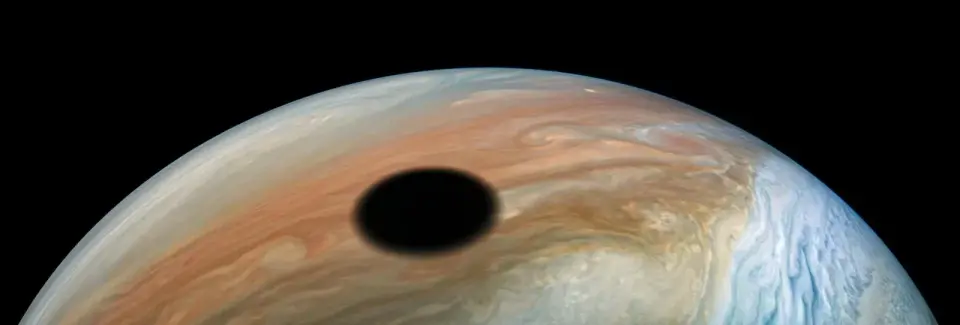
NASA shared images of solar eclipses on Jupiter and Mars, highlighting how moons block sunlight across the solar system. While Jupiter’s large moons create total eclipses, Mars’s small moons only cause partial transits. These events help scientists study orbital dynamics and atmospheric conditions.
Key points
- Jupiter’s Galilean moons, particularly Io, cast large shadows that create total solar eclipses visible from the planet’s cloud tops.
- NASA’s Juno spacecraft captured a high-resolution image of Io’s shadow on Jupiter in September 2019, measuring approximately 2,200 miles wide.
- Mars experiences partial solar transits due to its small moons, Phobos and Deimos, which are too small to fully cover the Sun.
- NASA’s Perseverance rover recorded Phobos transiting the Sun from Jezero Crater in September 2024, aiding in the measurement of orbital decay.
- Eclipse observations across the solar system provide data for testing physical laws, analyzing atmospheres, and tracking long-term orbital changes.
Background
Recent astronomical observations have focused on the Sun’s influence and the dynamics of celestial bodies. While the Sun dominates the solar system’s mass, its light is frequently blocked by moons, creating shadows that serve as tools for scientific measurement. Previous studies have utilized eclipse data to confirm theories of general relativity and refine orbital models, extending these methods to other planets to understand broader physical laws.
How outlets are covering it
Futura-Sciences emphasizes the scientific utility of eclipses, noting how they allow researchers to test physical laws and track orbital decay, such as Phobos’s inward pull on Mars. It highlights the 1973 Concorde flight that extended solar observation time. Mashable India focuses on the visual spectacle and the comparative nature of eclipses, noting that Jupiter has 115 recognized moons and that Mars’s moons are too small for total eclipses. Both sources agree on the basic mechanics but differ in emphasis, with Futura-Sciences prioritizing historical and scientific application, while Mashable India highlights the visual and comparative aspects for a general audience.
Why it matters
Understanding eclipses on other planets helps scientists refine models of orbital mechanics and atmospheric science. The data from these events, such as the decay of Phobos’s orbit, provides insights into the long-term stability of planetary systems and the physical laws governing celestial motion.
What to watch
Future missions to Mars and Jupiter may provide more detailed observations of these eclipse events, potentially offering new insights into atmospheric conditions and orbital dynamics. Continued monitoring of Phobos’s orbital decay will help predict its eventual impact or disintegration.
- What really happens on planets where the Sun suddenly vanishes from view Futura, le média qui explore le monde
- Other Planets Got Total Solar Eclipses Too? NASA Shares Surya Grahan From Jupiter and Mars [WATCH] Mashable India
Want the full story? Read the original reporting
Read on Futura, le média qui explore le monde