Tag

Cme

All articles tagged with #cme

X1.1 solar flare after M5.8 storm warning raises CME-space-weather prospect
space-weather10 days ago

X1.1 solar flare after M5.8 storm warning raises CME-space-weather prospect

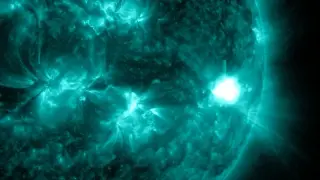
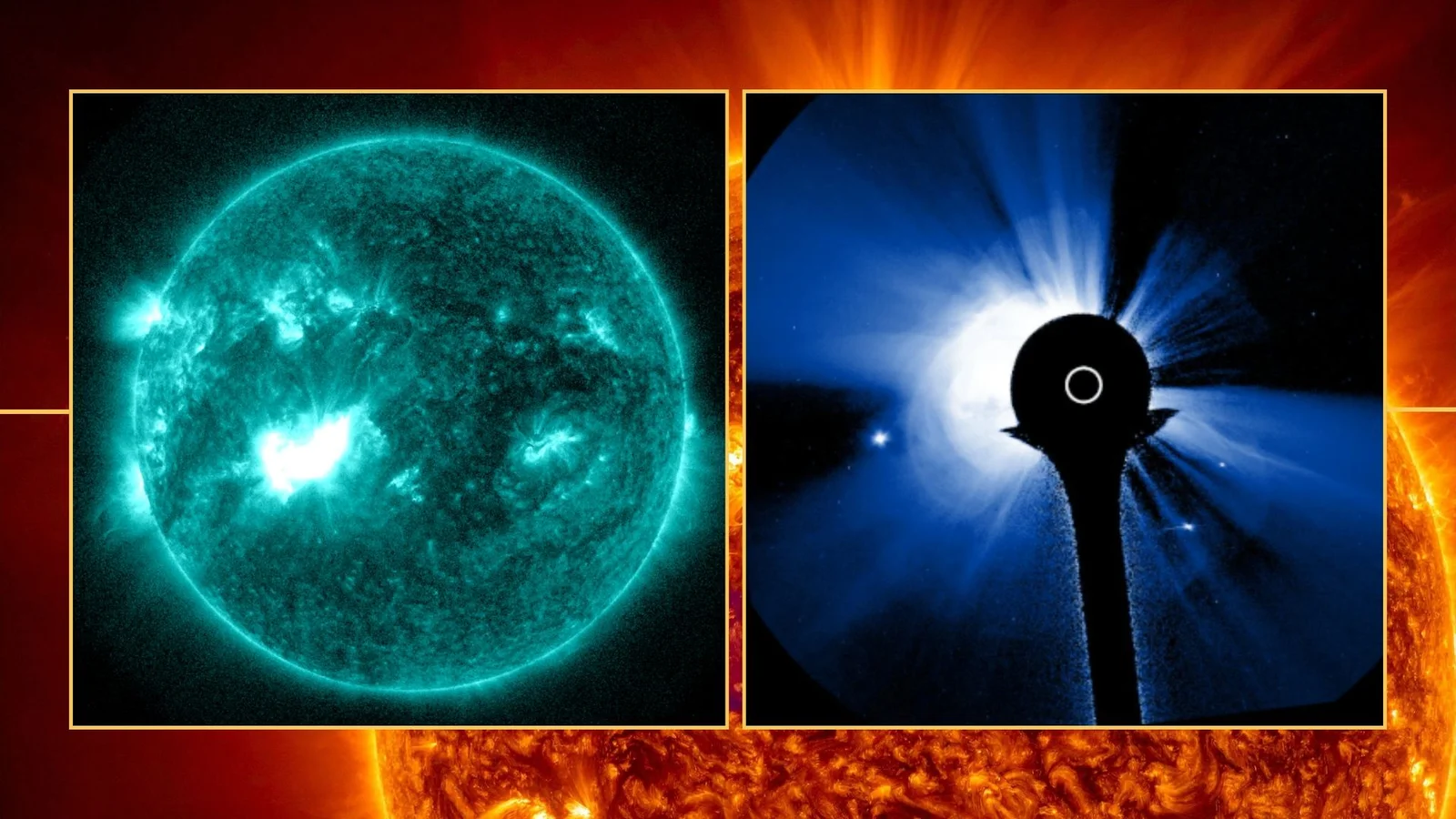
A moderate M5.8 solar flare from AR 4475 on June 29 prompted an S1 solar radiation storm warning (issued 16:00 UTC, canceled 16:36 UTC) with no CME detected at that time, though Western-limb location kept Earth at risk for energetic particles. Later, an Earth-facing X1.1 flare from AR 4479 near the solar disk center at 20:50 UTC produced a strong radio blackout (R3) and emitted Type II and IV radio bursts, with analysts awaiting coronagraph data to confirm any Earth-directed CME. Space‑weather conditions were quiet for now, but CME activity from later flares could bring unsettled to active conditions on June 30 into July 1, potentially triggering minor geomagnetic activity on approach of any CME.

Solar storm could turn the night sky into a canvas across parts of the U.S.
space1 month ago

Solar storm could turn the night sky into a canvas across parts of the U.S.

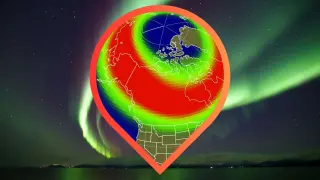
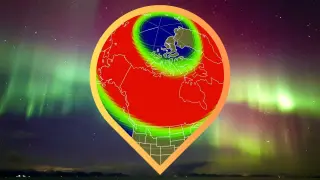
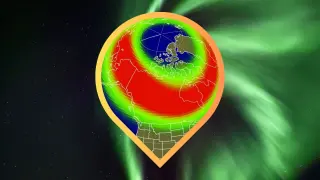
An incoming coronal mass ejection could hit Earth's magnetic field today, possibly triggering geomagnetic storms from G1 to G3 and boosting auroras into mid-latitudes across the northern U.S.; the strongest activity is expected 11 a.m.–2 p.m. EDT, with elevated chances into the evening, and auroras could be visible as far south as northern Michigan, Maine, New York, Idaho, Illinois, and Oregon depending on conditions. NOAA has issued a G3 watch for June 8 and a G2 watch for June 9.

Three CMEs Could Spark a Northern Lights Show Across the U.S. Tonight
space1 month ago

Three CMEs Could Spark a Northern Lights Show Across the U.S. Tonight

Three coronal mass ejections are racing toward Earth and could produce glancing geomagnetic storms over the next few days, raising the odds of seeing the northern lights across parts of the northern United States tonight and possibly into May 20. If conditions peak at G1, viewers in Alaska, Washington, Montana, North Dakota, Minnesota, Michigan and Maine may spot auroras; with a stronger G2, Idaho and New York could join the show. Most CMEs will miss Earth, but lingering solar wind from a coronal hole could boost geomagnetic activity. The best viewing window is a few hours around local midnight in clear, dark skies away from light pollution, though visibility remains unpredictable depending on magnetic field alignment.

Sun unleashes massive flare as Earth faces CME and potential Northern Lights displays
space1 month ago

Sun unleashes massive flare as Earth faces CME and potential Northern Lights displays

A massive solar flare produced a coronal mass ejection (CME) traveling toward Earth at roughly 650 km/s. The CME is expected to pass by Earth, possibly with a glancing impact late on May 12–13 UTC, potentially triggering auroral displays and light shows across northern latitudes. Met Office and NOAA are monitoring the situation, noting patchy UK cloud but the chance of Northern Lights across northern Scotland and similar latitudes.

science5 months ago

CME Arrival Triggers G4 Geomagnetic Storm Watch for Jan 20

NOAA’s Space Weather Prediction Center has issued a G4 (Severe) Geomagnetic Storm Watch for January 20 due to a coronal mass ejection released January 18 in association with an energetic solar flare; the CME is expected to reach Earth from late January 19 to early January 20, with storm levels potentially ranging from G1 to G3 upon arrival and the passage likely continuing through January 20, with residual effects possible on January 21. Forecasters have a fair degree of confidence in the timing and will provide updates as conditions evolve.

Earth-ward CME from X-class flare could spark auroras within 24 hours
space5 months ago

Earth-ward CME from X-class flare could spark auroras within 24 hours

An X1.9 solar flare from the Sun triggered a fast Earth-directed coronal mass ejection (CME) forecast to reach Earth within about 24 hours. If the CME’s magnetic orientation (Bz) is southward, it could couple with Earth’s magnetosphere and drive strong (G3) to severe (G4) geomagnetic storm conditions, potentially lighting up auroras as far south as parts of the U.S. (e.g., Northern California to Alabama). Forecasters caution that CME arrivals are hard to pin down and depend on magnetic orientation; disruptions to satellites, GPS, and radio signals and increased atmospheric drag on spacecraft are possible alongside spectacular auroral displays depending on the event’s exact geometry and timing.