A new method called Full-Partial Reconstruction Mapping (FPRM) uses machine learning to fill in missing data in complex systems. It works even when 90% of variables are missing, outperforming traditional techniques.
A new mathematical model explains how ant colonies synchronize activity bursts without a leader, identifying a phase transition triggered by a single 'first mover' ant. The study, published in PRX Life, suggests this mechanism could inform decentralized robot swarm design.
A study in PNAS Nexus uses stemmata (family trees of manuscripts) and computer simulations to estimate losses in medieval writing, finding that up to 60% of medieval literary works and more than 95% of manuscripts have vanished over the centuries. By modeling copying, destruction, and random disasters (e.g., fires, wars, Black Death), researchers show that texts were most at risk early on and that surviving copies typically stem from later branches; the original forms of famous works like the Song of Roland may be gone. The approach could help quantify losses in other historical texts as well.
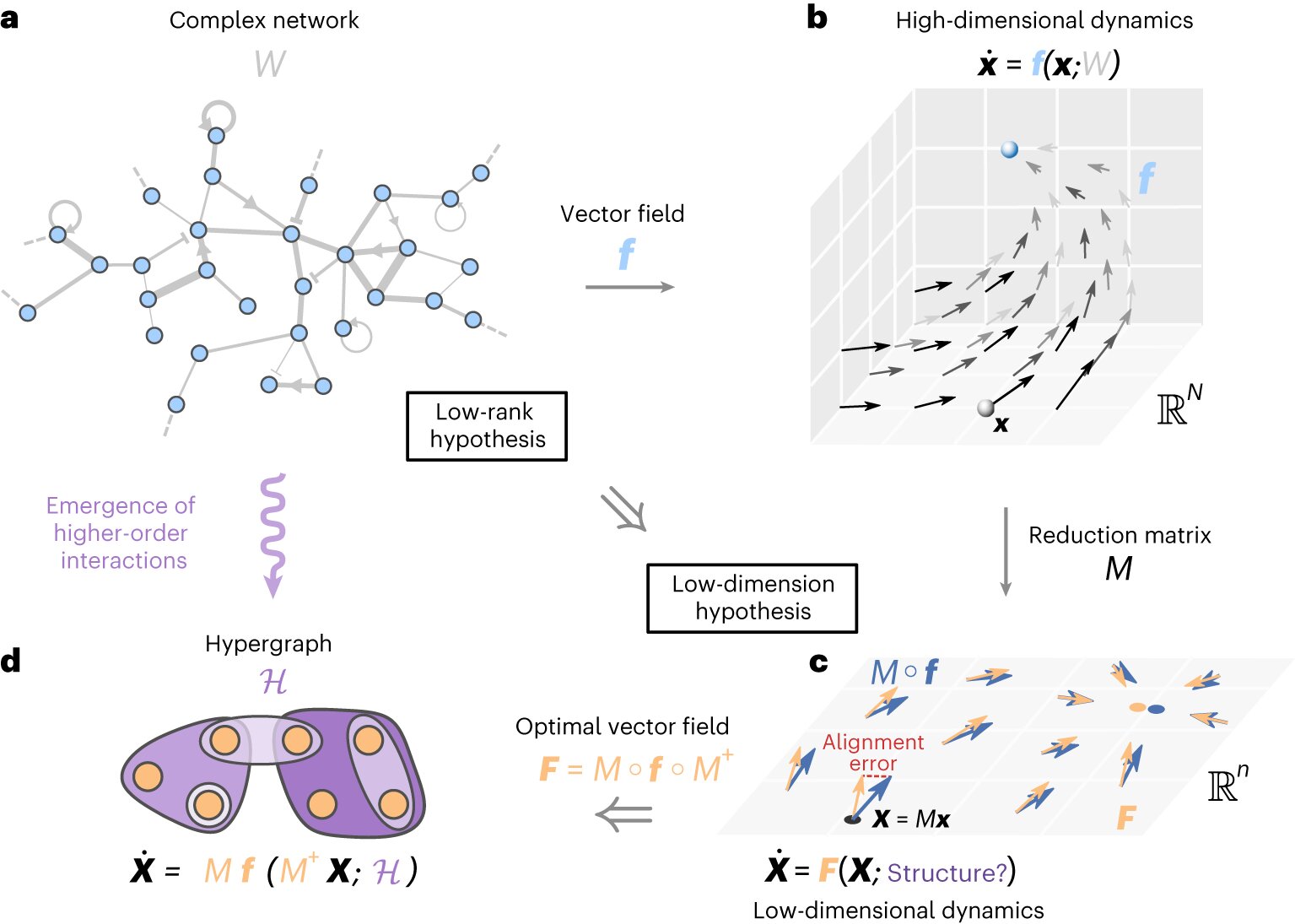
Scientists have investigated the low-rank hypothesis in complex systems, finding that despite high-dimensional nonlinear dynamics, many real networks exhibit rapidly decreasing singular values, supporting the feasibility of effective dimension reduction for understanding and modeling complex system behaviors. The study, published in Nature Physics, aims to address the challenge of understanding large-scale behavior in complex systems by exploring the intrinsic simplicity of these systems and finding an optimal dimension for simplifying models. The researchers sought to validate the low-rank hypothesis using singular value decomposition, a powerful mathematical tool from linear algebra.
Scientists have proposed a "missing" scientific law called the "law of increasing functional information" that applies to the evolution of life, minerals, planets, stars, and other systems in the universe. The law states that systems evolve and become more complex over time when different configurations undergo selection for one or more functions. This law expands on Darwin's theory of evolution by suggesting that non-living systems also evolve based on improved function. While some scientists praise the study as transformative, others argue that the emergence of diverse materials and structures in the inanimate world does not require a new underlying principle.
Scientists and philosophers have identified a missing law of nature that recognizes evolution as a common feature of complex systems in the natural world. The "Law of Increasing Functional Information" states that complex systems evolve to states of greater patterning, diversity, and complexity through selection for function. This law applies to various systems, including life, stars, atoms, minerals, and more. The research expands on Darwinian evolution and offers insights into the generative forces behind complex phenomena in the universe. It also has implications for understanding the potential complexity of evolving systems, influencing the rate of evolution, and aiding the search for life elsewhere.
Network science, a branch of mathematics that studies complex systems, has revealed that many real-world networks, such as the internet and metabolic networks, follow a scale-free architecture rather than a random one. This means that they are not governed by averages and that hubs, or highly connected nodes, emerge naturally. The growth of these networks is driven by preferential attachment, meaning that new nodes tend to connect to already highly connected nodes. Network science offers a framework for understanding the architecture of complex systems that emerge from the interaction of many components.
Researchers from Bar-Ilan University in Israel have solved the diversity-stability paradox, a 50-year-old puzzle in ecology, by showing that the heterogeneity of interaction patterns in social, biological, and technological networks enhances stability and makes them extremely robust against external forces. Large and heterogeneous complex networks not only can be stable, but, in fact, they often must be stable. This discovery can offer new guidelines for designing stable infrastructure networks that can protect against viable threats and strengthen the resilience of crucial ecosystems.