US high-grade corporate bonds have rallied recently, offering yields near 6%, as investors seek stability after stock market turbulence linked to Nvidia’s leadership crisis and rising inflation concerns.
Broadcom is arranging a $63 billion financing package to fund AI chips for Anthropic, with banks planning to issue up to $21 billion in high-grade bonds by early 2027. The deal, structured through a special purpose vehicle, includes $42 billion in senior secured debt backed by Broadcom, while Blackstone anchors the remaining $9 billion. This transaction serves as a critical test of investor appetite for AI-related debt, occurring amid broader market caution and a surge in global AI borrowing that has exceeded $455 billion this year.
Paramount Skydance issued $52bn in investment-grade bonds to fund its Warner Bros. acquisition despite a recent downgrade to junk status. The deal relies on a first-lien charge and a deleveraging commitment from the Ellison family to maintain investment-grade ratings, but market reception has been mixed.
Paramount Skydance is paying premium rates to fund its $110 billion acquisition of Warner Bros Discovery, launching a record-breaking $52 billion financing package to close the deal before a September 30 deadline. The merger, which clears regulatory hurdles, will leave the combined entity with approximately $80 billion in net debt, prompting concerns about high leverage and potential credit downgrades.
The AI infrastructure buildout is driving record corporate bond issuance, pushing the 10-year Treasury yield to 5.17% and raising borrowing costs for data center developers. While hyperscalers like Amazon and Microsoft can absorb higher rates, smaller firms face tighter financing, with some delaying projects to manage expenses.
AI-driven capital expenditure is pushing U.S. Treasury yields higher, driven by massive, often off-balance-sheet debt structures. Goldman Sachs estimates $1.5 trillion in lease commitments, with $1 trillion not yet reflected in financial statements. This hidden leverage, combined with rising bond issuance, is increasing borrowing costs and market scrutiny.
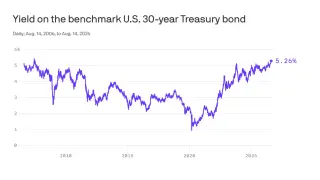
The 30-year U.S. Treasury yield reached 5.26%, its highest level since 2007, despite low inflation. Rising yields are driven by a widening federal deficit, heavy corporate borrowing by AI firms, and uncertainty over Federal Reserve policy under Chair Kevin Warsh. These higher borrowing costs could dampen economic activity and increase the cost of mortgages and business loans.
A consortium of banks led by Morgan Stanley is planning to refinance $15 billion in debt for a Google-backed data center in Texas leased to Anthropic. The move aims to reduce AI risk exposure on bank balance sheets and free up lending capacity. The debt will be split into multiple bond sales, with some portions potentially moving to the leveraged loan market. The project, developed by Nexus Data Centers, will house Google's custom TPU chips and is backed by Google, though the bond is expected to carry a speculative-grade rating due to construction risks.
SpaceX’s $25 billion debt deal triggered a sell-off in its bonds, with 10-year yields rising toward 6% and spreads over Treasuries widening to about 1.6 percentage points, pushing some long-dated issues closer to junk levels despite an investment-grade rating. Long maturities 2046 and 2056 showed larger spreads (about 1.93 and 2.01 points). The move underscores investor concerns about SpaceX’s cash flows, after a 2025 loss of $4.9 billion on $18.7 billion in revenue, even as an IPO this month valued the company near $1.78 trillion on AI-growth expectations. Analysts caution bond investors focus on cash flow over equity upside and flag governance/succession concerns, with some noting the scenario as indicative of bubble territory.
SpaceX’s $25bn bond sale, coming soon after its record IPO, has Allianz CIO Ludovic Subran warning that markets are in bubble territory. While demand was strong, SpaceX faces a higher cost of borrowing than peers, and investors remain wary of a flood of big deals amid record stock prices and still-loose credit conditions, suggesting frothier markets despite a resilient economy.
SpaceX is selling $25 billion of bonds to institutional investors at yields of about 1.1 to 1.75 percentage points above US Treasuries for five to 30-year maturities, after demand rose enough to upsize the issue from $20 billion. The deal, rated Baa1 by Moody’s, will fund repayment of a bridge loan tied to the xAI/X merger, underscoring investors’ willingness to back Musk’s AI and space bets despite heavy cash burn and longer‑term risk concerns. Demand leaned toward shorter maturities, and issuance comes as tech AI deals flood the market and investors weigh longer-term risks against near-term growth prospects.
Investors are demanding yields above Oracle’s 2040 bonds to back a $14bn Oracle-backed data-centre project in Saline Township, Michigan, as part of a $300bn OpenAI compute deal. Although some buyers want extra protections due to Oracle’s hefty AI spending and construction risk, the order book remains robust with Bank of America leading the sale in the 144A market; Pimco is expected to anchor, and Blackstone may contribute equity, signaling a potential rise in project-level debt financing without tech equity stakes.
The US national debt has surpassed $38 trillion, with a significant increase in corporate bond issuance, especially from tech hyperscalers, raising concerns about upward pressure on interest rates and potential market fragility. The growing competition for bond investors and shifting investor composition, from foreign governments to profit-driven entities, could threaten the stability of US financing and increase borrowing costs amid rising deficits and political debates over spending and tariffs.
Investors are increasingly viewing large corporations like Microsoft and Airbus as safer investments than governments due to rising sovereign debt, fiscal backsliding, and erosion of the perceived rule of law, leading to a shift in bond market dynamics where corporate bonds often offer lower yields than government bonds.
Investor demand for corporate bonds has surged, with about $50 billion of bonds sold in the past two weeks to finance acquisitions and spinoffs, marking a steep surge in M&A financing after the slowest year for dealmaking in a decade. US corporate investment-grade bond sales are set to surpass $60 billion for the first time in nearly two years, with some $276 billion of pending M&A activity potentially needing financing.