Tag

Infrared Astronomy

All articles tagged with #infrared astronomy

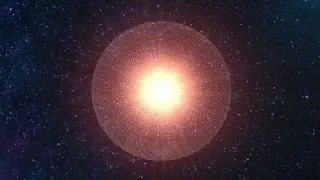
Planetary collision near Gaia20ehk may mirror Earth's Moon formation
science29 days ago

Planetary collision near Gaia20ehk may mirror Earth's Moon formation

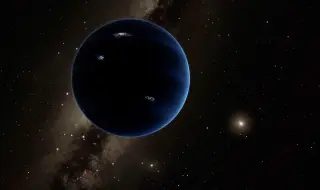
Astronomers have captured signs of a catastrophic collision between two planets orbiting Gaia20ehk, a sunlike star roughly 11,000 light-years away; the event, inferred from dips in visible light and a surge in infrared emission, suggests a planet-on-planet smash and may mirror the giant impact that formed Earth’s Moon, providing a rare look at planet formation and hinting Rubin Observatory could find more such events in the next decade.

Interstellar Comet 3I/ATLAS Flare Reveals Molecules From Another Star
space2 months ago

Interstellar Comet 3I/ATLAS Flare Reveals Molecules From Another Star

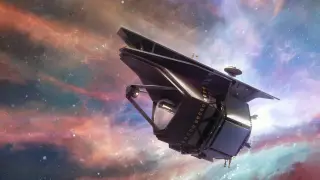
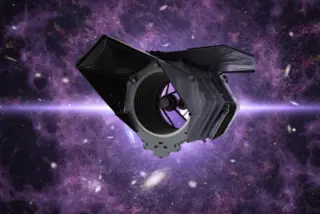
NASA’s SPHEREx infrared telescope observed interstellar comet 3I/ATLAS flare up as it was exiting the solar system in December 2025, revealing a coma rich in water vapor, carbon dioxide and complex organics (including methane, methanol and cyanide) and a pear-shaped dust tail. The observations suggest sunlight penetrated buried ices, triggering a delayed release of materials formed around another star. 3I/ATLAS is only the third confirmed interstellar object, discovered in 2025, with the findings published in February 2026 in the Research Notes of the American Astronomical Society.

Webb sharpens its view of a black hole's dusty feeding disk
space2 months ago

Webb sharpens its view of a black hole's dusty feeding disk

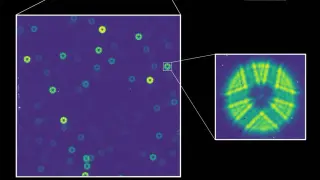
JWST’s high-contrast observations of the Circinus galaxy reveal the clearest view yet of the dusty torus feeding its central supermassive black hole. About 87% of the infrared emission comes from the inner disk near the hole, less than 1% from the outflow known as the North Arc, and ~12% from dust farther out. The findings, based on two 2024–2025 Webb observations using a seven‑aperture setup, provide an effective resolution like a 13‑meter telescope and challenge decades of outflow‑driven infrared models, confirming the torus as the primary fuel reservoir for black hole growth. The study was published Jan. 13 in Nature Communications.

JWST reveals brown dwarfs in Westerlund 2: a stellar nursery’s hidden population
space2 months ago

JWST reveals brown dwarfs in Westerlund 2: a stellar nursery’s hidden population

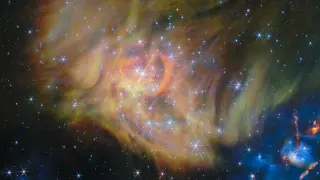
JWST’s infrared portrait of Westerlund 2, a young, massive star cluster about 20,000 light-years away in Gum 29, shows thousands of stars and brown dwarfs—“failed stars” too light to fuse—identified via methane and PAH emission. The discovery sheds light on ongoing star formation and how planet-forming disks around massive stars evolve, offering a new window into the life cycles of stars in our galaxy.

Webb Reveals Dust Feeding Circinus Black Hole, Upending Core Emission Views
space2 months ago

Webb Reveals Dust Feeding Circinus Black Hole, Upending Core Emission Views

Webb’s Aperture Masking Interferometer on NIRISS allowed a high‑contrast look at Circinus’ core, yielding the sharpest view yet of a black hole’s surroundings. The study finds roughly 87% of the near‑infrared emission comes from hot dust near the black hole’s torus rather than from outflows, overturning decades of models that emphasized outflows. This marks the first extragalactic infrared interferometry in space and demonstrates Webb’s ability to double effective resolution in a focused region, offering a technique to study other bright black holes and build a broader picture of accretion versus outflow contributions.

Origins of Cosmic Dust
science7 months ago

Origins of Cosmic Dust

Cosmic dust, composed mainly of small particles of silicates, ices, and metals, originates from processes like supernova explosions, stellar outflows, and planetary nebulae, but the primary source of the universe's dust appears to be core-collapse supernovae, which produce large amounts of dust that can survive destructive processes, playing a crucial role in star and planet formation.