
Ancient Irish cave art could rewrite Ireland’s earliest human story
Researchers have identified 15,000-year-old cave art in Ireland, potentially reshaping what we know about Ireland’s earliest inhabitants and the development of prehistoric art.

All articles tagged with #early humans
Researchers have identified 15,000-year-old cave art in Ireland, potentially reshaping what we know about Ireland’s earliest inhabitants and the development of prehistoric art.

A new study reports the earliest direct evidence that early humans butchered elephants at Olduvai Gorge, Tanzania, about 1.8 million years ago, with stone tools found alongside Elephas recki bones. The findings suggest a strategic, meat-rich subsistence and a shift toward larger, more complex occupation sites in the early Pleistocene.

A new study reports the earliest direct evidence that early human ancestors butchered elephants about 1.8 million years ago at Tanzania’s Olduvai Gorge, where stone tools were found alongside bones of Elephas recki. The findings suggest deliberate, systematic processing of megafauna and a food surplus that would have aided survival, signaling a major ecological and technological shift with larger, more complex occupation sites rather than opportunistic scavenging.
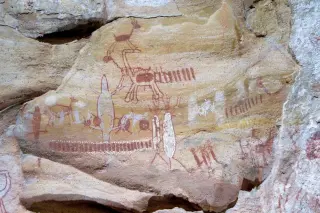
At the Santa Elina rock shelter in Brazil, researchers report three giant sloth osteoderms that were modified into artifacts, probably pendants, in a layer dated to about 25,000–27,000 years ago—potentially signaling earlier human presence in South America. The finding bolsters discussions of early dispersals and challenges Monte Verde II’s dates, but the claim is contested and some experts warn that natural processes can mimic such modifications; ancient DNA studies still point to a complex, multi-route peopling of the Americas with first entry roughly 16,000–23,000 years ago.

A non-invasive analysis of Wonderwerk Cave in South Africa finds burnt bones and heated remains dating from about 1.07 to 1.79 million years ago, likely linked to Homo erectus, well inside the cave rather than at the entrance. This suggests early humans actively used and possibly transported and maintained fire, pushing back the timeline for controlled fire use; researchers used bone fluorescence to distinguish true fire alteration from other changes, with findings published in PLOS One.

A new PLOS One study finds repeated burning in Wonderwerk Cave deposits dated to about 1.07–1.79 million years ago, among the oldest known records of hominin fire use. By analyzing 161 small-mammal bones with FTIR and bone luminescence, researchers detected heating deep inside the cave (at least 30 meters in) in distinct clusters, suggesting early Homo erectus populations carried and maintained fire for warmth, light, and protection—well before cooking became widespread.
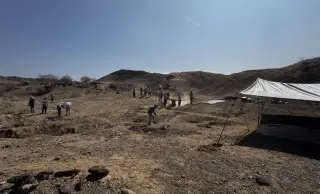
In Ethiopia's Afar Rift, burned bones dating to about 100,000 years ago may be the oldest evidence of cremation, implying early Homo sapiens engaged in or encountered cremation. The site also reveals thousands of stone tools and obsidian artifacts, indicating repeated visits and mobility shaped by seasonal floods, challenging climate-change–driven migration theories.
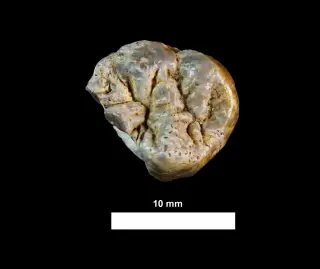
Analysis of over 1,000 bones from FwJj 80 in Kenya’s Koobi Fora Formation shows cut marks and marrow-extraction damage from stone tools, indicating early Homo butchered carcasses and transported prime meat away from kill sites across diverse habitats. This suggests planning and flexible foraging that could have supported higher energy needs for brain growth and social cooperation, with patterns similar to older sites like FLK Zinj and Kanjera South, pointing to continuity in meat-use strategies across landscapes.

A 1.6-million-year-old fossil assemblage from Koobi Fora, Kenya shows early Homo used a mixed strategy to access meat—both scavenging and hunting—transporting the meatiest parts for processing and later breaking bones for marrow, suggesting meat consumption evolved gradually in response to ecological conditions.

A Science Advances study reconstructing 74,000 years of sub-Saharan Africa climate finds prehistoric hunter-gatherers avoided malaria hotspots, especially Central West Africa, long before farming, suggesting malaria shaped where early humans lived and moved.
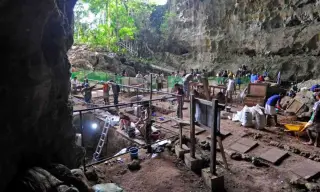
Archaeologists find evidence that around 40,000 years ago, early humans around Mindoro crossed open seas to coastal sites, forming long-lasting maritime lifeways and networks that spread tools, plant-working techniques, and knowledge across the Philippine archipelago, with robot-assisted excavation helping preserve fragile clues and illuminate deliberate sea crossings rather than random drift.
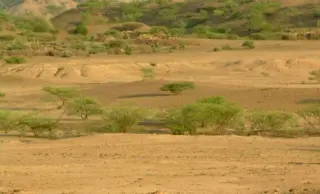
Archaeologists at Halibee in Ethiopia’s Afar Rift have uncovered 100,000-year-old human remains, thousands of basalt stone tools, and diverse animal bones, indicating repeated, non-permanent visits by early Homo sapiens to a resource-rich savannah-woodland landscape long before their expansion into Eurasia; the site preserves three human remains with different post-mortem histories and suggests a pattern of occupation rather than a single burial, with most animals not clearly butchered and some exchange inferred from a small fraction of non-local obsidian, all exposed by erosion and discussed in a PNAS study.

Researchers analyze chemical traces in fossil tooth enamel from Ethiopia’s Afar region to reconstruct how landscapes and diets changed over the past ~4 million years. Enamel preserves signals of what plants ancient animals ate, revealing forests, wetlands, and grassy plains that expanded into open savannas around 2–3 million years ago. The data suggest early hominins like Australopithecus afarensis had flexible, mixed diets, and that environmental shifts helped drive human evolution, including tool use and upright walking.

Researchers analyzing wood remains from the Marathousa 1 site in central Greece report two wooden fragments dating to about 430,000 years ago that show shaping and wear consistent with human use (one alder digging/bark-stripping tool; another willow or poplar fragment). A third alder piece bears carnivore marks, not human modification. Together with stone tools and butchered animals at the lakeside site, the find constitutes the oldest known hand-held wooden tools and pushes back the timeline for wooden tool use by at least 40,000 years, highlighting early plant-based technology during the Middle Pleistocene and suggesting fierce competition with large carnivores.
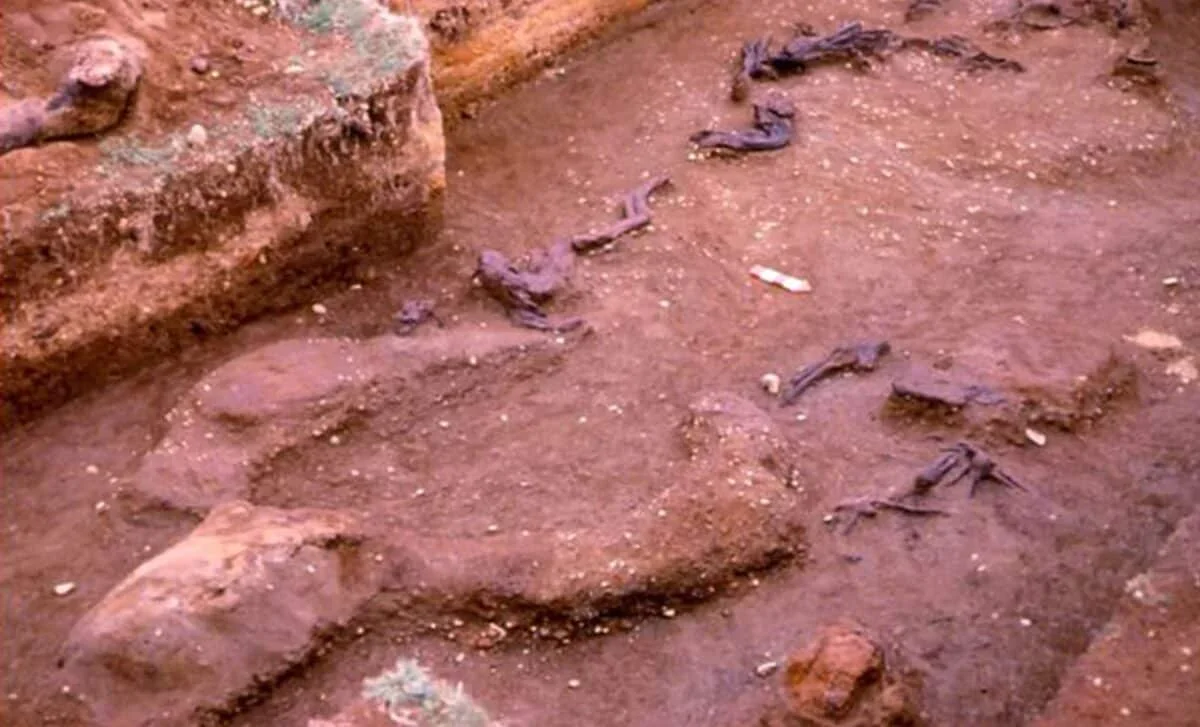
A new study re-dates the Monte Verde site in Chile to 4,200–8,200 years ago, far younger than the widely cited 14,500-year figure. The finding undermines its role as an early pre-Clovis reference point and prompts a reevaluation of migration theories into the Americas, suggesting older material may have been exposed or moved by geological processes rather than indicating very early human presence.