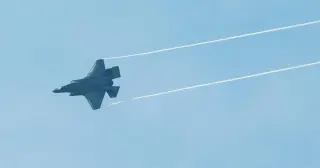
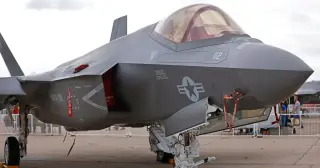
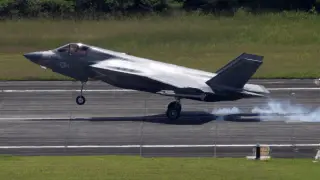
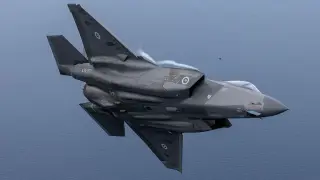
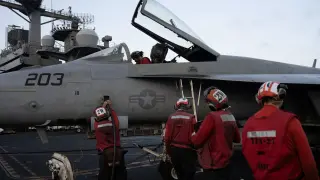
Israel approves a 10-year, NIS 350 billion defense plan that doubles its F-35 fleet to 100 and its F-15IA fleet to 50, creating two new squadrons and strengthening air superiority and overall readiness across the IDF.
An American F-35 conducting a combat mission over Iran made an emergency landing at a regional airbase; the pilot is in stable condition and the incident is under investigation, with Iran claiming it targeted the aircraft and the US having yet to confirm the cause, amid ongoing US-Iran hostilities.
A U.S. F-35 conducting a combat mission over Iran was damaged by what is believed to be Iranian fire and made an emergency landing at a U.S. airbase in the Middle East. The pilot is reported in stable condition and the incident is under investigation. If confirmed, it would mark the first time Iran has struck a U.S. aircraft in the current conflict; the jet is valued at about $100 million.
Bloomberg News, citing a soon-to-be-released Pentagon testing-office assessment, reports that the F-35 TR-3 software upgrades stalled in testing last year, delaying new combat capabilities and raising cybersecurity concerns due to limited vulnerability testing.
Israel conducted a large-scale strike against Iran, capped by an F-35I Adir shooting down a Russian-made Yak-130 over Tehran in a historic first for the jet in air-to-air combat; the operation involved hundreds of aircraft and thousands of bombs, with IDF claiming major Iranian casualties and targeting IRGC facilities, while RAF F-35s later downed a drone over Jordan.
Israel’s F-35I Adir reportedly shot down a Russian-made Yak-130 in what the IDF calls the first confirmed air-to-air kill by an F-35. The Yak-130 is an advanced trainer/attack aircraft, and Israel notes its last aerial kill was in 1985. The incident comes amid broader clashes involving Iranian jets, and is complemented by a separate RAF F-35 downing of an Iranian drone, underscoring Western air superiority in the region.
Israel’s F-35I reportedly shot down an Iranian Yak-130 in the war’s first fighter-jet dogfight, marking the F-35’s first confirmed air-to-air takedown. The claim followed prior IDF strikes on Iranian jets, with Israel and the US maintaining air dominance over the Tehran area. UK RAF F-35s are also cited as achieving a first combat kill by downing an Iranian drone, underscoring broader Western air superiority in the conflict.
An Israeli F-35I shot down a manned Iranian Yak-130 over Tehran in a historic air-to-air kill as Israel and the United States widen military operations under Operation Epic Fury, targeting Iranian security forces and Basij facilities. The campaign involves large US deployments (over 50,000 troops, about 200 jets, carriers) and broad strikes across Tehran and other cities, with no ground invasion planned, while related drone attacks and regional incidents underscore escalating tensions.
Canada’s plan to replace its CF-18s with an F-35 fleet is showing signs of collapse as Ottawa weighs Saab’s Gripen E/F offer, which includes thousands of local jobs and a domestic production hub, in a potential mixed‑fleet approach. The decision faces scrutiny over technology transfer, timelines, and NORAD implications, with a 2024 auditor review and ongoing U.S. readiness/diplomatic concerns adding to the uncertainty.
Canada is reviewing its plan to buy 88 F-35 fighters, with Saab’s Gripen pitched as a cheaper, sovereignty-focused alternative that offers modern sensors, electronic warfare, and potential in‑country sustainment and jobs. Proponents say the Gripen’s cost and capability meet Canada’s core missions—interception, patrol, maritime defense, and Arctic air sovereignty—without needing fifth‑generation stealth, making a mixed Gripen/F‑35 fleet feasible, while critics warn that reduced U.S. interoperability could complicate NORAD and future defense needs. Ottawa will weigh cost, sovereignty, and alliance considerations in deciding whether to pursue Gripen or the full F‑35 program.
The Singapore Airshow staged a rare cross‑power display featuring US F‑16s and F‑35s, China’s J‑10C, and Malaysia’s Su‑30MKM, flown by Singapore, Australia, Malaysia, and China. The F‑16s and F‑35A impressed with high‑power passes and internal weapons bays, the J‑10C delivered colorful aerobatics but felt underwhelming next to hype, and the Su‑30MKM wowed with flares, a Cobra maneuver, and dramatic climbs, highlighting different generations and export ambitions amid sanctions and limited direct US/Russia military involvement.
The NDP is pressing Prime Minister Carney to cancel Canada’s 16-jet order of U.S.-made F-35 fighters and switch to Saab Gripen, arguing the U.S. aircraft would deepen military integration with a superpower. Defence officials say procurement will serve Canadian needs and no final decision has been made as a review continues, all amid Trump-era threats to disrupt Western aircraft supplies and tariffs.
Ottawa is weighing a mixed fighter fleet that would trim the F-35A order by more than half, keeping as few as 40 jets and buying up to 80 Saab JAS-39 Gripen Es to boost sovereignty and create jobs (estimates around 12,600). The Gripen package focuses on industrial benefits and domestic aerospace links, while 16 F-35s are already obligated and 72 remain undecided as a review ordered by Prime Minister Carney proceeds. A mixed fleet is intended to preserve NORAD/NATO interoperability while diversifying partners away from Lockheed Martin, though no final decision has been made.
A US-led operation in Venezuela overwhelmed Russian- and Chinese-made air defenses, with failures blamed on maintenance gaps, inactivity, and poorly integrated defense networks by Venezuelan operators. The mission, which used tools like AGM-88 anti-radiation missiles and electronic jamming, underscores Western airpower advantages but cautions against generalizing the results to Russia or China, noting that export variants and training levels differ and the broader air-defense network has not faced the same test. The ongoing takeaway emphasizes maintaining advanced aircraft like the F-35 to preserve U.S. air superiority.
Denmark has retired its 77 F-16s as of January 18, 2026 after 46 years of service and is replacing them with the F-35A Lightning II, with a total of 43 F‑35s in its fleet (27 ordered in 2016 and 16 more in 2025). The F-35s began taking over NATO’s Quick Reaction Alert on April 1, 2025. Additionally, 19 of Denmark’s F‑16s are donated to Ukraine and 24 are being sold to Argentina, with training and maintenance support included, as Denmark becomes the third country to operate an all-F-35 fleet.