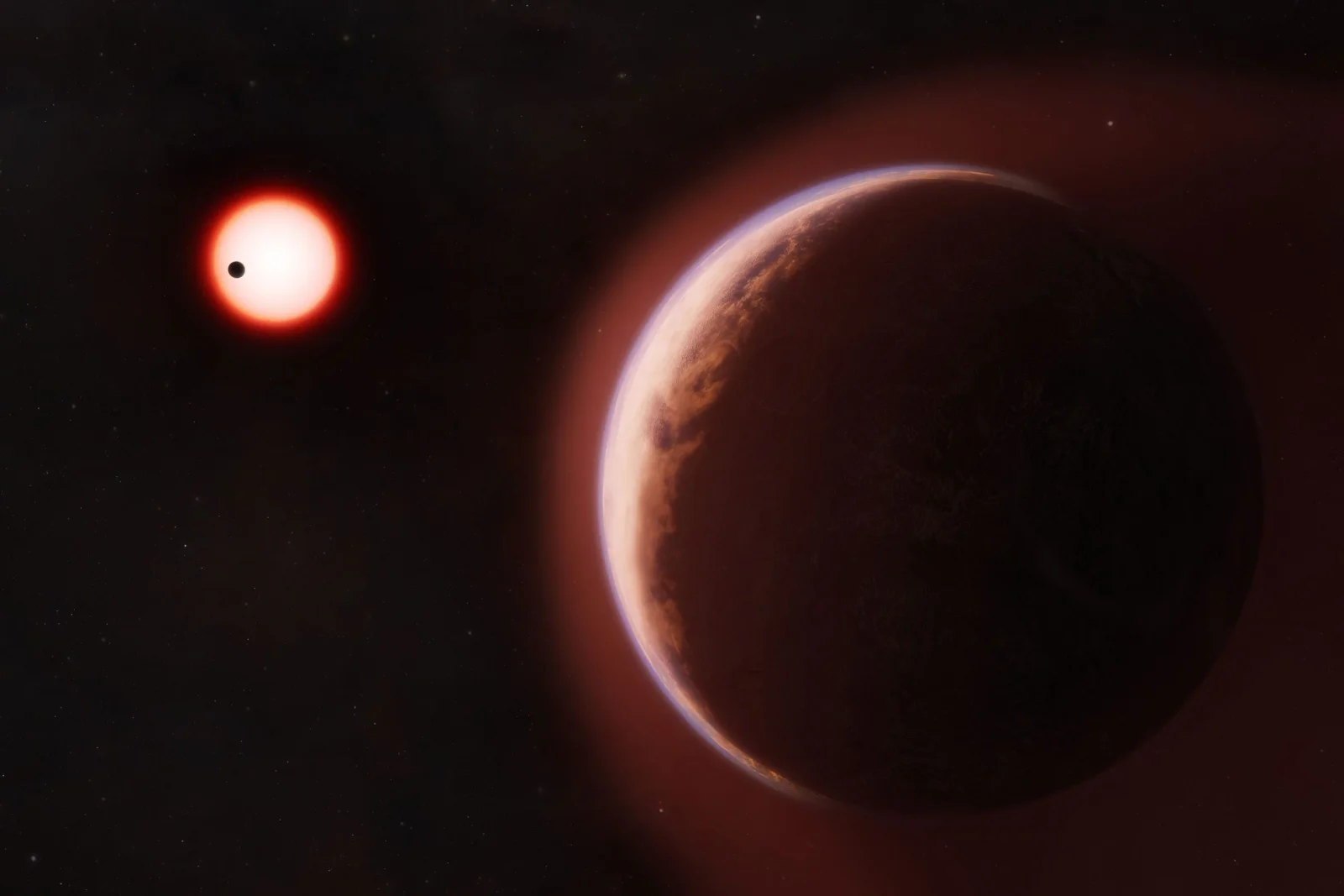
Astronomers have found the strongest evidence yet that the rocky exoplanet LHS 1140 b, orbiting a red dwarf in its habitable zone, retains an atmosphere, inferred from helium escaping from the planet and detected with ground-based spectroscopy; the result suggests Earth-like worlds can maintain atmospheres for billions of years and opens new avenues to study their habitability.
Astronomers detected helium escaping from LHS 1140 b, a rocky super‑Earth in the habitable zone of a cool red dwarf about 48 light‑years away, marking the strongest evidence yet of an atmosphere on a rocky world outside our solar system. Using the WINERED spectrograph during a transit, they observed a helium absorption signal for LHS 1140 b (but not for its closer neighbor LHS 1140 c), implying a retained upper atmosphere despite stellar radiation. The finding, published in Science, suggests some rocky planets around red dwarfs can hang onto atmospheres for billions of years, though it does not confirm habitability or the full atmospheric composition; future observations will seek other gases and features like oceans to assess potential habitability.
Astronomers detected helium escaping from the rocky exoplanet LHS 1140 b, providing the strongest evidence yet that a terrestrial world in another star’s habitable zone can retain an atmosphere. The signal was observed as the planet transited its star using the WINERED spectrograph, indicating a thin upper atmosphere and enabling atmospheric study of potentially habitable worlds, though it does not prove habitability. Future observations will aim to characterize the rest of the atmosphere and investigate whether oceans or other life-friendly features might exist on LHS 1140 b.
Researchers have detected helium in the upper atmosphere of LHS 1140 b, a rocky planet about 48 light-years away in the habitable zone of a red dwarf, marking the first confirmed atmosphere around an Earth-like world outside our solar system; while helium alone wouldn’t support life, the finding shows such planets can retain atmospheres and may host other gases deeper down, bringing us a step closer to identifying habitable worlds.
Astronomers detected helium escaping from the rocky super-Earth LHS 1140 b, the first rocky planet in its star’s habitable zone to show an atmosphere, suggesting a long-lived atmospheric reservoir despite radiation from its relatively quiet M-dwarf host. The planet is about 1.73 Earth radii and 5.6 Earth masses, transits every 24.7 days, and the helium signal was observed with the WINERED spectrograph on the Magellan telescope in 2024 (with a partial repeat in 2025). This points to atmospheric escape from the upper atmosphere, while the exact lower-atmosphere composition and surface conditions (including liquid water) remain uncertain. Future observations with Hubble and Webb could reveal heavier gases like nitrogen, CO2, or water vapor. No evidence of life is claimed; the result marks a major step toward testing atmospheric retention on rocky planets around red dwarfs.
Astronomers report the first detection of an atmosphere on a rocky, Earth-like exoplanet in the habitable zone of a distant star: LHS 1140 b, located 48 light-years away. The gas confirmed so far is helium, likely in the upper atmosphere, with the possibility of other gases deeper down. While not evidence of life, the find marks a major step toward assessing whether Earth-like worlds could host life beyond our solar system.
Scientists detected a helium-dominated atmosphere around the rocky exoplanet LHS 1140-b, a planet in the habitable zone about 48 light-years away, marking the first direct evidence that such worlds can retain an atmosphere and potentially host liquid water and Earth-like life. The finding comes from WINERED observations on the Magellan telescope and suggests atmospheric escape can vary over time, while a nearby planet (LHS 1140-c) shows no atmosphere.
Astronomers directly detected helium in the atmosphere of the rocky, Earth-like exoplanet LHS 1140 b, making it the first confirmed atmosphere on a rocky world in the habitable zone. Using the WINERED spectrograph on the Magellan telescope, the planet’s transit spectra reveal an atmosphere that could potentially harbor liquid water with greenhouse effects. The 48‑light‑year‑away planet orbits a red dwarf and appears to have retained its atmosphere over billions of years, challenging assumptions about atmospheric loss around active stars. While not a life-detection, the finding marks a major advance in understanding habitability on rocky exoplanets and guides future observations.
Scientists using the James Webb Space Telescope have identified the exoplanet LHS 1140 b, located 48 light years from Earth, as a potential ocean world. Initially thought to be a mini-Neptune, new observations reveal it is a rocky "super-Earth" with significant water content, possibly in liquid form. This makes LHS 1140 b one of the best candidates for finding liquid water on an alien world. Further research is needed to confirm the presence of an atmosphere and key gases like carbon dioxide.