High-Resolution Solar Observations Uncover Ubiquitous Magnetic Vortex Instabilities at the Sun's Surface
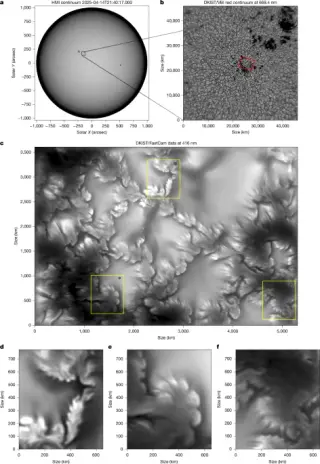
New DKIST observations reveal ubiquitous magnetized Kelvin–Helmholtz instabilities at the edges of magnetic flux concentrations in the solar photosphere, confirming long-standing theory. The vortices and stripe-like features seen in 416 nm filtergrams closely match 3D radiation-MHD MURaM simulations, showing KHIs generate strong shear at magnetic boundaries, drive turbulence, and enable plasma and magnetic-field mixing across multiple vertical layers. The analysis yields KHI wavelengths of roughly 50–70 km (with a 25–170 km observed range), growth rates ~0.01–0.05 s−1, and apparent phase speeds of ~0.7–3 km s−1, implying KHIs contribute to flux transport and magnetic-field braiding in the Sun’s magnetized atmosphere.