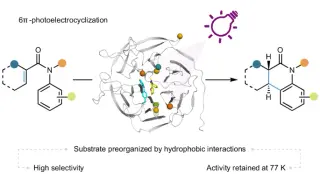
Researchers developed PEC1.3, an artificial photoenzyme that catalyzes 6π-electrocyclizations with high stereocontrol. By replacing hydrogen-bonding interactions with a hydrophobic network, the enzyme pre-organizes substrates for efficient light-driven reactions, even at cryogenic temperatures.
Researchers at the Shanghai Institute of Organic Chemistry and ShanghaiTech University have developed a new method to generate carbon-centered radicals using visible light. By employing copper-heteroaryl sulfone complexes, the team achieved irreversible metal-to-ligand charge transfer, breaking C-S bonds to create diverse alkyl radicals. This approach enables copper-catalyzed C-H fluoroalkylation and addresses long-standing challenges in incorporating perfluorocyclobutyl motifs into alkenes.
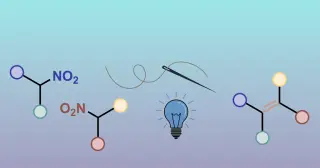
Two independent research teams in the US and Germany discovered new photochemical methods to convert nitroalkanes into substituted alkenes. A journal editor noticed the similarities in their rejected papers and introduced them, leading to a collaboration. The methods, described as 'photostitching,' offer a new route for synthesizing alkenes crucial for drug development and materials science.
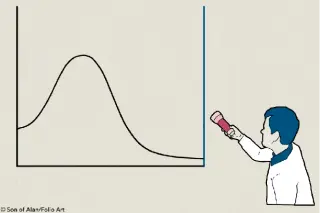
A decade of collaborative work overturns a 200-year-old rule in photochemistry by showing that many light-driven reactions perform better under longer, red-shifted wavelengths rather than at the absorption maximum. After extensive cross-lab validation and a microenvironment–based explanation, independent researchers are starting to confirm the effect, opening avenues for energy-efficient chemistry and new biomedical and 3D-printing applications.
UC Davis researchers developed a light-driven method that combines amino acids with tryptamine and, after UV exposure, reshapes them into new molecules that activate the serotonin 5-HT2A receptor and may offer psychedelic-like brain benefits without altering perception. In mice, the leading compound fully activated 5-HT2A but did not induce hallucinogenic behaviors (head-twitch responses), leading researchers to pursue further studies on how other serotonin receptors might modulate or suppress perceptual effects.
Researchers have developed a new manganese-based complex that absorbs light efficiently and has a record-breaking excited-state lifetime, offering a sustainable and simple alternative to rare metal complexes for large-scale photochemical applications like hydrogen production.
Space scientists are calling for closer collaboration with chemists to better understand the complex atmospheres of exoplanets, especially through improved models and laboratory experiments focusing on photochemistry and reaction parameters, aided by advanced telescopes like JWST and future technologies.
Scientists at Harvard have developed a novel method to capture CO2 using sunlight and specially designed organic molecules called photobases, offering a potentially energy-efficient and reusable approach to mitigate climate change by actively removing atmospheric CO2.
Scientists are studying a molecule called azulene, which violates the rules of photochemistry, in the hopes of creating more efficient solar cells that can convert sunlight into usable electricity. Azulene's unique behavior challenges a fundamental concept known as Kasha's rule, and understanding it could lead to a breakthrough in the search for limitless energy. While the exact form of limitless energy is still unclear, this discovery provides a promising starting point.
Researchers have discovered the formation of the methyl cation, a key molecule in astrochemistry, through photochemistry in a protoplanetary disk. The discovery was made using the Atacama Large Millimeter/submillimeter Array (ALMA) and the IRAM 30-meter telescope. The findings shed light on the chemical processes that occur in molecular clouds and protoplanetary disks, which are crucial for the formation of planets and other celestial bodies.
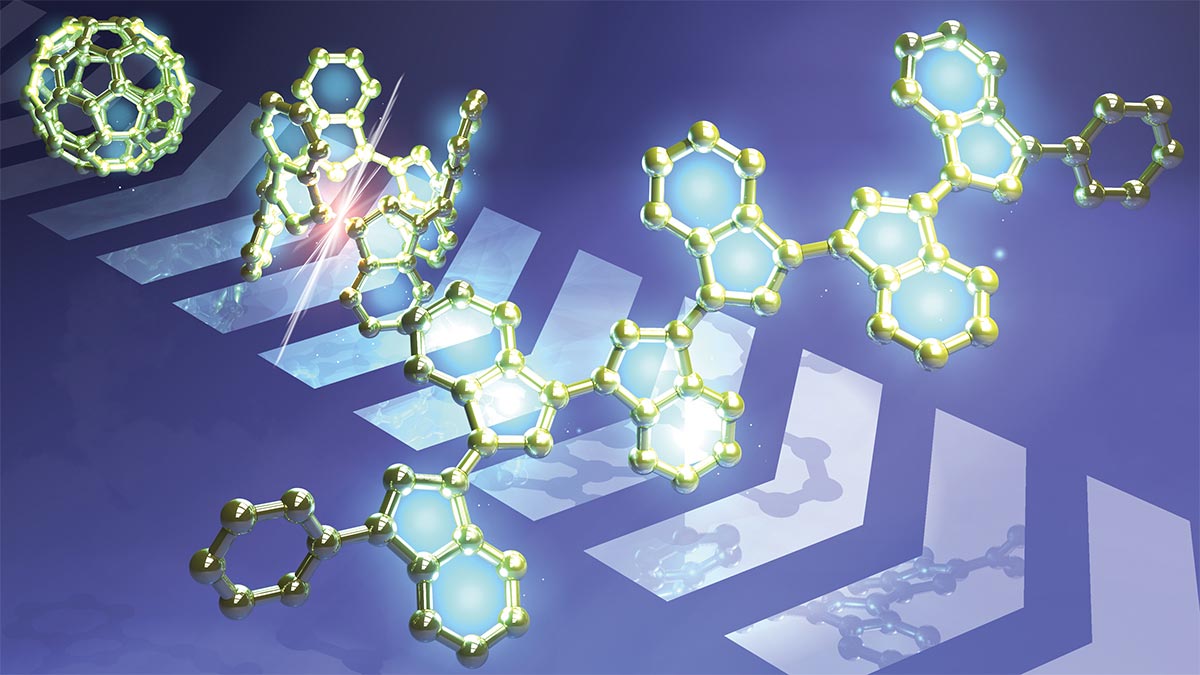
Researchers at Kyoto University have discovered that flat fragments of spherical molecules composed entirely of carbon atoms, called fullerenes, have stable electron-accepting ability with great practical potential. The team focused on the influence of the pentagonal substructures and designed and synthesized flattened fragments of fullerene, which surprisingly retained and even enhanced some key chemical properties. The fragments display enhanced absorbance of ultraviolet, visible, and near-infrared light compared to fullerene itself, which might open new possibilities in photochemistry. The team will now explore the possibilities their flat fullerene fragments hold in the vast variety of applications associated with electron-transfer processes.