
NASA's 'Big Bang' Power Swap Extends Voyager 2's Science Mission by One Year
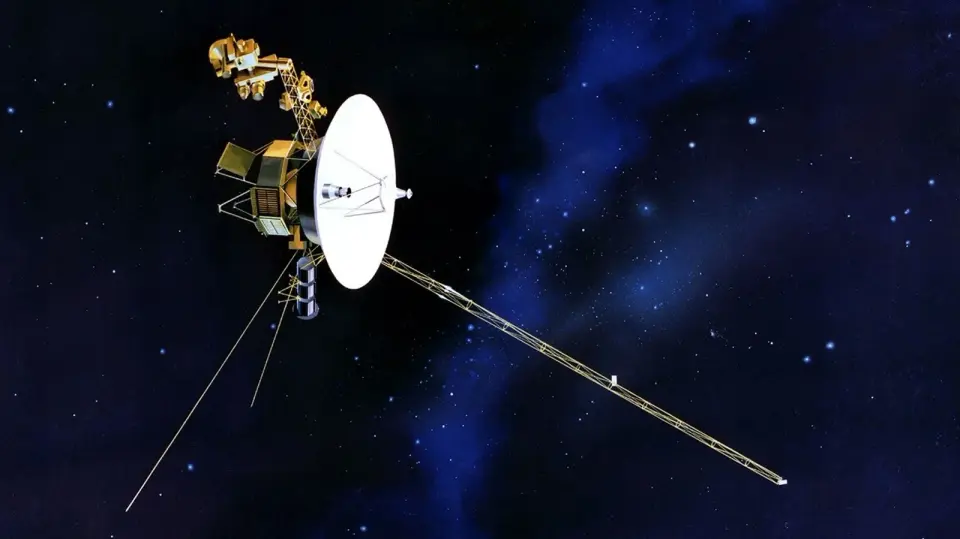
NASA successfully executed a power-saving maneuver called 'Big Bang' on Voyager 2, extending its operational life by at least one year. The update, sent across 13 billion miles, swaps high-power components for lower-power alternatives to preserve energy for its three remaining science instruments. Engineers are now preparing to apply the same fix to Voyager 1, which faces tighter power constraints and is farther from Earth.
Key points
- NASA’s 'Big Bang' operation on Voyager 2 involved simultaneously shutting down aging, high-power devices and replacing them with lower-power alternatives to conserve energy.
- The maneuver preserves power for Voyager 2’s three remaining science instruments, extending their operation by at least one year without requiring the shutdown of additional equipment.
- Both Voyager probes lose approximately 4 watts of power annually due to the decay of their radioisotope thermoelectric generators (RTGs).
- Voyager 1 currently has only two active science instruments, compared to Voyager 2’s three, and faces a more critical power situation.
- NASA plans to apply the same 'Big Bang' fix to Voyager 1 in the coming months, though engineers note the two spacecraft have diverged in behavior after nearly 50 years of independent flight.
Background
The Voyager program launched two identical probes in 1977 to study the gas giants. Both have since entered interstellar space, with Voyager 2 doing so in 2018. As their plutonium power sources decay, NASA has progressively deactivated instruments to preserve energy. Previous archive coverage noted that Voyager 1 recently revived dormant thrusters to maintain communication, highlighting the extreme care required to keep these aging spacecraft operational. The 'Big Bang' maneuver is the latest in a series of power-saving measures designed to extend the missions' scientific lifespans.
How outlets are covering it
Engadget and NASA Science emphasize the successful execution of the 'Big Bang' maneuver on Voyager 2, highlighting the technical achievement of freeing up power to keep three instruments active for another year. Space Daily provides a more cautious perspective, noting that Voyager 1 is in a more precarious state, having lost an instrument earlier than planned due to a power dip in February 2026. Space Daily also points out that Voyager 1 is farther from Earth (over 25 billion km vs. 21 billion km for Voyager 2), making command and confirmation cycles take nearly a full day. Good News Network offers a brief, positive summary of the power-saving success but lacks the technical depth of the other sources. All sources agree that the 'Big Bang' is a critical step in extending the missions, but Space Daily uniquely highlights the uncertainty surrounding whether the fix will work identically on Voyager 1 due to the spacecrafts' divergent aging behaviors.
Why it matters
The success of the 'Big Bang' maneuver demonstrates NASA's ability to extend the operational life of aging spacecraft through innovative engineering, rather than relying on new hardware. This extends the scientific value of the Voyager missions, which continue to provide unique data on interstellar space. The upcoming application of the same fix to Voyager 1 is critical, as it faces tighter power margins and is farther from Earth, making any failure more difficult to correct. The outcome of these maneuvers will determine whether the Voyagers can continue operating into the 2030s, potentially reaching the 50th anniversary of their launch in 2027.
What to watch
NASA will conduct a thermal test on Voyager 1 by the end of August 2026 to ensure the spacecraft remains within safe temperature limits after the 'Big Bang' power swap. If successful, the actual implementation will follow, with commands taking nearly a day to reach the probe. Engineers are also monitoring whether the freed-up power could allow the Low-energy Charged Particles experiment, which was shut off in April 2026, to be reactivated. Voyager 1 is expected to cross one light-day from Earth in mid-November 2026, a milestone that will further test the spacecraft's communication capabilities.
- NASA Updates Voyager 2 To Extend The 1977 Probe's Lifespan Yet Again Engadget
- NASA Engineers Help Prolong Voyager 2’s Science Mission NASA Science (.gov)
- Voyager 1 is down to two working science instruments, and the fix that just bought its twin, Voyager 2, another year of power is now being tested on a probe NASA says no longer behaves quite like its sibling Space Daily
- Voyager 2 was Running Low on Power Until NASA Engineered a ‘Big Bang’ to Buy Another Year Good News Network
- ‘Big Bang’ fix boosts Voyager 2’s mission in interstellar space CNN
Want the full story? Read the original reporting
Read on Engadget