
Voyager 1 Marks 50-Year Journey by Reaching One Light-Day Distance on Nov. 18
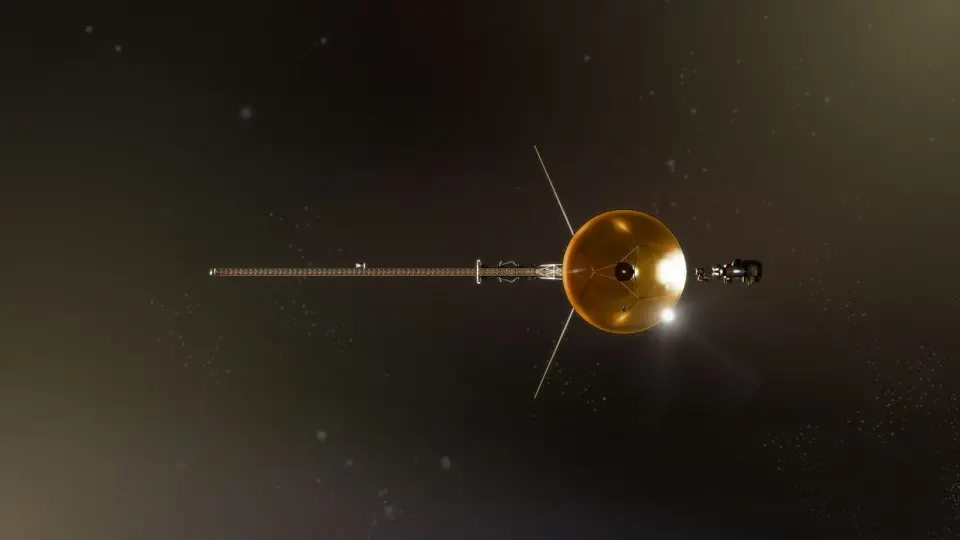
NASA's Voyager 1 probe will reach a distance of one light-day from Earth on November 18, 2026, becoming the first human-made object to achieve this milestone. The spacecraft, launched in 1977, is now approximately 16 billion miles away, requiring 24 hours for radio signals to travel between Earth and the probe. This achievement marks a symbolic step toward the mission's 50th anniversary in 2027, as the probe continues to operate in interstellar space despite dwindling power supplies.
Key points
- Voyager 1 will reach one light-day from Earth on Nov. 18, 2026, at 5:16 a.m. EST.
- The probe is approximately 16 billion miles (26 billion km) from Earth, a distance light takes 24 hours to traverse.
- NASA is celebrating the milestone with a global public event, including a Morse code light show using the call sign 'V-G-R'.
- Voyager 1 has only two science instruments still active due to power constraints, with the Low-energy Charged Particles experiment shut off earlier this year.
- The spacecraft is expected to continue operating into the 2030s, with full power loss anticipated around 2036.
Background
Voyager 1 launched from Kennedy Space Center on September 5, 1977, as part of a mission initially designed to survey Jupiter and Saturn. It entered interstellar space in August 2012 and has since been the farthest human-made object from Earth. The probe's journey has been marked by significant discoveries, including Jupiter's faint ring system and volcanic activity on its moon Io. Recent power-saving measures, including the 'Big Bang' power swap, have been implemented to extend the mission's lifespan.
How outlets are covering it
Space.com emphasizes the milestone as a symbolic step toward the 50th anniversary celebrations in 2027, highlighting the probe's resilience despite power constraints. NPR focuses on the public engagement aspect, detailing the Morse code light show and the probe's role as the farthest human-made object. ABC News underscores the probe's legacy in transforming our understanding of the solar system through its imagery and data, while Live Science highlights its contributions to planetary science, particularly its observations of Jupiter and Io. All sources agree on the significance of the milestone but differ in their emphasis on public engagement, scientific legacy, and technical challenges.
Why it matters
The one-light-day milestone underscores the enduring capabilities of Voyager 1, a spacecraft designed for a five-year mission that has now operated for nearly 50 years. It highlights the challenges of maintaining deep-space communication and the importance of power management in long-duration missions. The achievement also serves as a reminder of humanity's reach into the cosmos and the potential for future interstellar exploration.
What to watch
Voyager 1 is expected to continue operating into the 2030s, with full power loss anticipated around 2036. The probe will continue traveling through interstellar space indefinitely, eventually approaching the star Gliese 445 in 40,000 years. NASA will continue to monitor the probe's status and implement further power-saving measures as needed.
- NASA's interstellar Voyager 1 probe is about to reach 1 light-day from Earth after nearly 50 years in space Space
- Far from home. Voyager 1 is now farther than anything man has sent into space NPR
- A NASA probe from the '70s is still talking, and Wednesday it will be a light-day away ABC News - Breaking News, Latest News and Videos
- NASA's Voyager 1 probe poised to achieve mega-distance milestone Reuters
- NASA's Voyager 1 mission forever changed our view of Jupiter (photos) Live Science
Want the full story? Read the original reporting
Read on Space