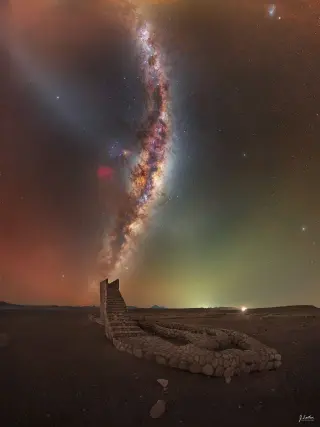
NASA’s Astronomy Picture of the Day features a wide-angle composite from the Atacama Desert in Chile, showcasing a local staircase sculpture against a backdrop of the Milky Way, zodiacal light, and the Small Magellanic Cloud.
NASA’s Astronomy Picture of the Day features a new telescopic image of Messier 33, also known as the Triangulum Galaxy. Located approximately 3 million light-years from the Milky Way, this face-on spiral galaxy is over 50,000 light-years in diameter. It ranks as the third-largest galaxy in the Local Group, behind only the Milky Way and Andromeda. The image, credited to George Chatzifrantzis, displays blue star clusters and pinkish star-forming regions along loosely wound spiral arms. Notably, the bright star-forming region NGC 604 is visible near the 5 o'clock position from the galaxy center. M33 is believed to be a satellite of the Andromeda Galaxy, meaning observers in both systems would likely see each other’s grand spirals clearly. Variable stars in M33 have historically served as cosmic yardsticks for establishing the universe’s distance scale.
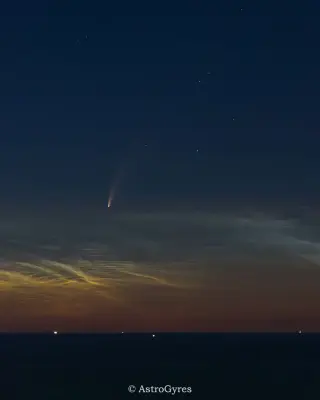
A new time-lapse video captures Comet C/2020 F3 (NEOWISE) rising over the Adriatic Sea in Italy, marking its return to visibility more than four years after its 2020 peak. The footage, compiled from over 240 images taken in 30 minutes, shows the comet emerging above bright noctilucent clouds and distant stars. This inner-Solar System intruder, known as the Great Comet of 2020, remains notable for its sustained brightness and a nucleus approximately five kilometers wide. The image is featured on NASA’s Astronomy Picture of the Day, which is transitioning to a new domain.
NASA’s Astronomy Picture of the Day features a ground-based image of the Southern Pinwheel galaxy (M83), located 12 million light-years away. The image highlights its spiral arms, dust lanes, and star-forming regions, while noting its active X-ray core and membership in the Centaurus A galaxy group.
NASA's Astronomy Picture of the Day featured LDN 1295, known as the Giraffe Nebula, located in the constellation Cassiopeia. The image, captured by Alessandro Merga, showcases a dark nebula that blocks starlight, often resembling animal shapes due to pareidolia. The feature notes the migration of APOD to a new NASA domain.
APOD's Aug 9, 2026 feature shows a Sun partially eclipsed by the Moon (with visible sunspots) captured in 2012 near Page, Arizona. It notes an upcoming solar eclipse sweeping northern North America, Europe, and northwestern Africa, with totality along a Greenland-to-Portugal path, and a chance for Perseid meteors during totality.
Scientists have found that older people produce higher levels of apolipoprotein D (ApoD), which impairs their immune response to influenza, leading to more severe disease; targeting ApoD could help reduce flu severity in the elderly.
NASA's Astronomy Picture of the Day (APOD) features stunning images of the cosmos, including rare phenomena like a rocket plume shadow pointing to the moon, the Helix Nebula in hydrogen and oxygen, the Milky Way over the Seven Strong Men rock formations, the Butterfly Nebula from Hubble, and the Horsehead Nebula in infrared. Other captivating images include the Lagoon Nebula, the Orion Nebula in visible and infrared light, the Veil Nebula, the Andromeda Galaxy in ultraviolet, and the Sun's corona from the Solar Dynamics Observatory, showcasing the beauty and wonder of our universe.