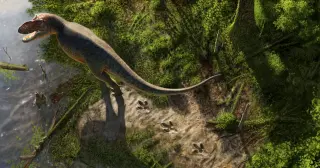
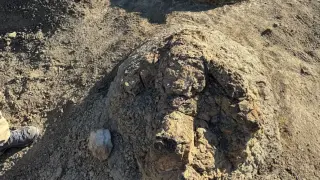
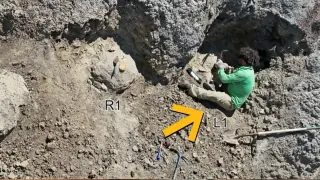
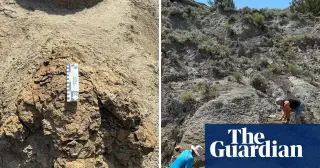
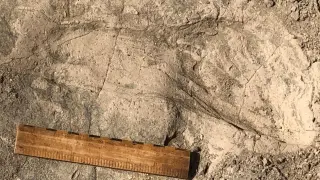
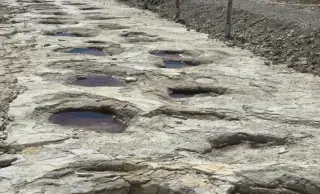
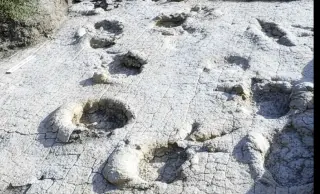
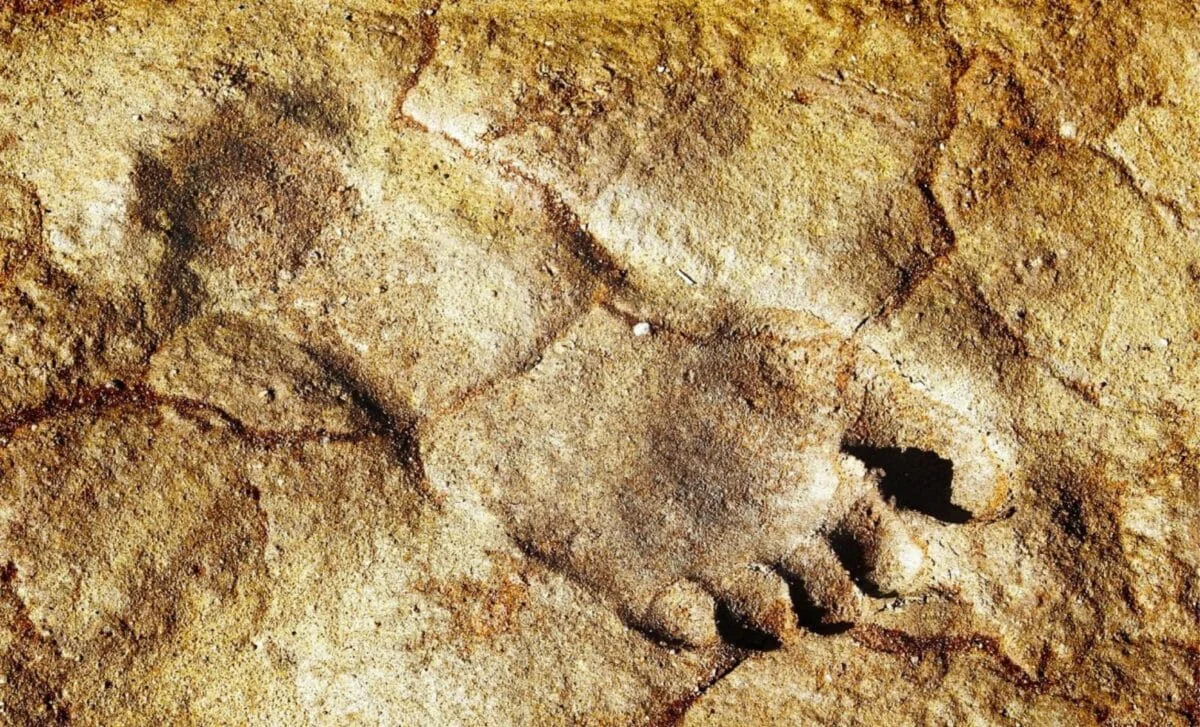
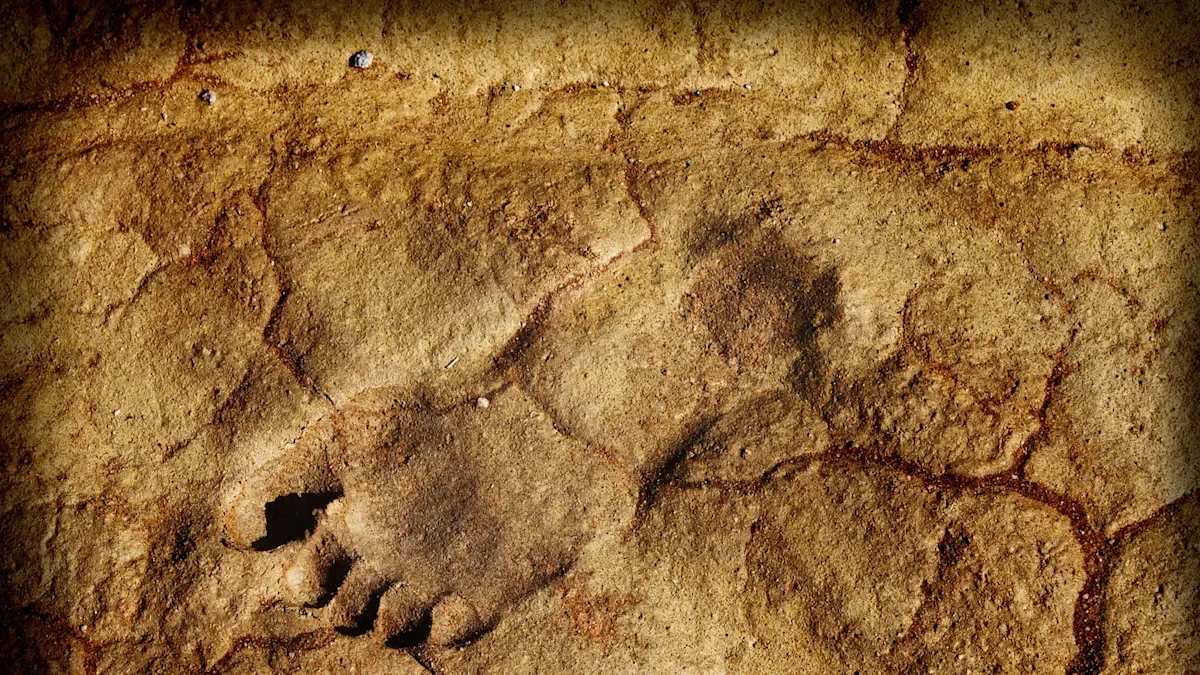
Colorado high school science teacher Kent Hups, while volunteering on a North Dakota fossil dig after knee-replacement surgery, uncovered a 23-foot trackway of Tyrannosaurus rex footprints, offering a rare glimpse into how the apex predator moved 66 million years ago.
Paleontologists report the first known trackway of an adult Tyrannosaurus rex: a 23-foot-long series of four three-toed footprints in North Dakota’s Hell Creek Formation. 3D scans confirm the massive prints date to about 66.5 million years ago, with a stride of roughly 13 feet and a walking pace of 3.5–4.5 mph, offering rare behavioral insight beyond bones. The site, discovered in 2025 near Marmath, will have three footprints excavated and transported to the Denver Museum of Nature & Science, where researchers hope to learn more about how the predator moved across its ancient landscape.
Scientists report the first known trackway of an adult Tyrannosaurus rex from North Dakota, a 7-meter-long site with four footprints about 1 meter long dating to around 66.5 million years ago. The find provides rare behavioral data from footprints (estimated walking speed ~3.3–4.5 mph) and complements bone records. Three footprints will be moved to the Denver Museum of Nature & Science for study, highlighting how trackways can illuminate behavior and gait in large dinosaurs.
Scientists have identified the first known trackway of an adult Tyrannosaurus rex in North Dakota’s Hell Creek Formation, dating to about 66.5 million years ago. The four three-toed footprints—each about 3 feet long—indicate the animal was walking at roughly 3.5–4.5 mph with a 13-foot stride; three of the prints will be recovered by helicopter later this year and transported to the Denver Museum of Nature and Science, while researchers used 3D scans to model the gait and behavior.
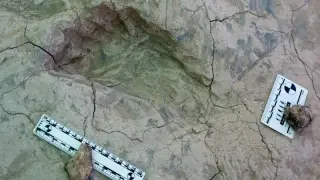
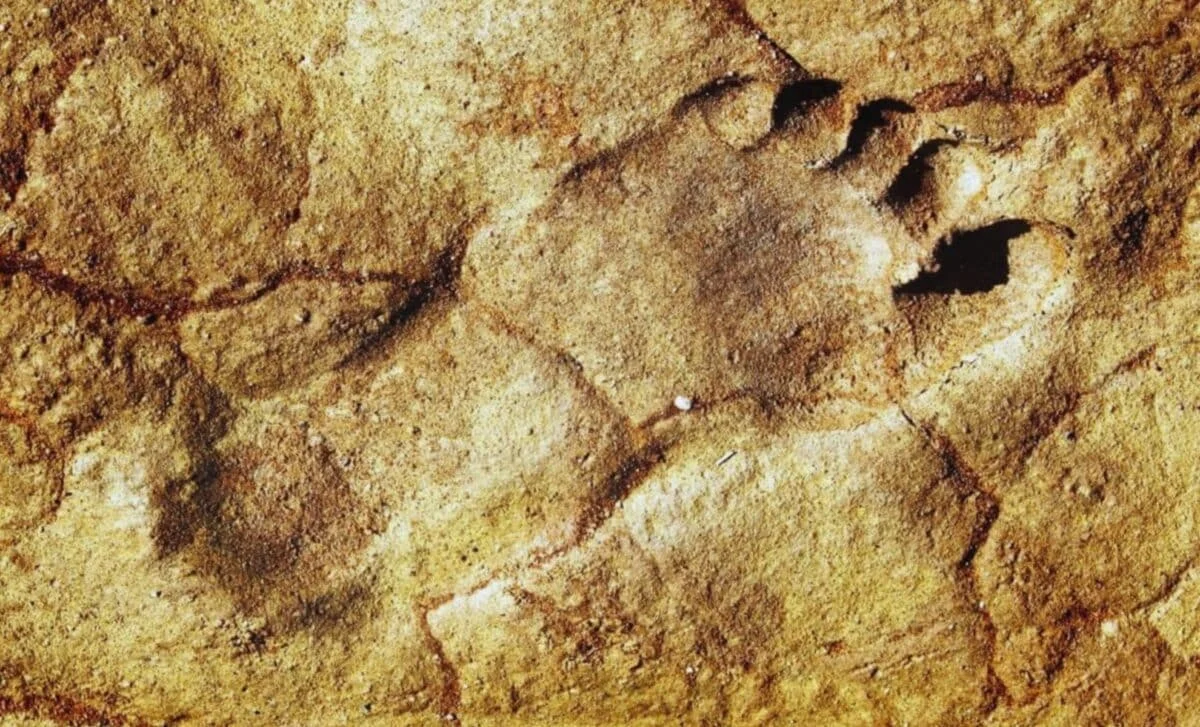
A 1.4-million-year-old footprint trail in northern Kenya shows eight Paranthropus boisei individuals, most likely adult males, moving together—with some tracks indicating body sizes up to about 1.8 meters tall and 75 kilograms—hinting at a more complex social structure than previously thought and offering rare insight into early hominin locomotion and group life along a lakeshore.
New analysis of 1.4-million-year-old footprints from Kenya’s Koobi Fora Formation shows Paranthropus boisei was likely taller and heavier than previously thought—up to about 6 feet and 165 pounds—and that eight individuals may have crossed the site together, suggesting more complex social behavior; the tracks also help compare P. boisei with Homo erectus and demonstrate how footprints reveal anatomy and behavior beyond what bones alone can show.
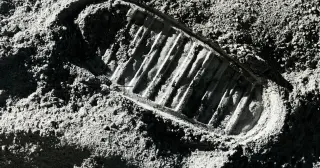
Apollo bootprints pressed into the Moon’s dry, airless regolith are expected to persist for about ten million years due to the lack of wind, water, and atmosphere. Slow erosion from micrometeorite impacts, solar wind, and extreme temperature cycling will eventually erase them, but NASA’s Lunar Reconnaissance Orbiter shows the sites remain intact from orbit. Future crewed or robotic activity near the sites could disturb the footprints, and there are protections being used to preserve the Apollo landing areas.
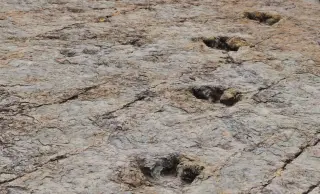
Paleontologists in Torotoro National Park, Bolivia, have documented Carreras Pampa as the largest known dinosaur tracksite, preserving nearly 18,000 footprints across 1,321 trackways dating to about 70 million years ago along the shore of an ancient freshwater lake. Most prints are three-toed theropod tracks, with ghost tracks and hundreds of swim traces; no bones were found. The site offers detailed clues on dinosaur movement and behavior and was published in PLOS ONE.
In the Dinoplagne site of the Ain region in the Jura mountains, researchers report a 155-meter-long, exceptionally well-preserved sauropod trackway dating to the early Tithonian stage of the Late Jurassic. This extends the record for the longest sauropod footprint sequence and provides detailed clues about the giant animal’s gait and size; a 2009 discovery at Dinoplagne identified a much shorter track (about 35 meters) but likewise highlighted the site’s significance. The footprints, attributed to a titanosaur, are preserved with sharp edges and intricate details, and the site remains open to visitors as scientists continue to study this geological treasure.
A rediscovered site in northern Mongolia, Saizhurakh, preserves 31 fossil footprints from giant sauropods and theropods dating to about 120 million years ago, revealing a shared landscape and complex ecosystem that hints at East Asia–North America faunal exchange during the Early Cretaceous.
A mobile AI tool called DinoTracker analyzes photos or sketches of dinosaur footprints to estimate likely makers. Trained on about 2,000 real fossil footprints plus millions of simulated variations to account for distortion, it achieved roughly 90% agreement with human experts and is meant to speed fieldwork, assist researchers, and engage the public. Notably, the AI flagged several footprints over 200 million years old with bird-like features, fueling debate about whether birds evolved earlier than thought or if some early dinosaurs had bird-like feet, and it reexamined Scotland’s Isle of Skye tracks. The study, led by Helmholtz Center and the University of Edinburgh, was published in Proceedings of the National Academy of Sciences (PNAS).
Researchers found 29 distinct footprints dating to about 13,000 years ago on Calvert Island, likely from three individuals walking barefoot along the shoreline; the prints are clustered and mostly inland-facing, suggesting a gathering spot rather than a linear path and supporting the idea that early people used Pacific coastal routes to reach North America as sea levels were 6–9 feet lower. Excavation and analysis are ongoing, with findings published in PLOS One.
Archaeologists report 120,000-year-old Homo sapiens footprints preserved in an ancient lake bed in Saudi Arabia’s Nefud Desert, indicating early humans occupied a wetter, greener Arabian environment and moved across the peninsula sooner than previously thought, underscoring Arabia’s important role in early human dispersals.
Archaeologists report seven Homo sapiens footprints at the Alathar paleolake in Saudi Arabia dating to about 115,000 years ago, the earliest evidence of modern humans in the Arabian Peninsula. The prints, found among tracks of elephants and camels, were preserved in lake sediment from a brief humid interglacial and dated via luminescence; no tools or skeletal remains were found, suggesting transient movement rather than settlement. The team used 3D photogrammetry to document the impressions before erosion.
Footprints at White Sands National Park in New Mexico have been calibrated to about 23,000 years old, placing humans in North America roughly 10,000 years earlier than previously thought. Radiocarbon dating tied to pine pollen and ditch grasses, with optical luminescence supporting the age, corroborates the finding. The footprints depict activities from play to hunting, including a woman carrying a child, and researchers hope to uncover more to broaden the North American archaeological record.