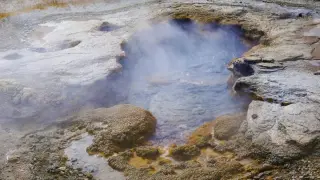
New research indicates the Chicxulub impact crater, formed 66 million years ago, generated a hydrothermal system that persisted for 8 million years, potentially providing a long-term habitat for microbial life.
A Nature Communications study using 3D impact modeling suggests Earth cooled enough for an RNA-based origin of life between about 4.4 and 4.3 billion years ago, with optimal conditions around 4.33 billion years ago. While this narrows the timeline for the RNA world, it doesn’t pin down the exact moment life began, since liquid water, nutrients and other environmental factors must align; zircon evidence of liquid water by ~4.4 Ga supports the window and the work also informs questions about habitability on Mars.
New analysis of data from NASA's Cassini probe has revealed complex organic molecules in the plumes of Saturn's moon Enceladus, suggesting the presence of a habitable environment similar to Earth's deep-ocean hydrothermal systems, and raising the possibility of life-supporting conditions beneath its icy surface.
Chinese scientists have discovered abiotic organic compounds in the oceanic crust of the Southwest Indian Ridge, providing insights into deep-sea carbon cycles and the origins of life. This research, published in PNAS, highlights the role of mineral-catalyzed reactions in forming complex organic compounds, which could inform the search for life on other planets. The study combines multimodal microanalysis and density functional theory to explore abiotic organic synthesis, emphasizing the catalytic role of goethite in these processes.
The origin of life remains a complex and interdisciplinary challenge, with competing hypotheses and fragmented research. Two prominent frameworks, prebiotic soup and hydrothermal systems, propose radically distinct environments for the origin of life, each with its own advantages and disadvantages. The field needs to move towards testing specific hypotheses within coherent wider frameworks, fostering good communication, embracing open science, and improving publishing practices to overcome fragmentation and promote objectivity, cooperation, and falsifiability in the pursuit of understanding the origin of life.