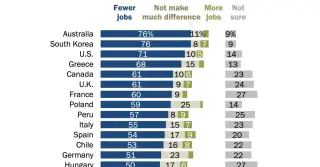
The Dow Jones hit a record high even as US consumer sentiment sank to an all-time low, underscoring a split between booming markets and anxious households as AI-related job concerns and rising yields weigh on the outlook.
Facing soaring bills, Britons are increasingly building multiple income streams—second jobs, online gigs, and passive earnings like renting space—to cushion costs. The trend, notable among women in low-paid work, includes so‑called polygamous or over‑employment, with about 1.35 million UK adults already juggling two jobs. But burnout is a real risk as people balance full‑time work with side hustles and passive ventures.
New York City Comptroller Mark Levin warned that artificial intelligence could cost thousands of local jobs as soon as this year, outlining five scenarios from a productivity-led growth to mass layoffs and urging policymakers to act with a multi-billion-dollar financial cushion and proactive local strategies to steer AI’s impact.
Despite Gen Z’s skepticism about higher education, two decades of U.S. Bureau of Labor Statistics data show graduates—especially bachelor’s degree holders—remain the least likely to be unemployed and earn more on average than those without a degree. The degree advantage persists since 2006, even as many graduates feel underemployed and burdened by debt, while some hiring practices hint at removing degree requirements—but in practice, degrees still influence hiring and career outcomes.
A recent journalism graduate in New York City struggles to land a full-time role amid a weakened entry-level market, working as a barista to cover living costs while freelancing; despite doubts about staying in NYC, a new East Coast job offer brings renewed hope and reframes the path forward.
The Detroit Three have cut more than 20,000 salaried U.S. roles—about 19% of their white-collar staff—as AI, software-defined vehicles and EVs reshape the industry. GM accounts for roughly 11,000 of the cuts since 2022, with Ford and Stellantis pulling back more gradually; overall white-collar headcount declined from a 2022 peak of about 102,000 to roughly 88,700 by the end of last year. Analysts say clerical tasks are most at risk to AI, though the technology also creates roles in AI, cybersecurity and software, and automakers continue hiring for select AI-related jobs while pursuing broader efficiency gains.
Goodyear will close its Fayetteville, NC tire plant by the end of 2027, eliminating about 1,700 jobs. The company says the move is necessary to strengthen competitiveness and the long-term health of the business, and is in discussions with the United Steelworkers. City officials say they will work on retraining and job-placement efforts with local community colleges and workforce programs to help workers transition as the plant’s closure approaches.
Five Guys is permanently closing four California locations (Whittier, City of Industry, Merced, and Hanford), resulting in about 55 layoffs, citing financial hardship and rising operating costs. The closures highlight price pressures and wage hikes in California’s fast-food scene, even as the chain remains active in the state and recently topped a national fast-food burger ranking.
AI isn’t wiping out jobs; it’s reshaping them by automating components of many roles rather than replacing entire positions. Experts say humans are still needed for problem solving, design, and complex decision-making, while tasks that can be automated are being distributed across teams and sometimes prompting title changes (e.g., software engineers evolving toward “builders”). The impact includes real layoffs at companies like Cloudflare and Coinbase, but there’s little sign of mass displacement across industries yet; McKinsey estimates up to 57% of work activities could be automated in parts, signaling a shift in skills and responsibilities rather than wholesale job losses.
Bank of America Global Research now expects the Federal Reserve to hold rates and not begin easing until the second half of 2027, citing stubborn inflation around 3.3% and solid job growth (April payrolls +115,000). This revises earlier expectations for cuts this year as policymakers weigh inflation, AI-driven productivity, tariffs and the Iran war; CME’s FedWatch shows less than a 50% chance of cuts before 2027, and the last rate cut was December 2025 at 3.5%–3.75%.
U.S. employers added 115,000 jobs in April and the unemployment rate held at 4.3%, a surprise gain led by healthcare, transportation/warehousing, retail and social assistance, with losses in federal government and information sectors. March was revised up to +185,000 and February down to -156,000. ADP private payrolls rose 109,000, the largest gain since January 2025. The data comes as the Fed keeps rates steady amid ongoing Middle East conflict and higher oil prices, fueling uncertainty about policy direction.
U.S. employers added 115,000 jobs in April 2026, signaling resilience in the labor market even as energy prices are pressured by tensions involving Iran.
Yann LeCun urges shedding doom-mongering about AI: don’t rely on front‑line CEOs for labor impact, continue higher education (especially physics or electrical engineering), and expect AI to reshape work—not erase it—by turning managers into overseers of AI agents, a new kind of boss.
A CNBC anchor reacts to a surprisingly weak monthly US jobs report showing 189,000 payroll gains, the slowest since the 1960s, signaling a cooling labor market and fueling debate over Federal Reserve policy.
The White House is weighing a Defense Production Act-backed rescue of Spirit Airlines to save jobs, potentially lending about $500 million and giving the government top debtor status, with the Pentagon and Commerce Department weighing involvement and assets like flight slots preserved for a future sale; the plan would need creditor approval and aims to prevent liquidation amid bankruptcy and higher fuel costs.