Tag

Kras Mutations

All articles tagged with #kras mutations

Young-Onset Colorectal Cancer With Liver-Only Metastases Shows Distinct Biology and Survival Advantage
medical-research1 month ago

Young-Onset Colorectal Cancer With Liver-Only Metastases Shows Distinct Biology and Survival Advantage

A real-world study of 1,691 Australians with colorectal cancer that spread only to the liver found that patients diagnosed at age 50 or younger have distinct tumor biology and clinical features (including left-sided tumors and different mutation patterns) and tended to survive longer after liver metastasis than older patients. Across ages, BRAF and KRAS mutations were linked to poorer outcomes. Surgery to remove liver tumors followed by systemic therapy was associated with better survival, though causality can’t be proven from observational data. The findings support biology-informed, personalized treatment decisions that consider more than just age.


KRAS-targeting drug offers renewed hope in advanced pancreatic cancer
health1 month ago

KRAS-targeting drug offers renewed hope in advanced pancreatic cancer

An experimental KRAS-inhibiting pill, daraxonrasib, significantly extends median survival in advanced pancreatic cancer (13.2 months vs. 6.7 months with chemotherapy) in a phase 3 trial, and is available to eligible patients via the FDA Expanded Access Protocol at 10 Intermountain Health hospitals while full approval is pending; it’s a second-line option with manageable side effects and is not a cure.

PCAIs push pancreatic cancer cells to self-destruct by overactivating key signaling pathways
health-and-medicine3 months ago

PCAIs push pancreatic cancer cells to self-destruct by overactivating key signaling pathways

Researchers found experimental PCAIs kill pancreatic cancer cells and block their spread by hyperactivating MAPK and PI3K/AKT pathways, triggering ROS buildup and apoptosis; the leading compound NSL-YHJ-2-27 cut migration by over 90% at 1 µM and disrupted tumor spheroids, suggesting potential against several KRAS mutations, though further research is needed.

KRAS-Targeting Pill Extends Survival in Metastatic Pancreatic Cancer
science4 months ago

KRAS-Targeting Pill Extends Survival in Metastatic Pancreatic Cancer

A KRAS-targeting pill called daraxonrasib nearly doubles median survival in metastatic pancreatic cancer, boosting it from 6.7 to 13.2 months in a 500-patient randomized trial after prior treatment, with fewer severe side effects; experts say it could become the new standard of care and researchers will study earlier use and KRAS subtypes. FDA expedited review and expanded-access programs are planned, and results were published in NEJM and presented at ASCO.

"Mapping Lung Adenocarcinoma Cell States and Plasticity"
medical-research2 years ago

"Mapping Lung Adenocarcinoma Cell States and Plasticity"

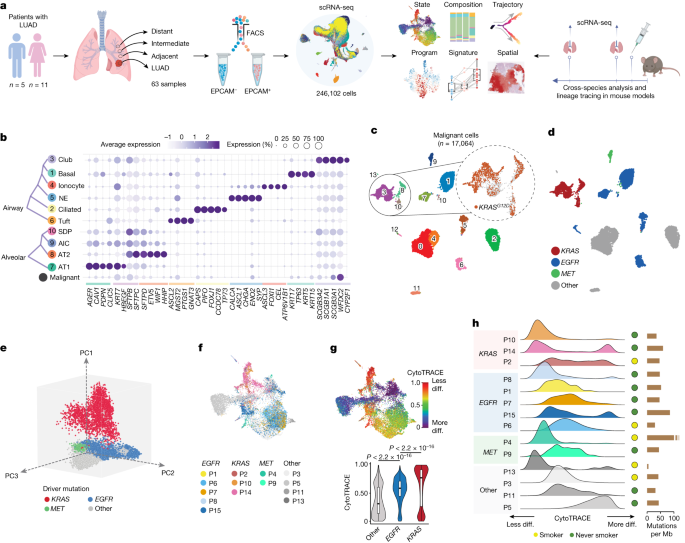
A study on lung adenocarcinoma (LUAD) reveals the transcriptional landscape of epithelial and malignant cells, identifying distinct cell subsets and their roles in LUAD development. The research shows that KRAS mutant LUADs exhibit unique transcriptional programs and extensive heterogeneity, while a subset of alveolar intermediate cells (AICs) transition to malignant cells, particularly KRAS mutant cells. These AICs, termed KRT8-high alveolar cells (KACs), are enriched in tumour-adjacent normal regions and display features of reactive epithelial cells. The study provides insights into the cellular and transcriptional phenotypes of LUAD, potentially identifying actionable targets for early treatment strategies.

"Advancements in Precision Therapy and Vaccines for Pancreatic Cancer"
health2 years ago

"Advancements in Precision Therapy and Vaccines for Pancreatic Cancer"

Researchers have found that certain KRAS mutations in pancreatic cancer are linked to better survival rates, paving the way for potential cancer vaccines. Pancreatic cancer, with a low 5-year survival rate, is often resistant to traditional treatments. The study analyzed data from 803 pancreatic cancer patients and found that specific KRAS mutations were associated with improved survival. Targeting KRAS mutations for vaccine development is a promising avenue, with ongoing research and clinical trials showing potential for new therapies in pancreatic and colorectal cancers.