Tag

Macromolecular Carbon

All articles tagged with #macromolecular carbon

Mars rocks harbor robust organic carbon, but life remains unproven
space1 month ago

Mars rocks harbor robust organic carbon, but life remains unproven

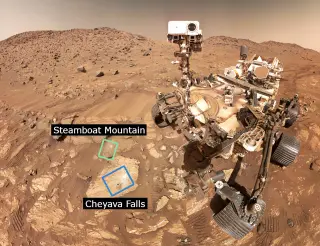
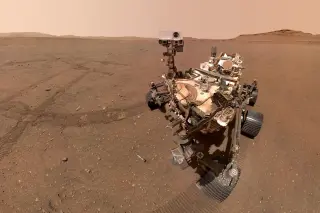
NASA’s Perseverance rover has detected macromolecular carbon—durable, complex organic matter—in two ancient mudstones in Jezero crater, identified by the SHERLOC spectroscopy instrument. The rocks—Cheyava Falls and a formation at the Bright Angel outcrop—show organics associated with different mineral settings, suggesting multiple organic-forming processes over time. While this represents the most extensive organic detection on Mars to date, the findings do not prove biology; the origin could be abiotic. Also, a 2026 funding shift means Mars Sample Return is unlikely this decade, so the cores remain on Mars for now.

Mars rocks reveal strongest carbon hint yet toward ancient life, but not proof
space1 month ago

Mars rocks reveal strongest carbon hint yet toward ancient life, but not proof

NASA's Perseverance rover found macromolecular carbon on bare rocks at Jezero crater's Bright Angel outcrop—the richest, most complex carbon yet detected on Mars—an intriguing hint toward past life, but not proof since it could be abiotic; confirming its origin will require Earth-based analysis of returned samples, with Cheyava Falls slated for return but subject to program changes. The carbon shows up across multiple rocks and settings, suggesting Mars’ ancient environment may have supported carbon-based chemistry beyond a single site.

Ancient Martian mudstones reveal organic carbon, fueling habitability debate
science1 month ago

Ancient Martian mudstones reveal organic carbon, fueling habitability debate

NASA’s Perseverance rover studied mudstones in Jezero Crater and found macromolecular carbon in two rocks, Cheyava Falls and Walhalla Glades. The carbon shows similarities to Earth carbon from both biotic and abiotic processes, offering clues about Mars’ ancient habitability but not proof of life; scientists say sample return to Earth is needed for definitive testing.

Martian rock at Bright Angel carries surface carbon; origin remains unclear
science-space1 month ago

Martian rock at Bright Angel carries surface carbon; origin remains unclear

NASA’s Perseverance rover detected a shallow surface presence of macromolecular carbon on a Martian rock at Bright Angel in Jezero Crater using the SHERLOC UV Raman spectrometer. While the compound resembles terrestrial kerogen, researchers caution it could be biotic or abiotic, and have ruled out instrument artefacts and Earth contamination. The carbon appears associated with carbonate/sulfate minerals at one target and with silicate-rich sediment at another, suggesting multiple emplacement events over geologic time. Definitive biogenic origin remains uncertain until samples are returned to Earth for isotopic and chirality analyses.

Mars rocks reveal complex organics, fueling questions about ancient life
science1 month ago

Mars rocks reveal complex organics, fueling questions about ancient life

NASA’s Perseverance rover has detected complex organic matter, specifically macromolecular carbon, in rocks within the Bright Angel mudstone sequence in Jezero crater on Mars. The finding strengthens evidence for ancient organics on the planet, but MMC can form through both biological and non-biological processes, so scientists say more analysis is needed to determine if life-related origins are likely. The discovery, part of ongoing work to identify rocks worth returning to Earth for closer study, adds to the broader search for past life on Mars.

Mars Rock Hints at Ancient Life, But Earth-Based Proof Is Needed
space-science2 months ago

Mars Rock Hints at Ancient Life, But Earth-Based Proof Is Needed

Analysis of Martian rock Cheyava Falls by Perseverance’s SHERLOC and WATSON detected macromolecular carbon, a potential sign of ancient organics and past habitability in Jezero Crater; but MMCs can form abiotically, so a definitive conclusion requires returning samples to Earth—an effort whose future remains uncertain amid stalled Mars Sample Return plans.

Perseverance uncovers Mars' largest cache of complex organic carbon near Bright Angel
space2 months ago

Perseverance uncovers Mars' largest cache of complex organic carbon near Bright Angel

NASA’s Perseverance rover found macromolecular carbon in the Bright Angel outcrop at Jezero Crater—the highest concentration of organic molecules detected on Mars to date. SHERLOC mapping and comparisons with Curiosity’s Gale crater data link the carbon to ancient, water-rich conditions and potential habitability, but the finding is not proof of life; a definitive biosignature would require future samples or more data.

Mars Rocks Hint at Ancient Life, But Proof Remains Elusive
science2 months ago

Mars Rocks Hint at Ancient Life, But Proof Remains Elusive

NASA’s Perseverance rover detected macromolecular carbon on Bright Angel mudstones in Jezero crater, a potential sign of ancient microbial life but non-biological processes could also produce such carbon; the rover’s measurements cannot confirm biogenicity, and Earth-based analyses of returned samples are needed for a definitive answer. This finding, together with Curiosity’s prior organics detections, suggests Mars may have been broadly habitable with widespread organics billions of years ago, though a dedicated sample-return mission is planned for the 2030s.