The gold-platinum ratio—a respected market-timing indicator—has fallen since late last year, suggesting the stock market may be living on borrowed time and a correction could be overdue, though its near-term predictive value is limited.
Contrarian analysts say the U.S. stock-market correction has more downside ahead, as March–April optimism hasn’t triggered a buy signal despite the Iran war and cease-fire; with May–October historically weak in midterm years, the bottom could be months away, so investors should keep expectations in check.
Retail investors have allocated a record share of their portfolios to U.S. stocks, a pattern often seen before a bull market peaks, while Mark Hulbert notes the “Single Greatest Predictor” indicator is at its most bearish reading ever—implying lower stock returns over the next decade, though not signaling an immediate bear market.
MarketWatch reports a cross-market study finding momentum is a persistent, universal feature of financial markets, with momentum strategies delivering profits across stocks and other asset classes. The piece then lists 20 high-momentum stocks from the Russell 3000 that produced strong trailing returns for 1/31/2025–12/31/2025: Terns Pharmaceuticals (TERN), Celcuity (CELC), Palvella Therapeutics (PVLA), Resolute Holdings Management (RHLD), Sandisk (SNDK), Inhibrx Biosciences (INBX), Zenas BioPharma (ZBIO), D-Wave Quantum (QBTS), Kodiak Sciences (KOD), Lumentum Holdings (LITE), Olema Pharmaceuticals (OLMA), EchoStar (SATS), Nuvation Bio (NUVB), Forge Global (FRGE), Praxis Precision Medicines (PRAX), Cogent Biosciences (COGT), Falcon’s Beyond Global (FBYD), Bloom Energy (BE), Taysha Gene Therapies (TSHA), and Vistance Networks (VISN). The article notes momentum’s persistence even beyond equities and emphasizes long-only momentum can still be profitable.)
In 2026, the best approach to buying Bitcoin isn't about timing a specific date but following a disciplined process, as the market shows signs of stabilization after a significant rally and correction. Bitcoin's price fluctuations are normal, and long-term investors should focus on patience and position sizing rather than trying to pinpoint the exact bottom, especially given the historical volatility and pullbacks during bull markets.
The article discusses how investors can approach investing during a bubble, highlighting options such as going all-in, hedging, diversifying, or doing nothing, while emphasizing the difficulty of predicting market turns and the importance of a well-planned, risk-appropriate strategy.
Investors holding cash in anticipation of a bear market should consider a disciplined approach, such as dollar-cost averaging and gradually buying quality dividend and large-cap tech stocks during market dips, while avoiding panic and maintaining a diversified portfolio to capitalize on potential downturns.
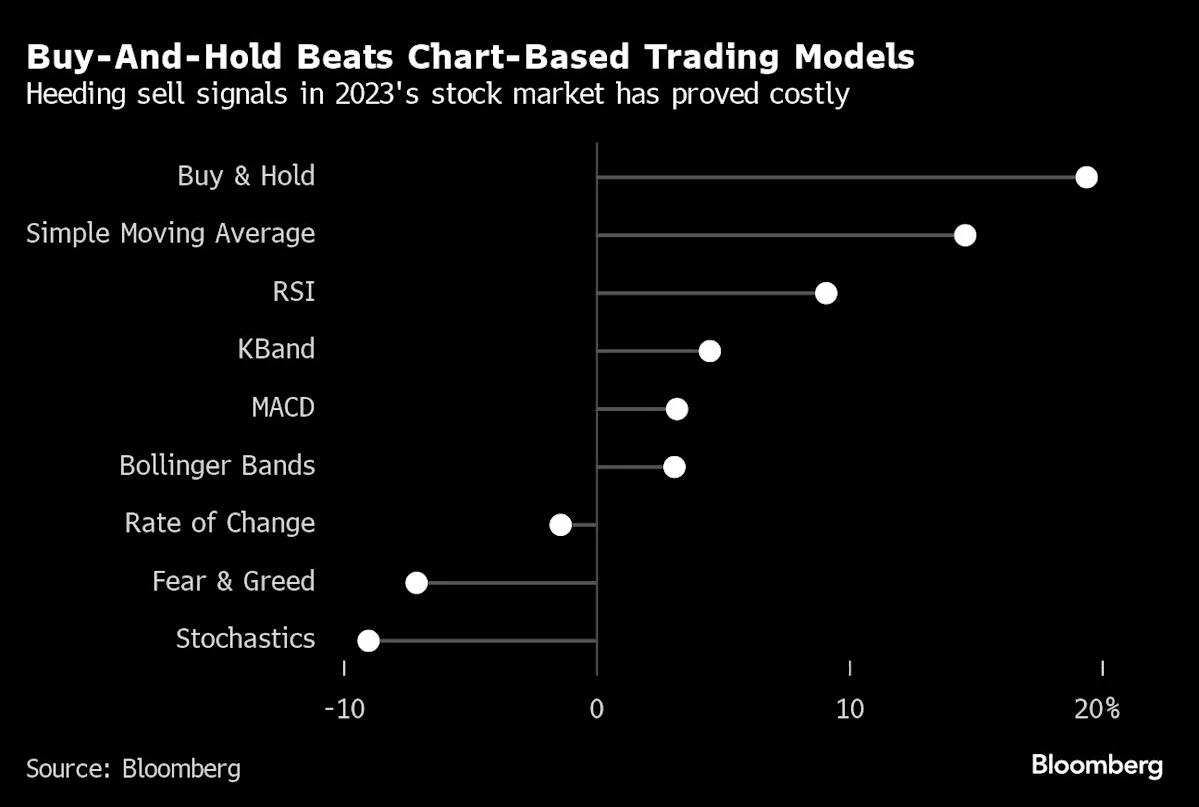
Despite market uncertainty and various selling signals, investors who stayed invested in stocks have seen significant gains this year, with the S&P 500 reaching record highs. Buying and holding equities has outperformed 22 technical strategies used by traders. The market has remained calm despite Federal Reserve uncertainty, economic anxiety, and geopolitical tensions. However, caution is creeping back as valuations look stretched and concerns about an economic downturn arise. While charting indicators suggest the market has run too far, too fast, investors who have followed these signals have fared worse than those who simply held their positions. The lesson learned is that timing the market is risky, as pullbacks are often followed by rapid recoveries.
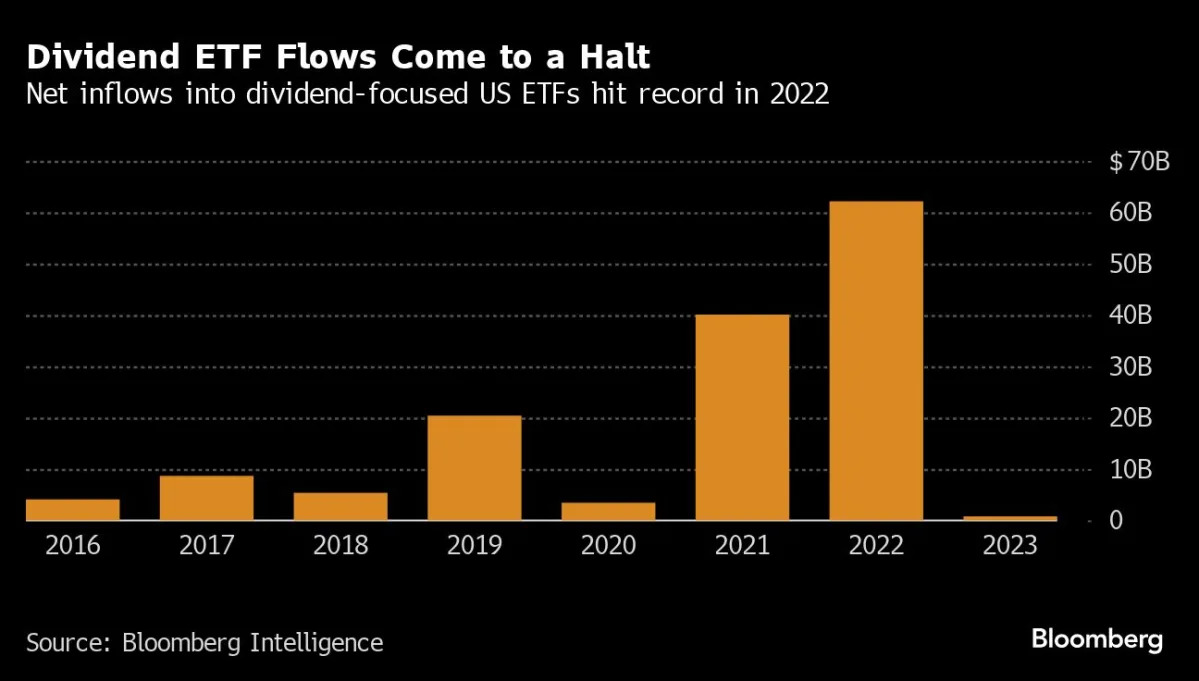
Dividend-focused exchange-traded funds (ETFs) have underperformed in the current tech-driven market, with the largest dividend ETFs experiencing losses while tech stocks surged. Investors sought exposure to dividend-paying companies as a precaution during the Federal Reserve's tightening cycle, but instead ended up with underperforming stocks that were vulnerable to rising yields. The $18 billion iShares Select Dividend ETF (DVY) is down 5.4%, while the $20 billion SPDR S&P Dividend ETF (SDY) is down 3%. Some dividend ETFs have posted small gains, but overall, only $786 million has flowed into dividend ETFs this year, the smallest amount since 2006. Bond yields have presented a more reliable income stream than dividend funds, with ultra-short bond ETFs attracting $30 billion this year.
A new study suggests that market timing strategies rarely work and that most investors are better off aiming for average returns by buying and holding the entire market through low-cost index funds. The study examined various market timing strategies and found that the ones that appeared to work were largely based on luck rather than a reliable method. Even if a strategy did work for a while, it would likely be quickly replicated by others, making it less effective. The study reinforces the idea of passive investing and focusing on minimizing costs to maximize market returns.
The S&P 500's 14% gain in 2023 can be attributed to just eight trading sessions, which were driven by positive news on interest rates, Big Tech earnings, and avoiding a recession. This highlights the risks of trying to time the market, as the margin of error for investors has been thin. The stock market tends to take the stairs up but the escalator down.
The S&P 500 has seen a 14% increase this year, but only eight specific days can explain most of the gains. Market timing, the strategy of predicting stock price movements and acting accordingly, is shown to be ineffective as missing out on these key days can significantly impact returns. This problem has been known to stock researchers for decades, as consistently identifying market tops and bottoms is nearly impossible. The statistics demonstrate that missing just a few of the best-performing days over a long-term investment period can result in significantly lower returns. Instead, consistent investing and understanding one's risk tolerance are emphasized as key factors in successful investing.
The stock market is experiencing its worst October in five years, causing investors to exit the market and adopt a defensive posture. Professional managers have reduced their equity exposure to levels last seen during the 2022 bear market, while hedge funds have increased single-stock shorts for 11 consecutive weeks. Investor sentiment remains low, with dip buyers scarce and the S&P 500 falling multiple times in October. The Nasdaq 100 is on track for its steepest October loss since 2018. However, some strategists see the current gloom as a positive, suggesting the potential for a year-end rally if sentiment flips.