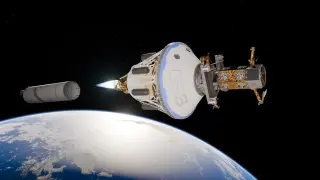
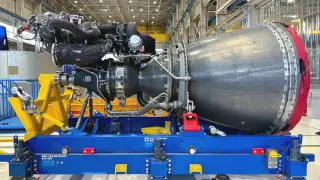
Blue Origin announced a new third stage and a more powerful first-stage engine for its New Glenn rocket, aiming to increase payload capacity and reduce manufacturing costs.
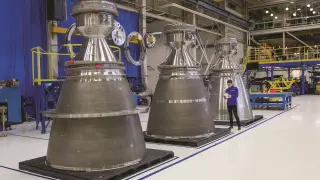
Blue Origin announced two major upgrades for its New Glenn rocket: the Northstar engine, which offers higher thrust at a fraction of the cost, and the GS3 third stage, designed for deep-space missions. The company aims to achieve a launch cadence of over 1,000 flights per year, though it faces delays from a recent pad explosion.
Blue Origin announced a major expansion of its Florida facilities, investing over $3 billion to support a launch cadence of multiple flights per week by 2030. The company is adding two new launch pads, a 1.37-million-square-foot upper stage manufacturing facility, and additional landing ships to recover New Glenn boosters. This aggressive scaling aims to capitalize on a shortage of commercial launch capacity as SpaceX reduces its Falcon 9 and Falcon Heavy availability. The expansion follows a catastrophic engine failure in May that destroyed a launch pad, which Blue Origin is currently rebuilding to resume flights in early 2027.
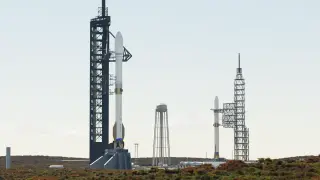
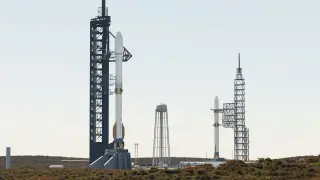
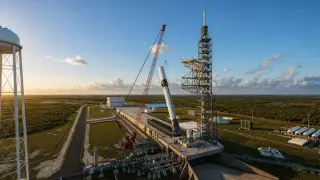
Blue Origin plans to add a second launch pad at Cape Canaveral to support its larger New Glenn 9x4 rocket, while simultaneously repairing the existing pad damaged by a May explosion. The company aims to resume flights with the current New Glenn 7x2 by year's end but has not provided a timeline for the new pad or the larger vehicle.
Blue Origin announced plans to construct a second launch pad, LC-36B, at Cape Canaveral to support the larger New Glenn 9x4 rocket. This expansion occurs alongside the urgent rebuilding of the existing LC-36A pad, which was damaged by a May 28 explosion. The company aims to return to flight by the end of 2026 using a new hybrid integration method, while the new pad will eventually host a 400-foot-tall vehicle capable of lifting 70 metric tons to low-Earth orbit.
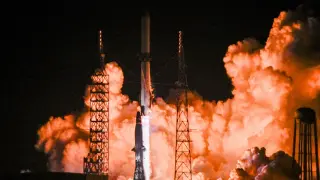
Blue Origin CEO Dave Limp confirmed that a faulty main oxygen valve on a BE-4 engine caused the May 28, 2026, explosion of the New Glenn rocket at Cape Canaveral. The company is manufacturing modified valves for retrofitting by late August and aims to resume flights before year-end, despite the failure destroying Launch Complex 36 and raising concerns for NASA’s Artemis program.
Blue Origin CEO Dave Limp confirmed that a faulty main oxygen valve on a BE-4 engine caused the May 28 explosion of the New Glenn rocket at Cape Canaveral. The company is manufacturing updated valve hardware for retrofitting by the end of August, aiming to return to flight by year's end despite the catastrophic loss of the launch pad.
Blue Origin CEO Dave Limp confirmed that a faulty main oxygen valve on one of the rocket's BE-4 engines caused the May 28 explosion at Cape Canaveral. The company is retrofitting existing engines with modified valves, with updated hardware expected by the end of August. While the root cause is identified, Limp noted that full fault tree analysis is ongoing. The incident destroyed the launch pad, but Blue Origin aims to return New Glenn to service by year's end to support NASA's Artemis III mission and commercial launches.
Blue Origin CEO Dave Limp confirmed on August 5 that a faulty liquid oxygen valve in a BE-4 engine caused the May 28 explosion of the New Glenn rocket at Cape Canaveral. The company is manufacturing updated hardware to be ready by late August, aiming to return to flight by year’s end. The shared engine design raises concerns for United Launch Alliance’s Vulcan rocket, which has already faced a separate anomaly.
Following the destruction of its primary launch pad, Blue Origin is expected to conduct rocket tests at alternative facilities, potentially including NASA sites, to maintain development schedules for the New Glenn rocket.
Blue Origin is reportedly raising $10 billion in private capital, valuing the company at about $130 billion. Lead investor Coatue Management would contribute $4 billion, with another $4 billion from large institutional investors and $2 billion from Jeff Bezos. The funds are earmarked to advance the New Glenn heavy-lift rocket, lunar landers, and two megaconstellations (TeraWave and Project Sunrise) to compete with SpaceX in launches and space services. SpaceX recently raised about $85 billion with a roughly $2 trillion valuation, underscoring the competitive context in private spaceflight.
Ars Technica's Ars Live recap features a panel debating when Blue Origin's New Glenn (especially the 9×4 variant) will fly, with no firm debut date and speculation of a late-2027/early-2028 timeline. Experts warn that adding more engines complicates the design and could delay milestones, potentially pushing NASA's Moon-landing plans this decade to rely on SpaceX's Starship rather than waiting for New Glenn. The discussion also touches on past architectural changes and the loss of Launch Complex 36A, highlighting ongoing uncertainty about achieving Artemis-era lunar missions.
NASA Administrator Jared Isaacman praised Blue Origin for its rapid cleanup and transparency after the May New Glenn anomaly, with Plan A to launch the Mk.1 Endurance on New Glenn still aiming for a year-end flight, while NASA evaluates alternatives such as SpaceX's Falcon Heavy and ULA's Vulcan for Artemis III; Blue Origin is pursuing a faster return-to-flight without rebuilding the same pad, investigators pointing to the aft section as a likely root cause, and some officials remain cautious about timelines as progress is monitored into 2027.
Blue Origin outlines a return-to-flight plan for its New Glenn rocket after an anomaly destroyed a pad vehicle, with early analysis pointing to the aft first stage. The company will implement a hybrid horizontal-vertical integration flow at LC-36A, reuse existing infrastructure, and coordinate with NASA on Moon Base timelines as Blue Moon landers advance toward VIPER and Artemis-era missions; the late-2026 return remains the goal, though some milestones may push into 2027.
Blue Origin says it will relaunch its New Glenn rocket from Cape Canaveral’s Launch Complex 36 later this year after last month’s fueling-test explosion; debris was cleared in nine days and reconstruction is underway, a rapid turnaround that underscores the high-stakes timeline as NASA weighs Artemis-era lunar-lander options and considers Starship/Blue Moon for future missions.