An uncrewed Blue Origin New Glenn rocket exploded on a Cape Canaveral launchpad, potentially delaying NASA's Artemis timeline and deepening reliance on SpaceX as the U.S. races China to the moon; the setback also complicates Blue Origin's broader plans, including satellite ambitions, while personnel were reported safe.
A catastrophic launch-pad explosion at Cape Canaveral destroyed Blue Origin's New Glenn during a hot-fire test, potentially delaying NASA's Artemis moon program by months or years. The incident damages the pad and rocket, raises questions about return-to-flight timelines, and could shift Artemis III to 2028–2029 if SpaceX's Starship and other plans can't compensate, while NASA conducts a thorough investigation and Blue Origin assesses repairs.
Blue Origin's New Glenn rocket exploded on the Cape Canaveral pad, grounding the orbital program and prompting questions about NASA’s launch cadence, while SpaceX’s Starship shows progress and NASA orders six additional Crew Dragon missions for the ISS. The day’s other headlines include China launching Shenzhou 23 to Tiangong with a year-long stay planned for one crewmate, DARPA funding Voyager’s solid-rocket motor thrust-control work, Virgin Galactic resuming flight testing toward its Delta-class ship, Germany’s Rocket Factory Augsburg upgrading its Helix engine, and the Pentagon pushing for a new heavy-lift spaceport to diversify U.S. launch capacity.
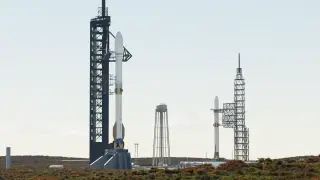
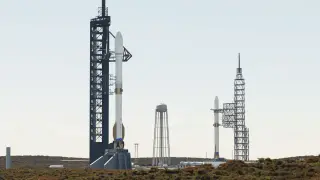
Blue Origin’s heavy-lift New Glenn rocket erupted in a massive fireball during a routine hotfire test at Cape Canaveral’s LC-36, causing significant pad damage but no injuries. The company said an anomaly occurred and a thorough investigation will follow. The incident could delay NG-4 activities and potentially impact NASA moon/m Artemis plans, though officials emphasized ongoing efforts to inspect, rebuild, and resume flight as soon as feasible.
Blue Origin's large New Glenn rocket exploded on the Cape Canaveral pad during a pre-launch engine-firing test. No injuries were reported, though nearby homes shook and the sky briefly glowed orange. Bezos said Blue Origin will investigate and rebuild, as the company pushes ahead with plans tied to NASA's Artemis program and a future lunar lander. The incident comes after a previous April setback for New Glenn, but Space Force officials said it will not derail other launches from the pad or nearby missions.
Blue Origin’s New Glenn failed during a static-fire test, causing a spectacular explosion that damaged LC-36A in Florida and leaving the company with no immediate alternative launch pad. Rebuilding is expected to take more than a year, forcing a rethink of US heavy-lift capacity as SpaceX’s Falcon lineup dominates and ULA’s Vulcan remains offline. The setback also threatens NASA’s Artemis plans, delaying the Blue Moon lunar lander and complicating crewed lunar missions in the near term, likely pushing more reliance onto SpaceX’s Starship for Moon objectives.
Blue Origin's New Glenn rocket exploded on Launch Complex 36 at Cape Canaveral during a hotfire test, destroying the vehicle and damaging the pad but causing no injuries; the incident grounds the program while investigators determine the cause, with potential ripple effects for Artemis missions and other customers relying on New Glenn.
A New Glenn rocket on a static-fire test at the Kennedy Space Center exploded, destroying the launchpad and lighting up the Florida night sky. No injuries were reported, and Blue Origin called it an anomaly while investigators review the incident. NASA had recently awarded Blue Origin a contract to launch the first of three missions toward its lunar base, but the blast could affect timelines for Artemis and Moon Base plans as agencies assess near-term impacts amid competition with SpaceX for lunar landers.
Amazon is expanding its satellite program by using both Blue Origin’s New Glenn and ULA’s Vulcan to deploy its Amazon Leo network. After a prior New Glenn upper-stage failure, Blue Origin plans a mission delivering 48 satellites for Amazon as soon as June, with the FAA having closed the investigation and Blue Origin outlining corrective actions. ULA’s Vulcan remains grounded due to booster anomalies, complicating the schedule for future Amazon launches. Amazon has previously relied on Atlas V, Falcon 9, and Ariane 6 and aims to deploy about 3,200 satellites, seeking faster deployment and potential competition to SpaceX’s Starlink, contingent on Vulcan’s recovery and ongoing testing.
Blue Origin’s rocket exploded into a massive fireball during a hotfire test at Cape Canaveral, with the company calling it an anomaly and confirming all personnel are accounted for and safe. Emergency responders are on site as Space Force and other authorities review data; the FAA noted the test was outside licensed activities and there was no impact to air traffic. Officials emphasized ongoing work to understand the cause and continue with spaceflight development.
Blue Origin's New Glenn rocket exploded on the Cape Canaveral launch pad during a hotfire test, with officials reporting no injuries. Blue Origin and Cape Canaveral Space Force Station said all personnel were accounted for and FAA noted the test wasn't within its licensed activities, with no air traffic impact. The 48-satellite Amazon Leo mission was not aboard; the incident could delay New Glenn’s future flights and Artemis III plans, though Blue Origin pledged to rebuild and resume flying.
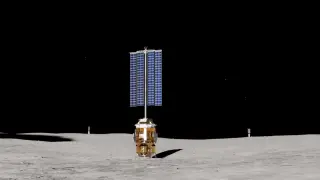
NASA unveiled a phased Moon Base plan to establish a permanent lunar outpost near the South Pole, starting with three uncrewed missions—Moon Base I (instruments testing thruster interactions and surface tracking), Moon Base II (rovers), and Moon Base III (NASA and international payloads)—to lay the groundwork for a semi-permanent infrastructure by 2029–2032 and a sustained presence thereafter. The effort, part of a roughly $20 billion program, includes Blue Origin’s contract to conduct the first mission using its Blue Moon Endurance lander. While NASA touts the initiative as the next era of lunar exploration and a stepping stone to Mars, experts caution that timelines are ambitious amid Artemis challenges and geopolitical competition, particularly from China.
NASA unveiled a three-phase plan to establish a sustainable lunar base at the Moon's south pole, beginning with robotic missions and technology tests in 2026–2029 (including testing Blue Origin's Blue Moon Endurance lander). Phase two, starting in 2029, adds semi-permanent infrastructure and first occupancy with sizable cargo deliveries, and phase three expands to durable habitat modules, power and logistics networks, and an annual cargo flow of about 38 tons to support ongoing operations.
NASA selected Astrolab and Lunar Outpost to design rovers to support a planned Moon Base, to be delivered to the lunar surface by Blue Origin’s Blue Moon Mark 1 lander under the Commercial Lunar Payload Services (CLPS) program; the rovers, intended for scouting and science and operable autonomously or via teleoperation, are expected to help Artemis astronauts by 2028. The awards total roughly $219–220 million for the rover contracts, with the first Moon Base mission renamed Moon Base 1 and related missions (Astrobotic Griffin-1 and Intuitive Machines IM-3) renamed Moon Base 2 and Moon Base 3. Separately, Firefly Aerospace will deliver MoonFall drones, launched from lunar orbit by a Firefly Elytra Dark spacecraft, to scout terrain, with a planned 2028 launch. Intuitive Machines was not selected in this initial round, though NASA says it may win later task orders. The program updates reflect NASA’s shift toward a more streamlined, affordable Moon Base rollout and the use of CLPS 2.0 for cargo deliveries.
NASA awarded about $220 million to Lunar Outpost and Astrolab to build two 1-ton lunar terrain vehicles capable of carrying two astronauts and climbing 20-degree slopes, with one rover ready for Artemis IV in 2028; Blue Origin received up to $468 million to transport the rovers to the Moon, and Firefly Aerospace got $75 million to deploy four reconnaissance drones for the lunar south pole.