Tag

Occultation

All articles tagged with #occultation

Tiny Kuiper World Reveals Thin Atmosphere, Second of Its Kind
science19 days ago

Tiny Kuiper World Reveals Thin Atmosphere, Second of Its Kind

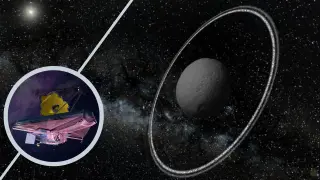
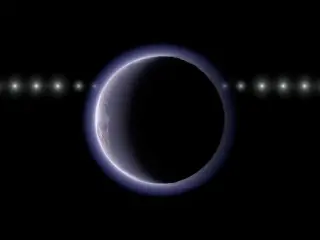
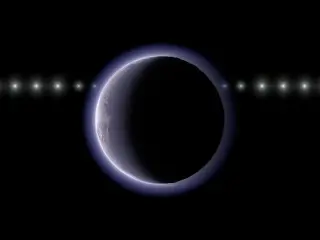
Astronomers observed the small Kuiper Belt object 2002 XV93 (about 311 miles across) during a stellar occultation and found a very thin atmosphere, making it only the second TNO known to have one after Pluto. The atmosphere, five to ten million times thinner than Earth's, could result from cryovolcanic activity or a recent icy impact; its persistence or dissipation could help distinguish between these sources. Future James Webb Space Telescope observations may detect additional gases like methane or carbon monoxide.

Tiny Kuiper Belt World Grows a Mysterious, Vanishingly Thin Atmosphere
space21 days ago

Tiny Kuiper Belt World Grows a Mysterious, Vanishingly Thin Atmosphere

A diminutive trans-Neptunian object known as (612533) 2002 XV93 (a ~500 km Pluto-like body in Neptune’s 2:3 resonance) has unexpectedly developed a thin atmosphere (exosphere). Its presence was inferred from a January 2024 stellar occultation observed by a Japan-led team; the exosphere is extremely tenuous, with surface pressures of 100–200 nanobars—5 to 10 million times thinner than Earth’s. The atmosphere could originate from a recent impact or from cryovolcanic outgassing, but either way it challenges the idea that only large bodies can sustain atmospheres. If it’s impact-driven, the gas would escape within ~1,000 years; if outgassing, the source is ongoing beneath the surface. JWST observations and density monitoring in coming years should help pinpoint the cause. The discovery was published May 4 in Nature Astronomy.

Tiny Kuiper Object Wears a Breath: Atmosphere Detected on a 500-km Plutino
space21 days ago

Tiny Kuiper Object Wears a Breath: Atmosphere Detected on a 500-km Plutino

Astronomers detected a surprisingly thin atmosphere around 2002 XV93, a ~500-km plutino in the Kuiper belt, via a 2024 stellar occultation observed from Japan. The inferred atmosphere is about 100–200 nanobars—extremely tenuous and likely transient—suggesting replenishment from a recent impact or ongoing cryovolcanism. This challenges the notion that atmospheres only form on large bodies and shows that small distant objects can host detectable atmospheres, with the research published in Nature Astronomy.

Moon to occult the Pleiades in a live telescope stream on April 19
space1 month ago

Moon to occult the Pleiades in a live telescope stream on April 19

Space.com reports a 2:00 PM EDT (1800 GMT) livestream from The Virtual Telescope Project showing the waxing crescent Moon occulting the Pleiades (the Seven Sisters, Messier 45) on April 19; US viewers get a daytime occultation while Italian viewers can watch after sunset, with Earthshine illuminating the Moon’s dark edge as the pair pass about 445 light-years away.

Hidden companion binds a vast cloud of vaporized metals around a distant star
astronomy4 months ago

Hidden companion binds a vast cloud of vaporized metals around a distant star

Astronomers observed a sun-like star, J0705+0612, being occulted by a colossal 120‑million‑mile‑wide cloud of metal-rich gas and dust for about nine months. Using high‑resolution spectroscopy from Gemini South (GHOST) and other telescopes, they mapped the cloud’s three‑dimensional motions and chemical makeup (iron, calcium), finding it is bound to another object heavy enough to exert gravity—likely a massive planet or a low‑mass star. The team proposes the cloud formed from a collision between two orbiting bodies, creating a circumplanetary or circumsecondary disk. The discovery, published in The Astronomical Journal, offers a rare glimpse into dynamic, late‑stage planetary systems and how such large structures can persist in a system thought to be ~2 billion years old.

Quaoar Dwarf Planet May Have an Additional Moon, Astronomers Find
science8 months ago

Quaoar Dwarf Planet May Have an Additional Moon, Astronomers Find

Astronomers may have discovered a new moon or a third ring around the dwarf planet Quaoar through occultation observations, with further confirmation needed. The findings suggest complex features in Quaoar's system, including potential new satellites or rings, and highlight the challenges of observing distant celestial bodies. The discovery was made during a carefully planned observation involving amateur and professional astronomers, emphasizing the importance of occultation studies in understanding the outer solar system.

Rare Eclipse: Asteroid Temporarily Obscures Betelgeuse, a Once-in-a-Lifetime Coincidence
astronomy2 years ago

Rare Eclipse: Asteroid Temporarily Obscures Betelgeuse, a Once-in-a-Lifetime Coincidence

A rare type of eclipse occurred on Monday night when an asteroid named Leona crossed over the giant star Betelgeuse in the night sky. The eclipse, classified as an occultation, caused Betelgeuse's light to briefly fade and then brighten again. The event lasted less than 15 seconds and was visible in a narrow path from parts of Europe to Mexico and the southern tip of Florida. Astronomers used the opportunity to study both Leona and Betelgeuse, with the latter being of particular interest due to its potential to explode as a supernova in the future.

"Rare Celestial Event: Betelgeuse, a Bright Star, Temporarily Vanishes During Asteroid Encounter"
astronomy2 years ago

"Rare Celestial Event: Betelgeuse, a Bright Star, Temporarily Vanishes During Asteroid Encounter"

An asteroid will temporarily block the light of Betelgeuse, one of the brightest stars in the night sky, during a rare event called an occultation. The event will be visible to millions in a narrow strip that includes Mexico, southern Florida, Spain, Italy, Greece, Turkey, and Central Asia. Astronomers are excited to observe the occultation as it will provide valuable scientific data on both the asteroid and Betelgeuse, which experienced a dramatic dimming event in 2019 and 2020. This event could help shed light on the star's future, as it is one of the best candidates for a future supernova.