Tag

Ocean Currents

All articles tagged with #ocean currents

Deep Atlantic Cold Blob Signals a Slowing Ocean Conveyor and Looming Climate Shifts
science10 days ago

Deep Atlantic Cold Blob Signals a Slowing Ocean Conveyor and Looming Climate Shifts

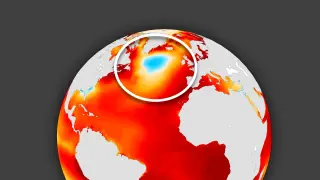
A new climate reanalysis-backed study links a persistent cold patch southeast of Greenland to a weakening Atlantic Meridional Overturning Circulation (AMOC). While surface heat loss has declined since 1955, deep-water temperatures drop as much as 1,000 meters below the surface, suggesting less warm water entering the region. If AMOC continues to weaken or collapses, Europe could cool, tropical rainfall patterns could be disrupted, and sea levels near the US East Coast could rise; however, scientists caution that the debate over the cold blob and AMOC's status is not yet settled.

Cold Atlantic Patch Signals Potential Weakening of Ocean Conveyor
environment25 days ago

Cold Atlantic Patch Signals Potential Weakening of Ocean Conveyor

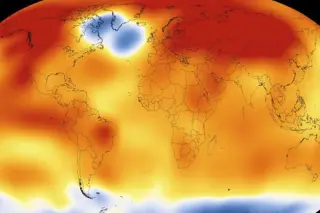
A large cold patch nicknamed the 'cold blob' south of Greenland is cooling the North Atlantic by about 2°F since 1900, suggesting the Atlantic Meridional Overturning Circulation (AMOC) is weakening due to warming and fresh water from melting ice; a significant slowdown or collapse could raise U.S. East Coast sea levels, bring colder European winters, and trigger droughts in Africa.

North Atlantic Cold Blob Signals Slower Ocean Conveyor
environment26 days ago

North Atlantic Cold Blob Signals Slower Ocean Conveyor

Scientists link a persistent cooling anomaly south of Greenland—the North Atlantic 'cold blob'—to a slowdown in the Atlantic Meridional Overturning Circulation (AMOC). A weaker AMOC could reduce the ocean's heat transport, shifting weather, storm tracks, and potentially accelerating sea-level rise along the U.S. East Coast, with the strongest impacts near Greenland, Iceland, and northern Europe.

Ocean Conveyor Slowing Could Spark Global Weather Shifts
science1 month ago

Ocean Conveyor Slowing Could Spark Global Weather Shifts

Evidence cited by New Scientist shows the Atlantic Meridional Overturning Circulation is weakening, allowing cold Greenland waters to pool in the North Atlantic and form a 'cold blob' that can disrupt the jet stream and drive extreme weather; some models warn of a potential climate tipping point by around 2040, though scientists debate whether the slowdown is driven more by oceanic processes or atmospheric forces.

Cold Atlantic Patch Signals Gulf Stream Slowdown and East Coast Risks
science1 month ago

Cold Atlantic Patch Signals Gulf Stream Slowdown and East Coast Risks

New study links the Atlantic's cooling 'cold blob' south of Greenland to a weakening Atlantic Meridional Overturning Circulation (AMOC), implying reduced heat transport and a sign of a climate tipping point. If AMOC collapses, Northern Hemisphere temperatures could drop dramatically (10–15°C in parts of the north), with heat and drought disruptions across Europe and rising sea levels along the US East Coast. Yet the exact rate of AMOC weakening is uncertain, and some researchers attribute the blob to surface heat loss rather than interior transport. The findings come as policy moves to remove deep-sea monitoring instruments could hamper tracking of this critical system.

Atlantic circulation could weaken by 51% by 2100, reshaping coasts and climates
science2 months ago

Atlantic circulation could weaken by 51% by 2100, reshaping coasts and climates

A new study projects the Atlantic Meridional Overturning Circulation (AMOC) to weaken about 51% by 2100—roughly 60% more than standard models predict—after correcting biases in simulations. Such a weakening could raise U.S. Northeast sea levels, shift tropical rainfall belts, and usher colder European winters, with a growing risk of crossing a tipping point toward collapse. Observations indicate a 10–20% weakening since the mid-2000s, and while attribution to human-caused climate change remains uncertain for now, scenarios with strong CO2 cuts could limit the decline much more than high-emission futures.

Atlantic circulation on the brink: new study suggests AMOC weakening near tipping point
planet-earth2 months ago

Atlantic circulation on the brink: new study suggests AMOC weakening near tipping point

A Science Advances study estimates the Atlantic Meridional Overturning Circulation (AMOC) could slow about 50% by 2100—a weakening stronger than some models predicted—potentially cooling northern Europe and altering rainfall in various regions. The researchers argue that including sea surface temperature and salinity improves forecasts, but experts caution there is substantial uncertainty in the magnitude and timing of the slowdown. While a catastrophic “collapse” is unlikely in the near term, the paper underscores a real risk of crossing a tipping point, prompting calls for nations to prepare for significant climate effects.

Earth’s Longest Creature Is a Brainless, Boneless Jellyfish With 1,200 Tentacles
science3 months ago

Earth’s Longest Creature Is a Brainless, Boneless Jellyfish With 1,200 Tentacles

The lion’s mane jellyfish (Cyanea capillata) is the longest known animal, with a bell up to about 2.1 meters and tentacles that can extend over 36 meters, longer than any other animal on Earth, though it has almost no mass compared with a blue whale. It is brainless and boneless, made mostly of seawater (~94%), and drifts with currents while its thousands of tentacles form a wide hunting net; the nematocysts on its tentacles fire in under 700 nanoseconds. This long-tentacled strategy is energetically cheap in cold Arctic waters, though it reduces propulsion efficiency by up to 80–90%. The species’ blooms are studied as indicators of ocean health and warming, contrasting with the blue whale’s massiveness but highlighting a different kind of “largest”—reach versus weight.

Southern Indian Ocean Freshening Could Redraw Global Climate Currents
science4 months ago

Southern Indian Ocean Freshening Could Redraw Global Climate Currents

New research shows the Southern Indian Ocean has become dramatically less salty over six decades, with salinity down about 30% due to wind-driven freshwater inflows from the Indo-Pacific pool. The resulting lighter, less dense water weakens deep ocean mixing, potentially disrupting the global thermohaline circulation and altering climate patterns beyond the region, with possible impacts on marine ecosystems.

Rare Hoodwinker Sunfish Emerges on California Shore, Redrawing Its Range
environment4 months ago

Rare Hoodwinker Sunfish Emerges on California Shore, Redrawing Its Range

A rare hoodwinker sunfish, Mola tecta, washed ashore at Doran Regional Park during a Northern California beach cleanup, a finding that challenges assumptions about the species’ range. Described in 2017 and distinct from the common mola, its presence off the U.S. West Coast hints at wider, less-understood migrations, while strandings provide scientists with data on movement and currents; observers are urged to document sightings from a distance and report to wildlife authorities.

Massive Antarctic Sea Ice Hole Unveils Hidden Force
science6 months ago

Massive Antarctic Sea Ice Hole Unveils Hidden Force

A massive hole in Antarctic sea ice, known as a polynya, was caused by complex interactions between wind, ocean currents, and salinity, revealing how localized ocean processes can have significant impacts on global climate and ocean circulation. The event, driven by Ekman-driven salt transport and deep convection, highlights the changing dynamics of the Southern Ocean in the context of climate change, with potential implications for heat and carbon exchange.

North Atlantic Ocean Currents Show Signs of Critical Instability, Threatening Climate Stability
science9 months ago

North Atlantic Ocean Currents Show Signs of Critical Instability, Threatening Climate Stability

Scientists studying ancient clam shells have found evidence suggesting the Atlantic Ocean is nearing a critical tipping point in its current systems, which could lead to significant climate disruptions globally. The study highlights two destabilization episodes in the past 150 years, with current signs indicating increased instability, emphasizing the importance of reducing greenhouse gas emissions to prevent severe climate impacts.